

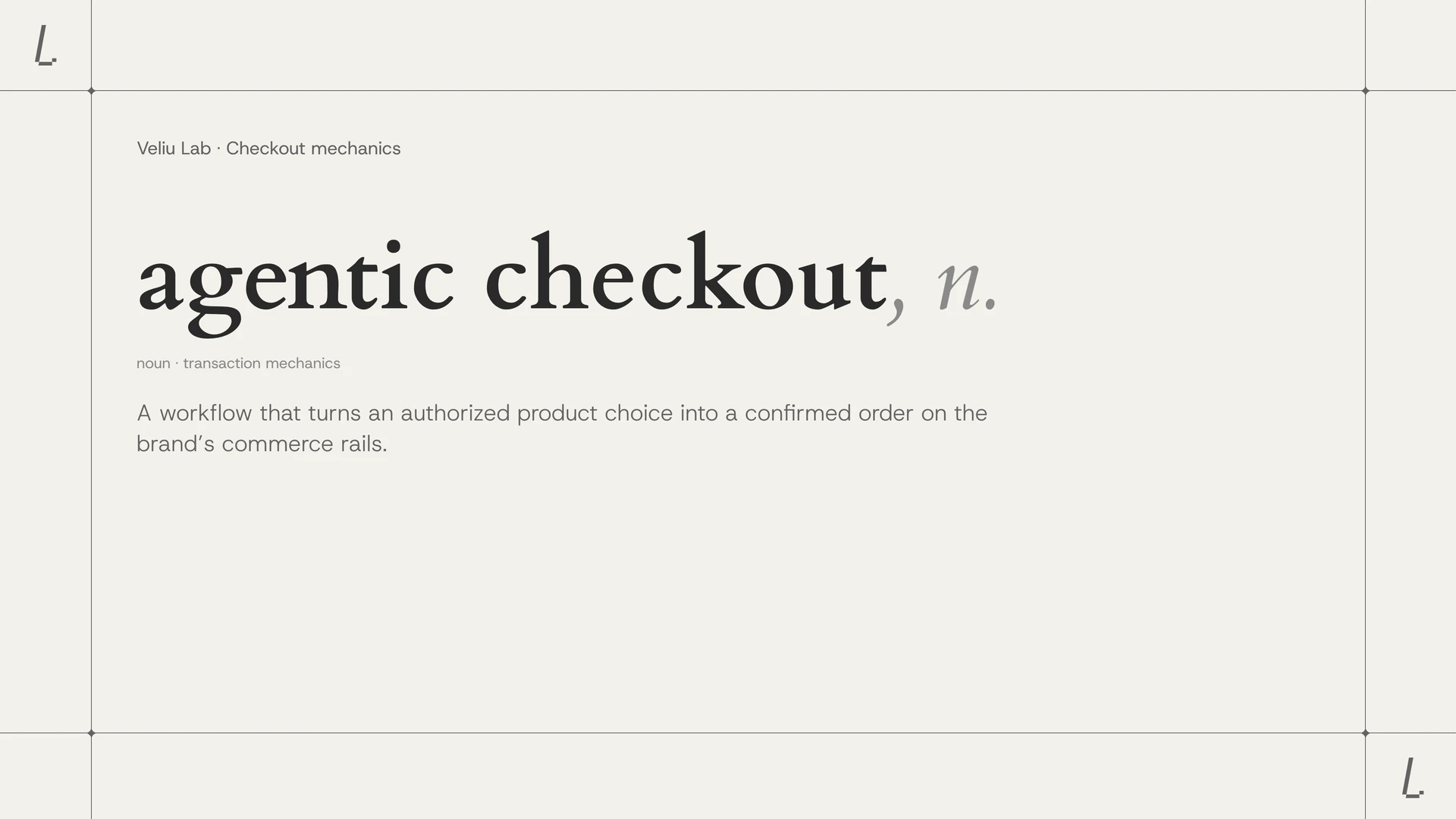
In brief. Agentic checkout is the transaction workflow in which an authorized AI shopping agent validates a selected product and variant, creates a cart, calculates shipping and tax, secures payment authorization, creates the order, and returns confirmation. In the merchant-hosted flows covered here, checkout stays on the brand's rails; legal and operational responsibility depends on the actual commercial arrangement and any delegated payment, tax, fulfillment, or returns functions.
- Agentic checkout turns a selected product into an authorized, traceable order through variant, cart, payment, and confirmation controls.
- A stale price, missing size, or ambiguous SKU can stop an AI-led purchase before the payment step begins.
- Merchant-of-record responsibility depends on the actual commercial arrangement, even when checkout runs through merchant-hosted commerce systems.
- Structured product data can improve machine readability, while AI platforms retain control over product selection and recommendation.
- The strongest operational test follows one real variant from shopper instruction through order, retry, cancellation, and refund.
A wrong size can stop an AI-led order before payment. Agentic checkout is the transaction workflow in which an authorized AI shopping agent validates a selected product and variant, creates a cart, calculates shipping and tax, secures payment authorization, creates the order, and returns confirmation.
Shoppers may begin with ChatGPT or Gemini, yet the navy jacket in medium still has to become one valid SKU, at one current total, under one recorded authorization. This guide is for US brand and ecommerce operators deciding what must change in their catalog and commerce stack before software can complete that purchase.
The central issue is control.
Agentic checkout turns a choice into an authorized order
Agentic checkout begins when a selected product can become a valid transaction. An AI shopping agentSoftware agents that search, compare and complete purchases on a buyer's behalf. They read structured catalog data and transact through protocols like ACP and MCP.Read more, meaning software that can interpret a shopping goal and perform permitted actions, may validate the variant, create the cart, obtain a payable total, carry payment authority, submit the order, and return confirmation.
For example, “Buy the navy jacket in medium if the delivered total stays below $240” contains a product constraint, a variant, a spending limit, and an implied need for current stock. If medium disappears or tax pushes the total above $240, the system needs a defined exception path.
In the merchant-hosted flows covered here, the brand’s commerce systems calculate the cart and record the order. Merchant-of-record status and responsibility for payment, tax, fulfillment, returns, and disputes still depend on the actual contracts and on which functions the merchant delegates.
Six terms cover the transaction
AI shopping agent: Software that interprets a shopping goal and performs an authorized sequence of actions, such as checking a size, creating a cart, or submitting an order.
Delegated checkout: A checkout in which a shopper gives software limited authority to complete defined transaction steps on the shopper’s behalf.
Payment mandate or delegated payment token: Protocol-specific evidence that a shopper authorized a payment under stated limits. Google’s AP2 documents signed mandates, while OpenAI and Stripe have documented delegated payment tokens in the ACP lane.
Merchant of record: The legal seller responsible for the transaction under the applicable commercial arrangement. Payment, tax, fulfillment, returns, or dispute functions may still be delegated to providers.
Checkout rails: The commerce systems that price the cart, calculate tax and shipping, accept or submit payment, create the order, and trigger fulfillment.
Agentic commerce: The wider journey in which software can perform authorized work across discovery, comparison, carting, checkout, payment, fulfillment, and service. Agentic commerce covers the whole journey; agentic checkout covers its transaction segment.
Product truth breaks the order before payment
ChatGPT, Gemini, Perplexity, and Copilot can read structured product information before a transaction begins, depending on the surface, merchant participation, geography, and current product access. A missing size, stale price, or unavailable delivery method can prevent a valid cart from forming; for Perplexity specifically, the feed and landing-page facts that affect merchant eligibility and product inclusion require separate verification.
Google says its Shopping Graph contains more than 50 billion product listings, with 2 billion listings refreshed every hour. OpenAI’s Product FeedA structured export of the catalog (id, title, description, link, image, price, availability) in the Google Merchant Center spec, the format most shopping surfaces ingest.Read more specification allows participating merchants to refresh feeds as often as approximately 15 minutes. These figures describe infrastructure expectations; they do not establish recommendation outcomes for an individual product.
Freshness has a shop-floor consequence. If a page says $219, its structured markup says $199, and the feed says $229, a shopping engine may show an outdated offer or the merchant cart may force a correction at the final step.
One price must survive the handoff.
| Primary source | Date checked | Documented point | Named limitation |
|---|---|---|---|
| Google Shopping Graph | June 17, 2026 | More than 50B listings; 2B refreshed hourly | Availability varies by surface and market |
| OpenAI Product Feed specification | June 17, 2026 | Refreshes can occur about every 15 minutes | Merchant eligibility and access vary |
| ACP repository | June 17, 2026 | Public protocol release history | A public release does not prove universal deployment |
| Google UCP announcement | June 17, 2026 | UCP announced at NRF 2026 | Surface availability varies |
| Google AP2 repository | June 17, 2026 | Human-present and human-not-present authority models | Implementations depend on partners |
Methodology: Veliu Editorial Team reviewed vendor documentation and public protocol repositories on June 17, 2026. The sample covers five named primary sources; its main limitation is that public documentation can describe a protocol before every merchant, shopper, or country can use it.
The appeal is obvious: install an AI button and let it buy. The evidence does not support that shortcut. OpenAI’s commerce documentation, Google’s UCP materials, and AP2’s authorization model separate catalog, cart, consent, payment, and order controls across multiple systems.
Eight controls carry the order from intent to confirmation
The protocols differ, yet merchant-hosted implementations generally need eight controls. Repository descriptions and governance can change, so teams should verify the governing source and version on the date they plan an integration.
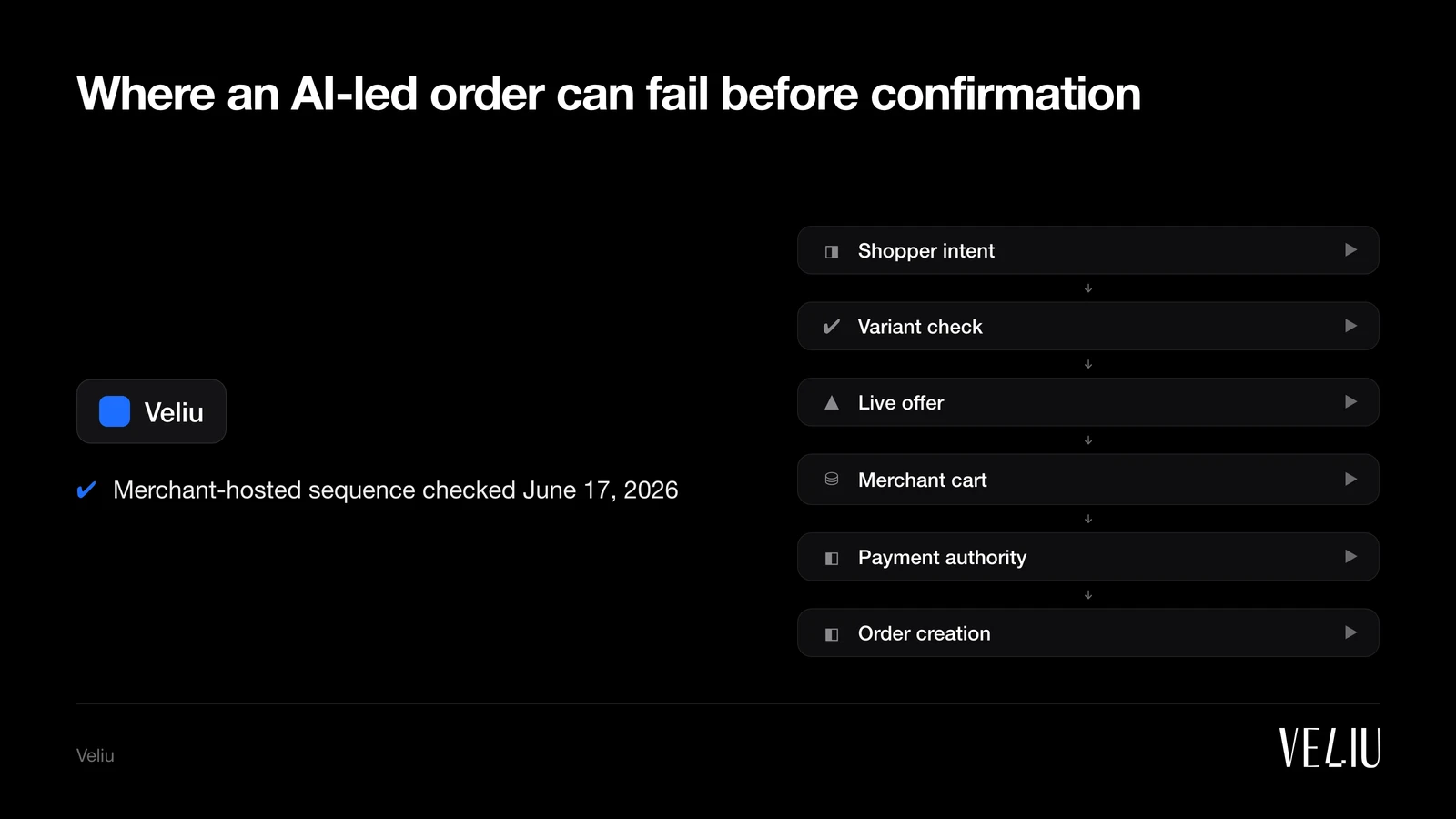
1. Intent needs bounded authority
A shopper defines the task, constraints, and autonomy level. A human-present flow may request confirmation after the final total appears; a human-not-present flow may permit a purchase only within a signed budget, category, delivery deadline, and expiration period.
AP2 documents an Intent Mandate, a signed record of what the shopper authorized. Other systems may use different evidence, but the operational requirement remains: connect the order to a bounded instruction that a merchant and payment provider can inspect.
2. Product identity must resolve to one variant
“Merino Crew” cannot be purchased safely when navy medium and black large have separate stock. The buying agent needs the exact SKU, size, color, seller, condition, bundle, and quantity.
A GTINThe GS1 Global Trade Item Number, the identifier that lets engines merge your offer with the same product sold elsewhere. A valid GTIN is numeric, 8 to 14 digits, with a GS1 check digit.Read more is a GS1 trade-item identifier commonly encoded in a barcode. When no GTIN exists, a brand name plus MPN, the manufacturer part number, can help establish identity, although sufficiency depends on the platform and product context.
Google’s Merchant Center product data specification documents attributes such as ID, title, link, image, availability, and price, with identifiers and variant fields required when applicable. A clean record makes the navy-medium SKU addressable before checkout.
3. Current price and stock decide whether a cart is valid
The agent checks offer facts against an authoritative merchant source. Price needs an amount and currency, while availability needs a defined state such as in stock, preorder, or out of stock.
A stale feed can advertise the final unit after it sells. Teams should record the time of the stock change and the time each consuming surface reflects it, creating a measurable propagation-latency trail.
4. The merchant cart calculates the payable total
The cart returns tax, shipping methods, delivery estimates, discounts, fees, and total. A buying agent should not infer that “Free US delivery” includes Alaska or invent tax from a product-page subtotal.
ACP and UCP document different session and checkout patterns. Their usefulness depends on the participating platform, merchant stack, provider, market, and live implementation.
5. Consent and payment credentials stay distinct
Consent answers whether the purchase may happen under stated limits. The payment credential identifies the authorized instrument and transaction context.
AP2 separates intent, cart, and payment evidence. Mastercard has described agent-token work that can scope payment credentials to agent and merchant contexts, with exact scope and availability determined by the program, partners, and implementation.
6. The commerce system creates the order
Discovery may happen inside an AI surface. In the merchant-hosted model covered here, the merchant’s systems accept or submit the authorized payment, create the order, assign its identifier, and become the operational source for fulfillment status.
Legal responsibility still follows the actual arrangement. A payment provider may process funds, a tax service may calculate liabilities, and a logistics partner may fulfill the order without changing the need for one traceable transaction record.
7. Confirmation must survive retries
A complete response identifies the order, amount, items, delivery choice, and status. It also covers failed authorization, disappearing stock, rejected substitutions, cancellation, and inventory reservation.
ACP documents an Idempotency-Key, a unique retry key that helps prevent the same request from creating two orders. If a network timeout occurs after payment, the system can retrieve or retry the result without buying a second navy jacket.
8. Returns preserve the authority trail
A returned jacket still needs an order record, payment reference, shopper authorization trail, refund destination, and inspectable status. Permission to buy navy medium does not automatically authorize black medium, a higher price, or another seller with different return terms.
AI visibility depends on exact product truth and a valid checkout path
A shopper asks ChatGPT, Gemini, Perplexity, or Copilot for a product. Depending on access and merchant participation, the engine can read feeds, product pages, structured markup, and merchant systems; product identity and eligibility affect whether it can form a valid cart; the merchant checkout determines whether that cart becomes an order.
Accurate structured product data can make products easier for AI systems to read, compare, cite, and transact on; a practical process for aligning product facts and testing recommendation changes explains how to validate that work. Selection and recommendation remain controlled by each platform.
The seller-side bridge starts before payment. A Google Shopping feed with the wrong price can break the offer, while an agentic storefront still needs an exact variant and authoritative checkout response behind its interface.
This closes the navy-jacket problem. The system must buy one SKU, at one current total, under one recorded authorization.
Protocol names describe lanes, with availability attached
| Standard or system | Affiliation described by public sources | Primary role | Status checked June 17, 2026 |
|---|---|---|---|
| ACP | Public repository associated with OpenAI and Stripe | Product feeds, checkout, delegated payment | Open materials; implementation availability varies |
| UCP | Announced through Google with Shopify participation | Discovery through checkout and loyalty | Open materials; surface availability varies |
| AP2 | Google-led repository with FIDO Alliance involvement described in project materials | Signed intent, cart, and payment authority | Open specification; partner implementation varies |
| MCP | Originated at Anthropic with governance described by its current project sources | Tool and resource access | Widely implemented; no canonical payment layer |
| Visa TAP | Visa | Agent identity and request verification | Provider-dependent rollout |
| Mastercard agent tokens | Mastercard | Agent-scoped payment credentials | Partner-dependent rollout |
OpenAI and Stripe launched ChatGPT Instant Checkout on September 29, 2025, and Stripe documented its historical design. Reports indicated retirement around March 2026, but Veliu found no primary confirmation by June 17, 2026. Treat that status as medium confidence and verify current availability before planning an integration.
MCP, the Model Context Protocol, can expose tools such as product search or inventory lookup. Its specification does not supply a universal commerce checkout state machine or payment-authorization layer.
Measure valid orders and the inputs that cause them
Agentic-checkout measurement should separate business outcomes from causal inputs. Every rate needs a stated denominator and segmentation by AI surface, market, device, and human-present or human-not-present mode when those dimensions are available.
Track checkout-session success, authorized-payment success, order-creation success, and abandonment by workflow step. A payment authorization with no merchant order is a critical reconciliation event, since money and order state have diverged.
Then measure variant-resolution failure, price or stock disagreement, propagation latency, delivery-option completeness, refund success, and authorization-to-order traceability. An llms.txt file is a publishing artifact; it does not show that a valid cart, payment, order, or refund succeeded.
| Control | Evidence | Failure symptom |
|---|---|---|
| Exact variant identity | SKU and applicable identifiers | Wrong size or unresolved item |
| Price consistency | Timestamped page, feed, markup, and cart comparison | Total changes at checkout |
| Availability freshness | Source-change and observation times | Sold-out item selected |
| Shipping and tax | Destination-aware cart response | No payable total |
| Retry safety | Retry key and order log | Duplicate order |
| Scoped payment authority | Token or mandate reference | Rejected or unauthorized payment |
| Fulfillment events | Reserve, ship, delay, and delivery trail | Buying agent loses order state |
| Cancellation and refund | Request, decision, and refund reference | Funds and order status diverge |
Common failures have visible evidence
Stale offers: A feed says in stock after the final unit sells. Update the source and measure how long each surface takes to reflect the change.
Ambiguous variants: “Blue shirt” maps to three sizes. Require one exact sellable SKU before cart creation.
Incomplete shipping or tax: The agent receives a subtotal with no delivered total. Return destination-aware methods, tax, timing, and fees from the merchant cart.
Lost consent evidence: An order exists with no retrievable instruction. Store references linking intent, cart, payment authority, order, and refund.
Duplicate orders: A timeout triggers a second completion call. Use idempotent operations and retrieve the first result before another charge attempt.
Protocol assumptions: A public specification is treated as universal availability. Record a verification date, market, platform, provider, and live status for every dependency.
Test one jacket from request through refund
- Freeze the outside view for priority SKUs, recording price, stock, variant, shipping promise, and policy links before changes.
- Compare the product page, structured dataMachine-readable schema.org markup (Product, Offer, AggregateRating) embedded in a page as JSON-LD. It is the canonical way to hand engines unambiguous product facts.Read more, feed, merchant interface, and final cart for one real size or configuration.
- Map the references connecting shopper intent, cart total, payment authority, merchant order, cancellation, and refund.
- Run a successful order, stock failure, payment failure, retry, cancellation, and refund.
- Date every assumption about protocol version, AI surface, market, provider, and availability.
Veliu’s brand agent studies the market, readies the store, and sells to people and to the AI shopping agents that arrive. Current catalog facts and machine-to-machine endpoints help it answer with the correct price and valid variant. On the brand’s own site, the experience adapts from permitted signals and approved components, sells outside store hours, answers shopping agents machine to machine, returns customers’ questions to the brand, and keeps checkout on the brand’s rails.
Authors: Alessio Savi, Member of Technical Staff at Veliu, and Azra Hadziabdic, Co-Founder & Founding Product Engineer at Veliu. Methodology note: the Veliu editorial team reviewed the linked primary vendor documentation, protocol repositories, and merchant data specifications through June 17, 2026. Feature status is separated from protocol availability. The reported retirement of ChatGPT Instant Checkout remains medium confidence pending primary confirmation.
The next paper, when it is written.
One email per paper, and nothing else.
Subscribe