In brief. Selling to AI agents is program work, and the rules are published. OpenAI requires nine feed fields and chains checkout eligibility behind search eligibility, Google gates a UCP checkout button behind Merchant Center and select-merchant status, Copilot Checkout started as a default for Shopify merchants and now sits behind a per-channel toggle, and Perplexity runs a free merchant program. Each buying step maps to a seller obligation, and the readiness checklist in this piece turns those obligations into pass or fail checks you can run this week.
- OpenAI's product feed spec requires nine fields for a discovery feed, and a product cannot be checkout-eligible in ChatGPT unless it is search-eligible first.
- Google runs agentic checkout for AI Mode and Gemini through Merchant Center, with a UCP checkout attribute and access for select merchants in the US, Canada, and Australia.
- Microsoft enrolled Shopify merchants in Copilot Checkout by default; today a per-channel toggle in the Shopify admin sets it, while merchants on PayPal or Stripe apply through a form.
- Perplexity's merchant program is free and stated to be separate from its sponsored ads.
- A per-program readiness checklist turns each agent buying step into a pass, fail, or unknown seller obligation you can verify on the live store.
OpenAI's product feedA structured export of the catalog (id, title, description, link, image, price, availability) in the Google Merchant Center spec, the format most shopping surfaces ingest.Read more specification lists nine required fields for a discovery feed: item_id, title, description, url, brand, seller_name, image_url, availability, and price. That list reads like a sales script written for machines, and it is the most concrete answer any platform has published to what selling means when the buyer is software.
Search "how to sell to AI agents" and most of page one answers a different question: how to sell AI tools to human sales teams. The operator question is narrower. What exactly do ChatGPT, Gemini, Copilot, and Perplexity need from your catalog before they can retrieve a product, compare it against rivals, and complete a purchase?
Each program has published its answer in a feed spec, a help center, a blog post, and a merchant program. Almost nobody reads the four documents side by side. This guide does, then inverts them into a checklist you can run against your own store this week.
For a buying agent, the sales conversation starts in the product feed.
Selling to AI agents starts with the programs' own rules
Selling to AI agents means meeting four published programs on their terms: a product feed with exact required fields for OpenAI, Merchant Center data plus a checkout attribute for Google, a recorded on-or-off decision for Microsoft's Copilot Checkout, and a free merchant program at Perplexity, so shopping agents can retrieve, compare, select, and buy your products.
These four are the buying surfaces with documented seller entry points today. They form the sell side of the buy side and the sell side of agentic commerce: the buying agent belongs to the platform, and the evidence it buys from belongs to you. That seller-side craft is Agentic Selling, and its raw material is the catalog.
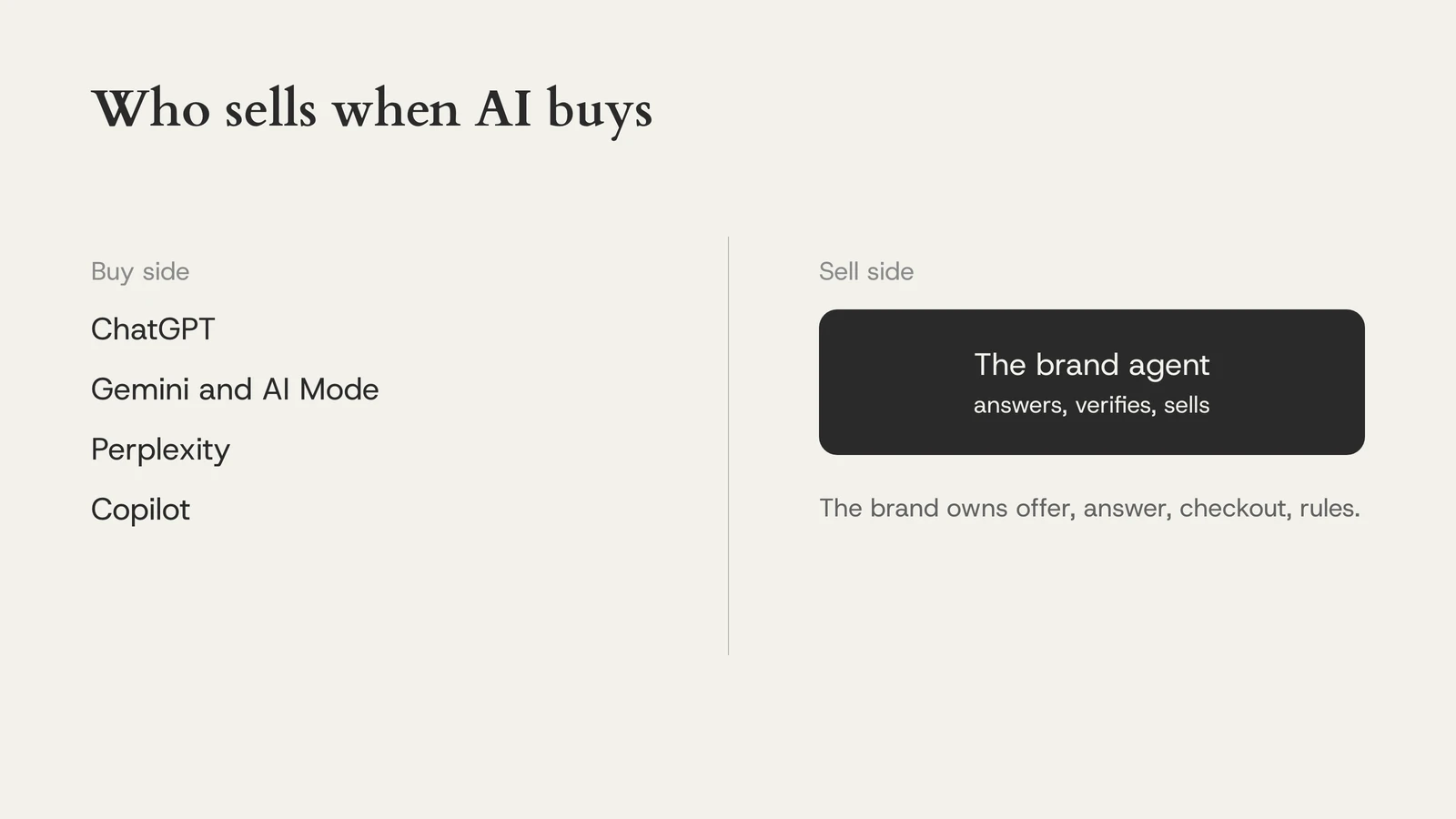
The programs differ on three axes that decide your order of operations: what you must publish, who is allowed in, and where the purchase happens. Get those three straight per program and "how to sell to AI agents" turns into a short list of files, flags, and forms.
Every step the agent takes is an obligation you own
A buying agent performs up to four consequential steps, depending on the platform: it retrieves candidate products, compares them on aligned attributes, selects under the shopper's constraints, and completes or hands off checkout. Read from the seller's side, each step is a requirement with a named enforcement point.
| Agent step | What the agent does | Your obligation | Where it is enforced |
|---|---|---|---|
| Retrieval | Pulls candidates from feeds, indexes, and pages | Publish an ingestible feed and accessible product URLs | OpenAI feed spec, Merchant Center, Perplexity's index |
| Comparison | Aligns price, availability, and attributes across sellers | Fill every required field with a current, page-consistent value | Required-field validation in each program |
| Selection | Shows only what it may show | Set eligibility flags and clear the account gates | is_eligible_search, UCP checkout attribute, program approval |
| Checkout | Buys directly or hands off to your store | Implement the checkout spec and keep policy URLs live | Agentic Checkout Spec, UCP, Copilot Checkout |
The third column is the article. Everything below walks those obligations program by program, at the altitude where an e-commerceSelling products online through your own store or marketplaces. For AI visibility the deciding factor is whether the shop's catalog is readable by machines.Read more team actually works: field names, flags, account gates, and forms.
OpenAI wants nine fields, and checkout waits behind search
The OpenAI product feed spec requires nine fields in every discovery feed: item_id, title, description, url, brand, seller_name, image_url, availability, and price. One of them gives the game away: seller_name exists so a machine can present an offer and say who stands behind it.
Eligibility is explicit, and it is chained. In the spec, is_eligible_search set to true "enables search eligibility; false disables it and checkout eligibility." For is_eligible_checkout, "true opts in only when search eligibility is also true and checkout is enabled for the integration." The spec adds that "eligibility does not guarantee display." A product can be searchable yet unbuyable. A buyable product is always searchable first. Checkout rows also need live seller_privacy_policy and seller_tos URLs, and a separate is_ads_eligible flag governs sponsored placement.
Search eligibility is the tollgate.
Formats are where secondhand advice goes wrong most often. The popular belief, repeated across agency explainers, is that any structured export will do and the platform will cope. The spec is stricter. A Google-compatible feed is accepted only "after OpenAI confirms it for your registered feed", as a tab-delimited .txt or .tsv file, a .csv file, or their gzip variants, and the document closes the door in writing: "JSON, spreadsheets, XML, RSS, and Atom are not supported by this compatibility path." A Merchant Center XML export is not an OpenAI feed until it is converted.
The full merchant path runs from feed to money. In OpenAI's commerce documentation: "Merchants integrate with OpenAI's checkout flow by implementing the Agentic Checkout Spec", while payment providers implement the Delegated Payment Spec. One timing note belongs here: as of September 2026, Shopify documents that ChatGPT buyers complete the purchase on the merchant's own checkout, opened in a ChatGPT in-app browser, so everyday ChatGPT shopping centers on discovery and the merchant's store. The feed makes you a candidate either way; selling on ChatGPT is its own playbook, built on the same catalog truth.
One jacket through the feed, field by field
Take an illustrative product from Fernline, an invented outdoor brand: the Marlowe Field Jacket in waxed olive cotton, $248. Its feed row is nine decisions, and each wrong cell carries a specific cost at the moment an agent shops the category.
| Field | Fernline's value | What a wrong value costs |
|---|---|---|
| item_id | FL-MFJ-OLV-M | Duplicated IDs collapse two variants into one listing |
| title | Marlowe Field Jacket, Waxed Cotton, Olive | A vague title loses the "waxed jacket" query |
| description | 10 oz waxed cotton, corduroy collar, four pockets | Missing attributes drop it from comparisons |
| url | fernline.com/products/marlowe-field-jacket | A dead link ends the journey at retrieval |
| image_url | cdn.fernline.com/marlowe-olive.jpg | A broken image leaves the product card bare |
| brand | Fernline | Brand-name queries miss the product entirely |
| price | 248.00 USD | A price that contradicts the page discredits the feed |
| availability | in_stock | Recommending a sold-out jacket burns the shopper once |
| seller_name | Fernline | The agent cannot say who is selling |
Now the flags. Fernline sets is_eligible_search to true, which makes the jacket a candidate in ChatGPT search. Checkout needs is_eligible_checkout set to true as well, honored only while search is true and checkout is enabled for the integration, plus a privacy policy and terms of service resolving at the seller_privacy_policy and seller_tos URLs in the feed. Sequence is the design principle: discovery comes first, and checkout follows.
Google keeps Merchant Center as the hub and gates the button
Google's route runs through infrastructure most merchants already operate. The Universal Commerce Protocol, which Google defines as "a new open standard for agentic commerce", lets an integrated merchant "implement a checkout button on eligible product listings in AI Mode in Google Search and on Gemini". The data side stays where it was: "Merchant Center will continue to be the central hub to prepare your product data". Google announced UCP at NRF in January 2026, co-developed with Shopify and a group of large retailers, under the Apache 2.0 license.
Entry has three checkable parts: the checkout eligibility product attribute (native_commerce with checkout_eligibility) on your offers, a Google Pay & Wallet Console account, and Google's permission, since checkout is "available for select merchants at this time", with eligibility listed for the US, Canada, and Australia and the button itself live for select US merchants first.
The gating extends past checkout. Google's Business Agent prerequisites ask for a US e-commerce store, a verified Merchant Center account, and at least 50 approved offers. Approval rate and offer count have quietly become agent-entry criteria, which means the unglamorous work of tuning a Google Shopping feed for AI surfaces now buys entry at two doors.
For most brands the Google door opens on Google's schedule. The feed behind it is yours to fix today.
Microsoft enrolls Shopify merchants before they apply
Microsoft's Copilot Checkout announcement of January 8, 2026 contains the most consequential default in agentic commerce. From the post: "If you're on Shopify, you'll automatically be able to sell in Copilot Checkout. No application. No integration." Enrollment is automatic "following an opt-out window", and Microsoft pitches the buying moment as a purchase completed in place, with no redirect and the merchant staying merchant of record.
Merchants outside Shopify who process payments on PayPal or Stripe apply through a form, and the rollout is "beginning in the U.S. on Copilot.com". Shopify's help pages add that selling in Copilot's direct checkout carries no fees beyond standard payment processing.
An opt-out program flips the operator's job: participation is the default state, and the real decision is whether your catalog, exactly as it stands, is ready to be sold inside a Copilot conversation. Audit first, then choose, then write the choice down.
Silence is a yes here. As of September 2026 the switch lives in the Shopify admin: under Sales channels > Agentic, a merchant turns Copilot's direct checkout on or off, and Shopify describes Copilot Checkout as powered by UCP.
Perplexity charges merchants nothing and keeps ads separate
Perplexity's merchant program, described on its "Shop like a Pro" hub and in its merchant terms, is free: merchants share a product feed into Perplexity's index, become eligible for in-answer checkout, and receive free API access. The terms call the program "distinct from and unrelated to" sponsored ads, which keeps organic inclusion and paid placement legible as separate decisions.
Perplexity publishes fewer field-level specifics than OpenAI or Google. For a free program feeding a shopping index, the calculation is short: reuse the governed feed you built for the stricter specs, apply, and watch which products surface.
Which program do you start with?
Side by side, the four programs form an uneven chessboard: different entries, different defaults, different gates.
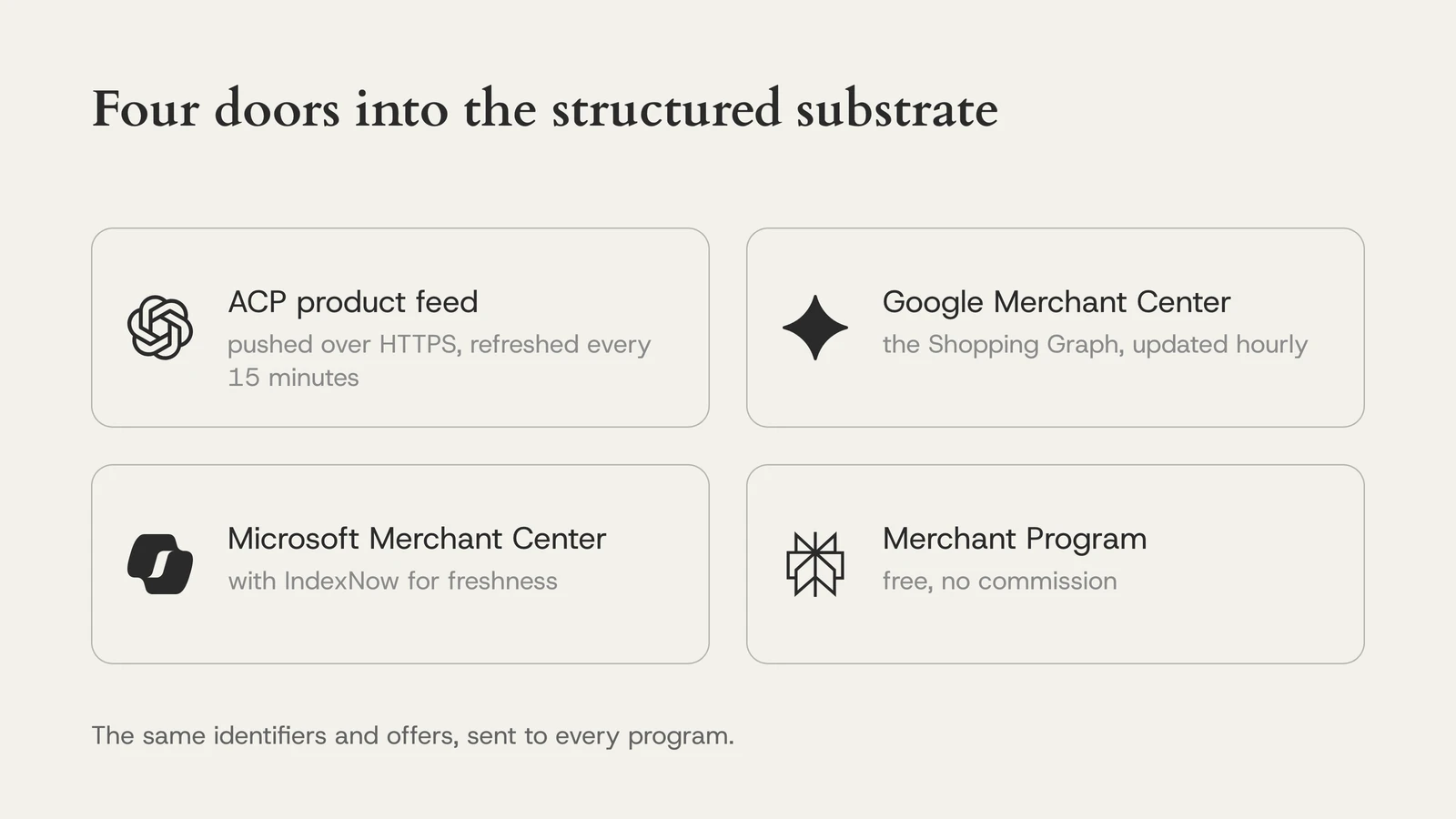
| Program | Entry mechanics | Participation default | Gating today | Where the purchase happens |
|---|---|---|---|---|
| OpenAI (ChatGPT) | Product feed per the public spec, then the Agentic Checkout Spec | Opt in | Checkout chained behind the search flag and policy URLs | On your own store by default (on Shopify, in a ChatGPT in-app browser); inside ChatGPT only with a separately enabled checkout integration |
| Google (AI Mode, Gemini) | Merchant Center data, checkout attribute, Google Pay & Wallet Console | Opt in | "Select merchants"; US, Canada, Australia | Checkout button on eligible listings |
| Microsoft (Copilot) | Automatic for Shopify; a form for PayPal and Stripe merchants | On by default on Shopify, with a per-channel toggle | Rollout beginning in the US on Copilot.com | Inside the Copilot conversation |
| Perplexity | Free merchant program, feed shared into the index | Opt in | Application, no cost | In-answer checkout for eligible merchants |
If you run on Shopify, part of the decision is already made. Shopify's help documentation lists agentic storefront channels for ChatGPT, Google AI Mode and Gemini, Microsoft Copilot, and Meta as "active by default for eligible stores", and Shopify's agent documentation is explicit about the scale: one endpoint lets agents search every Shopify merchant, build carts, and hand checkout back to the merchant. On Shopify the work is verification: which channels are on, which flags are set, which defaults you accept.
Everywhere else, sequence by gate. Build the OpenAI feed first, because the spec is public and its format rules force catalog discipline. File the free Perplexity application the same week. Fix Merchant Center while Google's select-merchant gate decides your timing, and submit Microsoft's form if you process payments on PayPal or Stripe. Every feed above carries your product URLs, so the same work also serves an agentic storefront on the brand's own domain, where people and buying agents read one catalog truth.
Run the readiness checklist before you spend anywhere else
The checklist folds all four programs into one artifact. Run it against your live store, one row at a time, and write pass, fail, or unknown in the result column with a date next to it. Unknown is a finding. If you want an outside read first, the free report reads your catalog from the outside, the way a buying agent does.
| # | Check | Program | How to verify | Result (pass / fail / unknown) |
|---|---|---|---|---|
| 1 | A feed exists in an accepted format (.txt/.tsv, .csv, or gzip) | OpenAI | Open the exported file, check delimiter and extension | |
| 2 | All nine required fields populated on every row | OpenAI | Sample 25 SKUs against the spec's required list | |
| 3 | is_eligible_search set deliberately per product | OpenAI | Read the flag on your 20 best sellers | |
| 4 | No row has checkout true while search is false | OpenAI | Filter the feed on the two flags | |
| 5 | seller_privacy_policy and seller_tos URLs load | OpenAI | Open both URLs straight from the feed | |
| 6 | Merchant Center account verified and offers approved | Merchant Center diagnostics | ||
| 7 | Business Agent prerequisites met (US store, 50+ approved offers) | Count approved offers, confirm verification | ||
| 8 | Checkout attribute and Google Pay & Wallet Console in place | Confirm the attribute and the console account | ||
| 9 | Copilot direct-checkout setting known and the decision recorded | Microsoft | Shopify: Sales channels > Agentic; others: application status | |
| 10 | Perplexity merchant program applied for, or declined on record | Perplexity | Program application status | |
| 11 | Product URLs load without login walls or geo blocks | All | Fetch 10 product URLs from a clean session | |
| 12 | Page and feed agree on price and availability | All | Compare 10 SKUs on both surfaces |
When rows 2 and 12 fail together, the usual root cause is organizational: the feed and the product pages are owned by different teams on different schedules. Fix ownership before format.
Where the brand agent fits
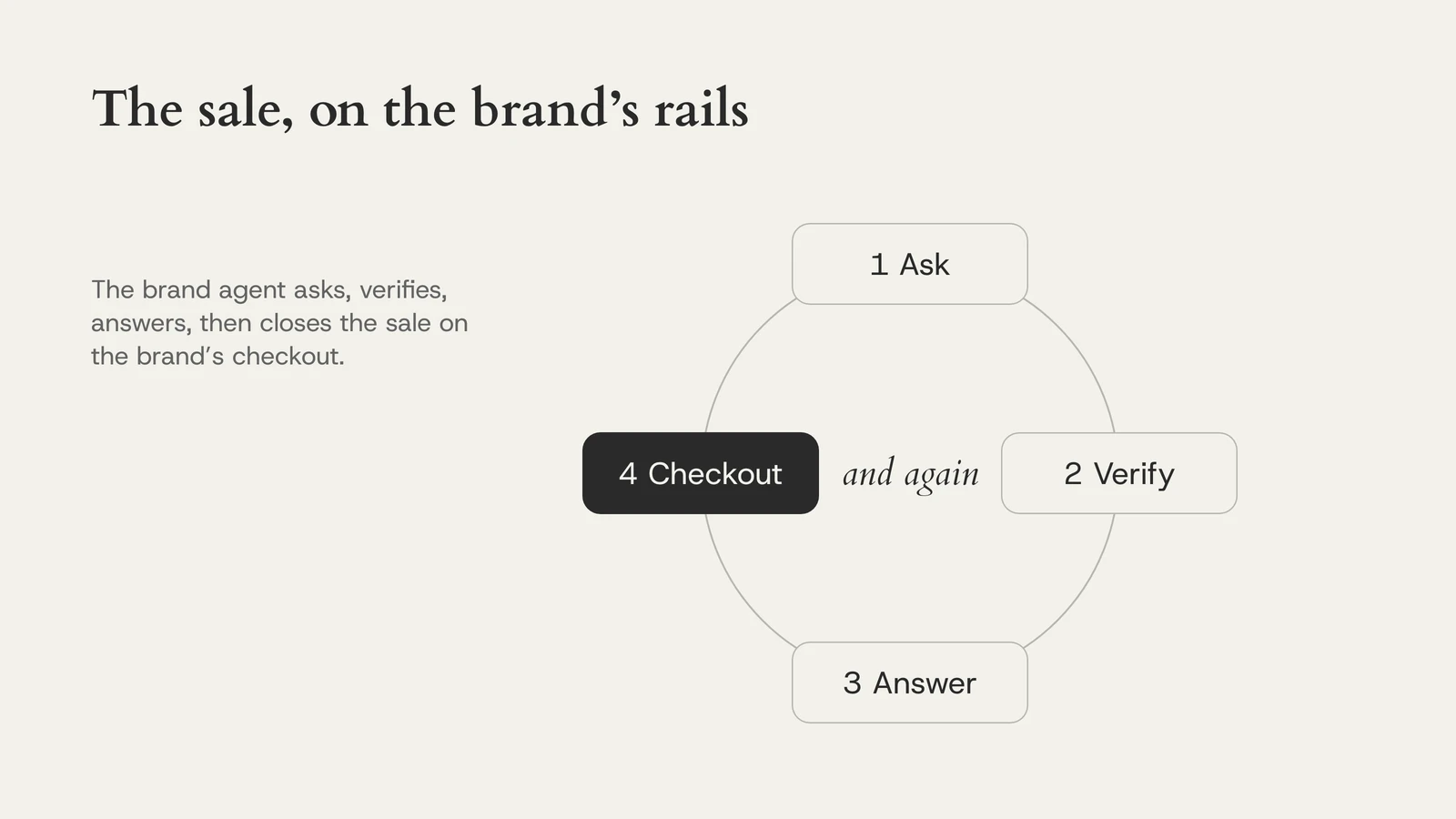
Veliu is the brand agent that does the selling: it studies how your category gets shopped across ChatGPT, Gemini, Copilot, and Perplexity, readies the store so every required field carries a current, defensible value, and sells to people and to the AI shopping agentsSoftware agents that search, compare and complete purchases on a buyer's behalf. They read structured catalog data and transact through protocols like ACP and MCP.Read more that arrive, in the brand's voice, with checkout on the brand's rails. We set out the thesis in our founding paper.
What this means for you
- Field names are now revenue work. The agent's buying behavior is documented, so catalog quality has a written rubric: nine fields for OpenAI, an attribute plus a console for Google, a decision for Microsoft, an application for Perplexity.
- Defaults decide your exposure. Microsoft enrolls Shopify merchants automatically and Shopify activates agentic channels for eligible stores, while Google waits for you to qualify. Map where you already are before choosing where to apply.
- Eligibility flags are strategy. is_eligible_search and is_eligible_checkout encode your funnel inside ChatGPT; set them per product, deliberately, and re-verify after every catalog sync.
- Agreement beats volume. A feed that contradicts its own product pages loses comparisons the catalog could have won, on every surface at once.
- Gates move, feeds compound. Select-merchant programs widen on the platform's schedule, and the feed you clean now is the entry ticket each time a gate opens.
The concrete next step: export your current product feed this afternoon, check 25 rows against OpenAI's nine required fields, and fill the OpenAI block of the readiness checklist before the week ends.
Author: Veliu Editorial Team
Methodology note: Veliu Editorial Team reviewed the linked primary documentation from OpenAI (commerce documentation and product feed specification), Google Merchant Center help (Universal Commerce Protocol and Business Agent prerequisites), Microsoft Advertising's January 2026 Copilot Checkout announcement, Perplexity's merchant program pages and terms, and Shopify's agent documentation and Help Center pages, as available on August 6, 2026, with the OpenAI feed specification, Google's UCP help page, the Microsoft announcement, and Shopify's Agentic Storefronts pages re-checked on September 24, 2026. Program availability changes quickly: gates described as select-merchant or US-first can widen or close without notice, and this review did not test a live merchant account on any of the four programs.
The next paper, when it is written.
One email per paper, and nothing else.
Subscribe