

In brief. AI shopping agents read the request, gather products from feeds and the web, narrow the field to what the shopper asked for, compare what is left and write the answer in their own words. No company publishes its ranking weights. A brand controls four things: facts that match across feed, page and checkout; a feed in each program; answers to the questions shoppers ask; and which agents may read its site and buy on it.
- OpenAI says ChatGPT ranks stores selling the same item on factors like availability, price, quality and whether the store is the maker or primary seller.
- Google, Microsoft, Perplexity and Amazon describe their agents in general terms, and none publishes ranking weights.
- In controlled studies, ratings, price, badges, list position and listing text all moved agents' choices, by amounts that differed from model to model.
- Price, stock, shipping and returns have to match in the feed, on the product page and at checkout; Microsoft warns that incomplete or outdated data can remove a product from the recommendation entirely.
- Access is a brand's decision: which agents may read its site, and which may buy on it.
When several stores sell the same item, ChatGPT ranks them on factors like "availability, price, quality, and whether they are the maker or primary seller of that item," according to OpenAI's shopping help page. That sentence is close to the whole public rulebook. Google, Microsoft, Perplexity and Amazon publish similarly general descriptions of their own AI shopping agentsSoftware agents that search, compare and complete purchases on a buyer's behalf. They read structured catalog data and transact through protocols like ACP and MCP.Read more, and none of them publishes its ranking weights.
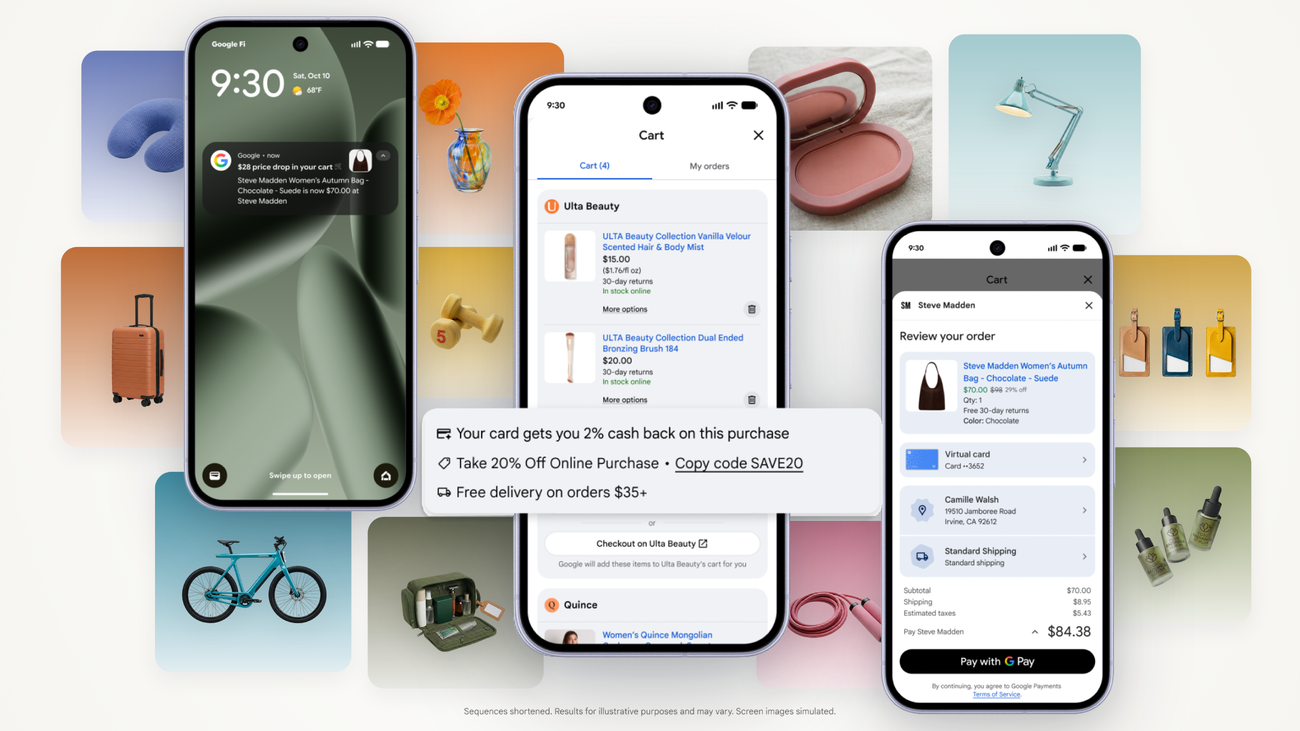
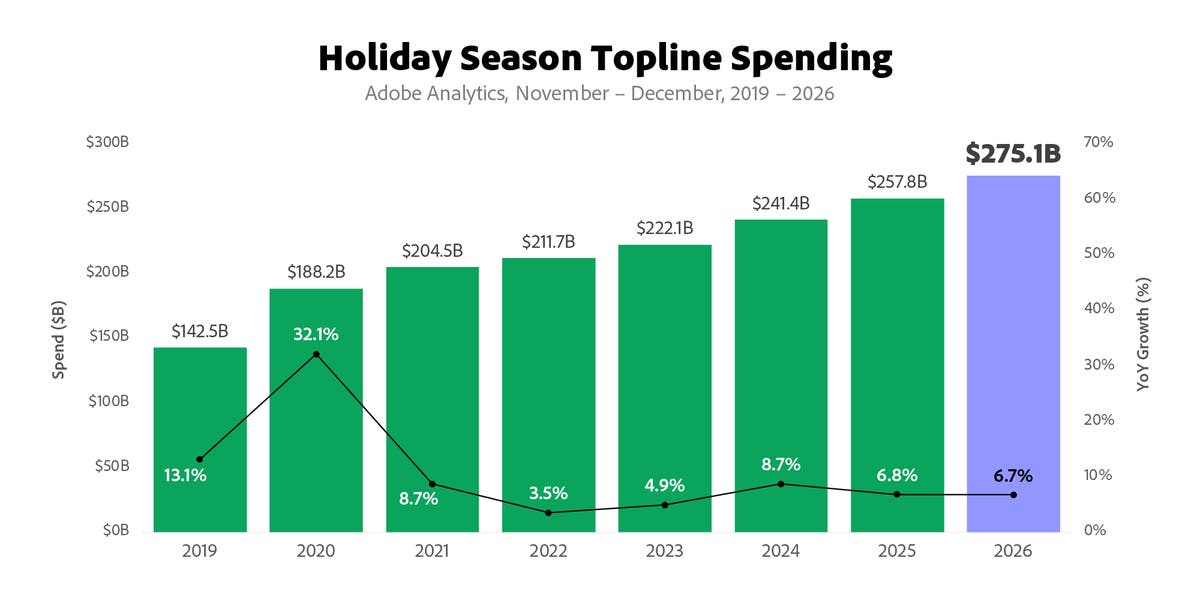
How agents choose matters more this season, because the agent that builds the shortlist is starting to close the sale. Amazon's assistant can complete a purchase when an item reaches the shopper's price target. Google began rolling out Universal Cart, one cart across stores, to US shoppers on October 15. OpenAI launched ChatGPT Wallet on November 13, starting with US Pro subscribers, so its agents can pay on a merchant's own website. Visits from AI answers to stores are growing too: Adobe forecasts that AI traffic to US retail sites, measured as shoppers clicking a link, will rise 130% year over year this holiday season.
How does an AI shopping agent get from a question to a shortlist?
Take a request like "a down jacket for a six-year-old, under $120, delivered before December 20." The agents in this guide handle it in roughly five moves, and most of them read data a brand supplies.
- It reads the request and the shopper. ChatGPT "considers your query and context (such as Memory or Custom instructions)." Perplexity uses "your past searches, interactions, and saved preferences." Two shoppers who type the same words can get different shortlists.
- It gathers candidates. ChatGPT can use "information from the public web, private API integrations, and, for retail, merchant product feedsA structured export of the catalog (id, title, description, link, image, price, availability) in the Google Merchant Center spec, the format most shopping surfaces ingest.Read more" (OpenAI). Google works from its Shopping Graph, built in part from the product data brands and retailers send through Merchant Center. A product the agent cannot find never reaches the next move.
- It narrows the field to what the shopper asked for. For the jacket, that means a child's size, a $120 budget and a delivery date. In OpenAI's own examples, "if you specify a budget of $30, ChatGPT will focus more on price," and if a shopper has said they dislike clowns, "it may leave out clown costumes." Microsoft tells merchants that with incomplete or outdated data "you might eliminate yourself from the recommendation entirely" (Microsoft Advertising).
- It compares what is left. OpenAI, Google, Microsoft and Perplexity all describe ranking by relevance to the request, then name signals such as price, reviews or the detail a merchant supplies. Perplexity says it "is more likely to recommend merchants who provide deeper product details such as availability, reviews, pricing, and specifications."
- It writes the answer in its own words. The agent writes the titles, summaries and labels the shopper reads. OpenAI notes that labels such as "Budget-friendly" are "generated by ChatGPT" and that "Reviews and ratings are not verified by OpenAI."
Then comes the hand-off: a link to the store, a checkout inside the agent, or an agent that fills in the store's own checkout. Our agentic checkout guide covers that step.
What each company says its AI shopping agent uses
| Agent | Product data it draws on | What the company says about selection | Paid placements | Where the purchase happens |
|---|---|---|---|---|
| ChatGPT | The web and merchant feeds; Shopify and Etsy catalogs are "already integrated" | Products "relevant to your intent"; stores ranked on availability, price, quality and maker or primary seller | Ads for Free and Go users; OpenAI says "Ads do not influence ChatGPT's answers," and products in ad feeds stay out of organic conversations during the beta | The store's site or app; Wallet lets ChatGPT's agents pay on the store's site |
| Google AI Mode and Gemini | The Shopping Graph, "60+ billion continually refreshed product listings," and the web | Answers "are generated independently using Google's Search quality and ranking systems" (Google Ads Help) | Text and Shopping ads labeled "Sponsored" inside AI Mode and AI Overviews, in English, in the US and other markets | The store's site, or checkout through the Universal Commerce Protocol for select merchants in the US, Canada and Australia |
| Microsoft Copilot | The web and the store's Microsoft Merchant Center feed | Options based on "your prompt, likely engagement, available merchant data, and other factors" (Microsoft Support) | "Sponsored links are clearly identified" | Copilot Checkout for US buyers in USD, or the store's site |
| Perplexity | Its index and the data merchants provide | Listings ranked like sources, "based on authority and relevance" (Perplexity Help Center) | Says advertisers "cannot pay to list their products" in its related products section | Instant Buy for US users, or the store's site |
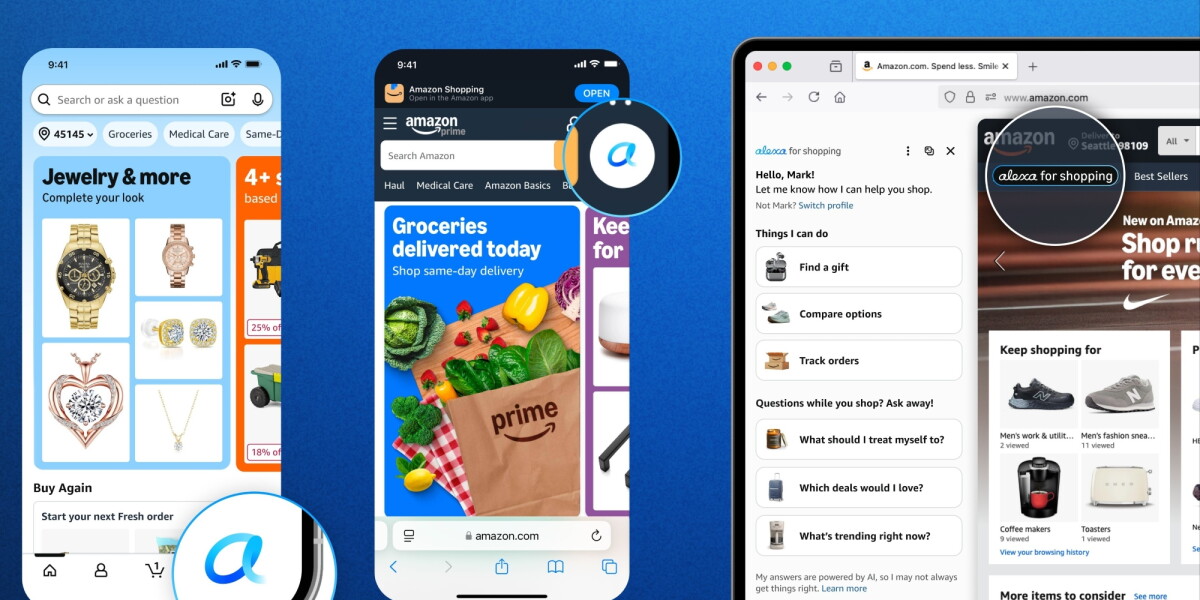
| Amazon Alexa for Shopping, called Rufus until May 13, 2026 | Amazon's catalog, customer reviews, community Q&A, the web and the shopper's shopping history | Amazon describes its sources; we found no published ranking factors | Sponsored prompts, generally available in the US since March 25, 2026 | Amazon's checkout; Buy for Me buys single items on brands' own sites, for US customers |
A product feed is the common entry point for Google, Copilot, ChatGPT and Amazon. OpenAI, Google and Perplexity each say paid placements do not influence the organic answer, and Microsoft says sponsored links in Copilot are clearly identified; these are the companies' own statements, and we found no independent audit of them. And no page promises a place on the shortlist: OpenAI writes that connecting a feed doesn't "guarantee that ChatGPT recommends your products" (OpenAI Help Center).
What have independent studies measured?
Almost all of the research on how these agents choose ran in controlled simulations with mock stores, so its findings are tendencies across models under test conditions.
- Ratings and price move agents. ACES is a simulated store built by researchers at Columbia, Yale and MyCustomAI, the company where two of the five authors work. Across three models tested in 2025 (Claude Sonnet 4, GPT-4.1 and Gemini 2.5 Flash), raising a product's rating by 0.1 stars took its share of choices from 10% to between 15.4% and 20.3% (Allouah et al.). The models' response to price was broadly in the range measured for human shoppers.
- Badges and labels carry weight. With the same three models, an "Overall Pick" badge took the same product's share from 10% to between 19.9% and 42.6%, and a "Sponsored" tag lowered it to between 7.9% and 8.9%. When ACES reran the test in December 2025 with Claude Opus 4.5, GPT-5.1 and Gemini 3 Pro Preview, the rating, the badge and the tag pushed choices in the same direction.
- Position matters, differently for each model. ACES found that GPT-4.1 and GPT-5.1 "exhibit almost opposite position biases," and telling an agent to ignore position did not significantly reduce the effect.
- A model update can change the winners. In ACES, with every product's place on the page shuffled at random, GPT-4.1 chose one phone-case brand in 62.6% of runs and GPT-5.1 chose it in 5%.
- A brand's identity works as a tiebreaker. In a skincare test across three models, rating, price and reviews explained 82.4% of the variance in rankings and brand identity 1.2% (Chu and Hou).
- Missing facts lead agents astray. McGill researchers found that when product details took effort to fetch and the shopper's goal was vague, agents skipped the facts needed to compare unit prices; with complete information, "pricing cues rarely mislead" (Wadi and Ma).
- Answers change between identical requests. The one audit of live assistants in this list asked 117 real product questions three times each, from logged-out browsers in the Netherlands. Between repeats, the products ChatGPT recommended overlapped by 0.178 on a 0-to-1 scale, against 0.287 for Gemini and 0.421 for Google's AI Overviews (Uberti-Bona Marin et al.). The authors call these overlaps lower bounds: a product named two ways counts as two, so the real overlap may be higher.
The wording of a listing moved agents too, though less evenly. In ACES, an AI seller agent, given the product's details and the competitors' sales data, rewrote one listing per category a single time. Averaged across categories, the rewrite raised that product's market share for five of the six models, by 3.7 to 14.9 percentage points. In 67% of the pairings of category and model the change was not statistically significant, and in the rest the gains were large, up to 80.4 percentage points (Allouah et al.). The rewrites that worked put the shopper's query first and named attributes a buyer looks for, such as "2-Ply" and "Septic-Safe" on toilet paper. So the studies point a brand to one job: complete facts, written in the words shoppers use.
What you control
The facts that can disqualify a product
Price, stock, shipping and returns are the facts that can knock a product off the shortlist, so they have to match in the feed, on the product page and at checkout. For its AI placements, Google asks merchants to "Ensure your Merchant Center product data matches your landing pages" (Google Ads Help). OpenAI warns shoppers that when merchants change prices or shipping terms, "there may be some delay before it is reflected in the information you see" (OpenAI Help Center). A sale that starts on the site before the feed updates can show the old price in ChatGPT for a while.
A feed in each program your customers use
Each program has its own format and rules, covered in our guide to selling to AI agents.
- Google: Merchant Center, plus the optional conversational attributes, such as product questions and answers. In Google's test with lululemon, the brand's attributes "were incorporated 50% of the time in relevant product recommendations in AI Mode" (Google). That figure is Google's own, from one brand, with no published method. Our feed guide for AI shopping goes through Google's fields one by one.
- ChatGPT: a product feed uploaded in Business Hub after identity verification, with eleven required fields: nine basic ones from
item_idtoprice, plustarget_countriesandstore_country(OpenAI feed specification). Selling on ChatGPT walks through the setup, and our Business Hub guide covers the claim, the identity check and the feed upload. - Copilot: Microsoft Merchant Center, which accepts feeds built for the Universal Commerce Protocol. Microsoft adds that if a feed "includes only advertised items, AI-powered experiences may overlook the rest of your offerings" (Microsoft Advertising).
- Amazon: the free Shop Direct Merchant Workspace, opened on November 4, where merchants choose which items appear and "can opt out at any time."
Answers to the questions shoppers ask
Agents compare on detail, so the questions a store's staff hears every day belong in the product data. Amazon tells sellers to "make sure your product descriptions address frequently asked questions so Rufus can recommend your products" (Amazon seller blog). Google's AI performance insights report shows how a store performs on "conversational queries with shopping intent" and which popular attributes may be missing from its data. It covers English-language queries for Merchant Center accounts in the US, Canada, Australia, India and New Zealand.
Who may read the site, and who may buy
For a site to be eligible for ChatGPT's search results, OpenAI asks it to "allow OAI-Searchbot to crawl the site" (OpenAI Help Center), and for Wallet it asks stores to recognize signed agent requests through Web Bot Auth, the method our guide to accepting ChatGPT Wallet payments explains. Amazon's robots.txt blocks outside agents, Perplexity's among them, and its Conditions of Use require every agent to identify itself. Its own Buy for Me agent buys on other brands' sites, and a brand that wants out can write to the address on Amazon's merchant page. Any brand can draw the same lines on its own site: which agents may read it, which may buy, and on what terms.
What stays out of your hands
No company publishes its ranking weights, and OpenAI says it expects to personalize "merchant rankings even more to user preferences." For Google, the shortcuts sold as AI ranking tricks are unnecessary: its Search Central guide says "Structured dataMachine-readable schema.org markup (Product, Offer, AggregateRating) embedded in a page as JSON-LD. It is the canonical way to hand engines unambiguous product facts.Read more isn't required for generative AI search," and that for Google Search, sites can ignore content "chunking," inauthentic mentions and "creating unnecessary AI text files (like llms.txtA proposed convention: a markdown file served at /llms.txt that gives language models a curated map of a site's most useful content.Read more)." That leaves the work in the sections above: matching facts, a feed in each program, answers to real questions and a decision on access. For ChatGPT in detail, read how brands get found on ChatGPT.
A check to run before Black Friday
Amazon's Black Friday Week and Cyber Monday deals run from November 19 to November 30.
- Pick five products that matter most to your season.
- Ask the agents (ChatGPT, Google AI Mode, Copilot, Perplexity and Alexa for Shopping) what your customers ask, with a budget, a size and a delivery date. Save each answer with its timestamp.
- Compare the price, stock and shipping each agent shows with your live site at the same moment.
- Fix every mismatch at the source, then check the feed in each program you use.
- Settle access: check that your robots.txt and your CDN let in the agents you want, and decide whether Amazon's Buy for Me may buy on your site.
- Repeat after the season with the same questions, and compare the two records.
When the agent works for the brand
Every agent above works for the shopper or for the company that runs it, and each one weighs a brand's product against other brands' before it answers. Two of those companies now also offer an agent that speaks for a brand on their own services. Google's Business Agent lets shoppers "chat with your brand" on Search. OpenAI's Business Agents, launched in beta on November 10 for eligible US e-commerceSelling products online through your own store or marketplaces. For AI visibility the deciding factor is whether the shop's catalog is readable by machines.Read more and online service businesses, explain products and policies and link to the brand's website.
Before you choose any agent that speaks for your brand, ask three questions: who writes its rules, who keeps the conversation, and where the sale closes. When all three stay with the brand, the agent is a brand agent: it follows the brand's rules, hands the brand the questions buyers asked and closes the sale at the brand's own checkout. It sells to people and to the AI agents that shop for them.
An agent that answers for your brand
Everything above is about what a brand publishes for other companies' agents to read: pages, feeds, policies. The questions those sources leave open, about one product, its fit or its delivery date, still need an answer from the brand itself.
Veliu is an agentic commerce lab building the Brand Agent: an agent that sells for one brand, in that brand's voice, to people and to the AI agents that shop for them.
We are opening the Brand Agent to its first brands, in Europe and the US. If you want yours among them, the application takes two minutes, and we read every one ourselves.
Authors: Elyas Tirit (Founding Designer & Builder) and Azra Hadziabdic (Co-Founder & Founding Product Engineer) of Veliu, an agentic commerce lab building the Brand Agent. Methodology: every company statement in this guide was read on the company's own page on November 13, 2026. Company figures are the companies' own and are attributed to them. The guide estimates no ranking weights. Studies are summarized with the setups and limits their authors state; all but the audit of live assistants ran in simulations.
The next paper, when it is written.
One email per paper, and nothing else.
Subscribe