In brief. A brand agent is an AI agent that works for one brand and sells for it, to people and to the AI shopping agents that shop for them. Google and Microsoft now offer platform versions in the brand's voice, which proves the category exists. The brand's own agent differs in three ways: it answers only to the brand, it does the whole job (it studies the market and the store from outside, readies the store at the source and sells), and it arrives educated on the category.
- A brand agent is an AI agent that works for one brand, with a mandate to sell to people and to AI shopping agents, closing each sale on the brand's own checkout.
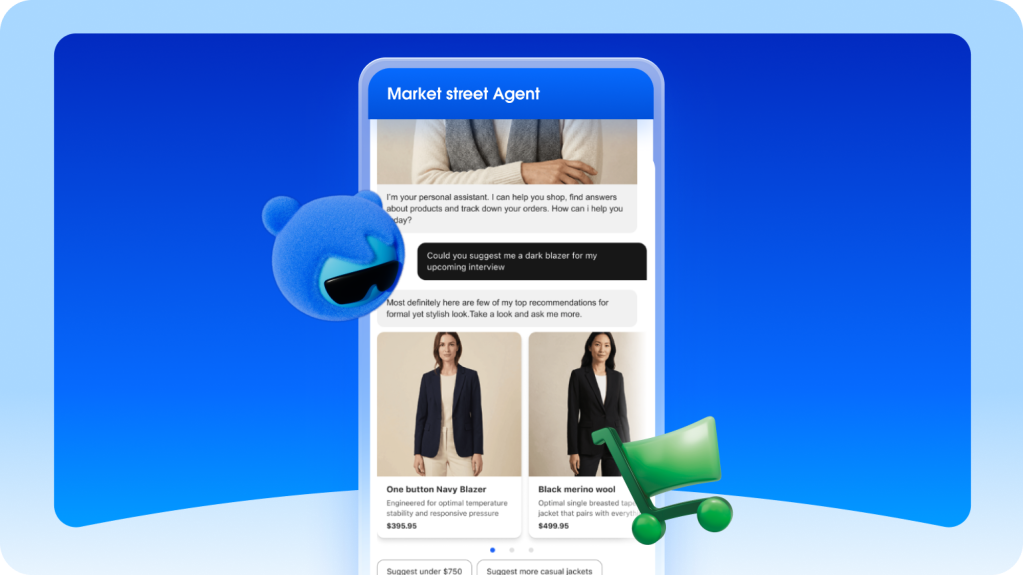
- Google's Business Agent and Microsoft's Brand Agents already speak in the brand's voice, so voice and a place on the brand's site are table stakes.
- The brand's own agent differs in three ways: it answers only to the brand, it does the whole job from studying the market to selling, and it knows the category.
- With AI shopping agents, a brand agent answers structured questions in fields and offers only what its mandate allows, while the brand stays merchant of record.
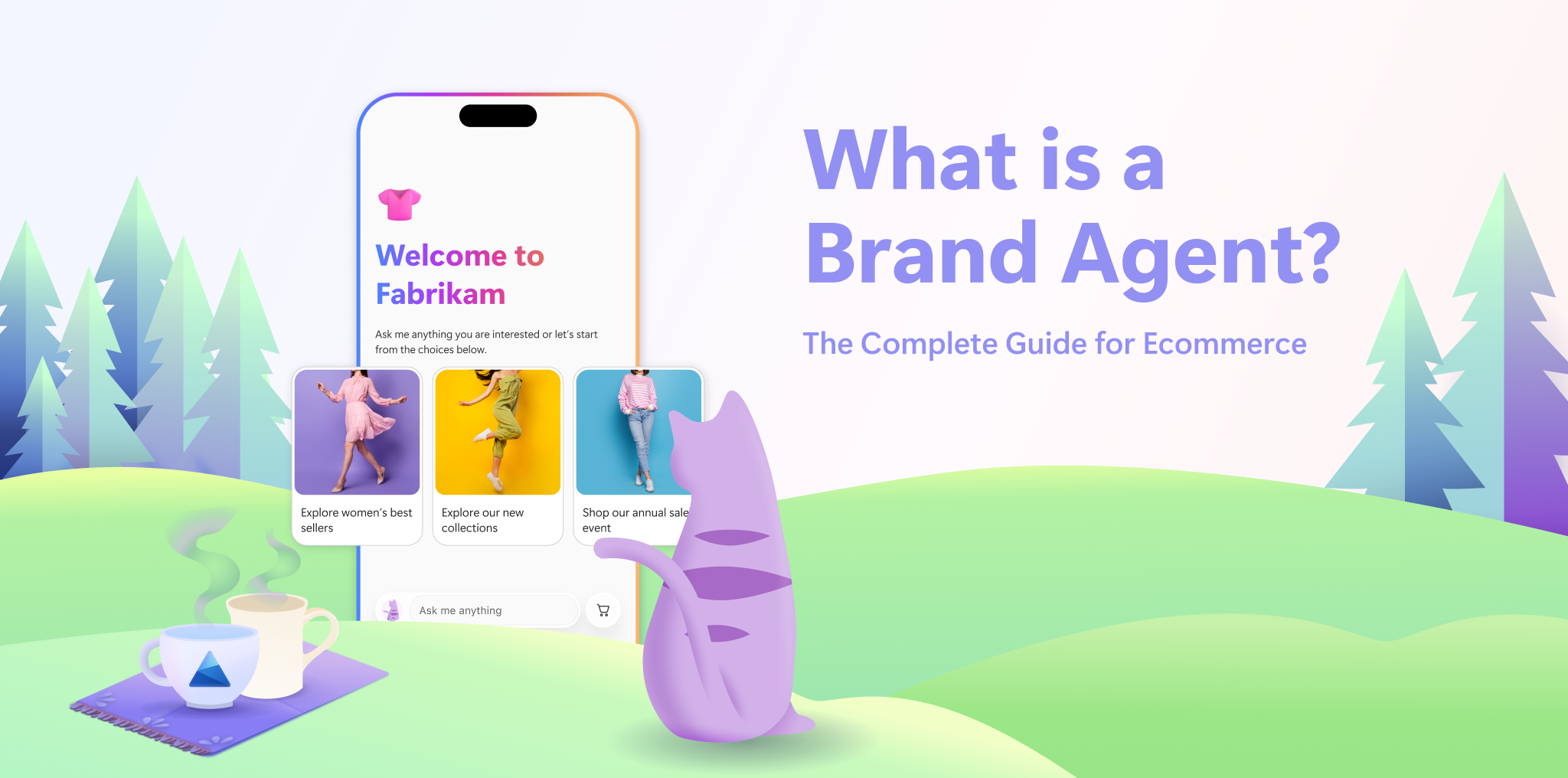
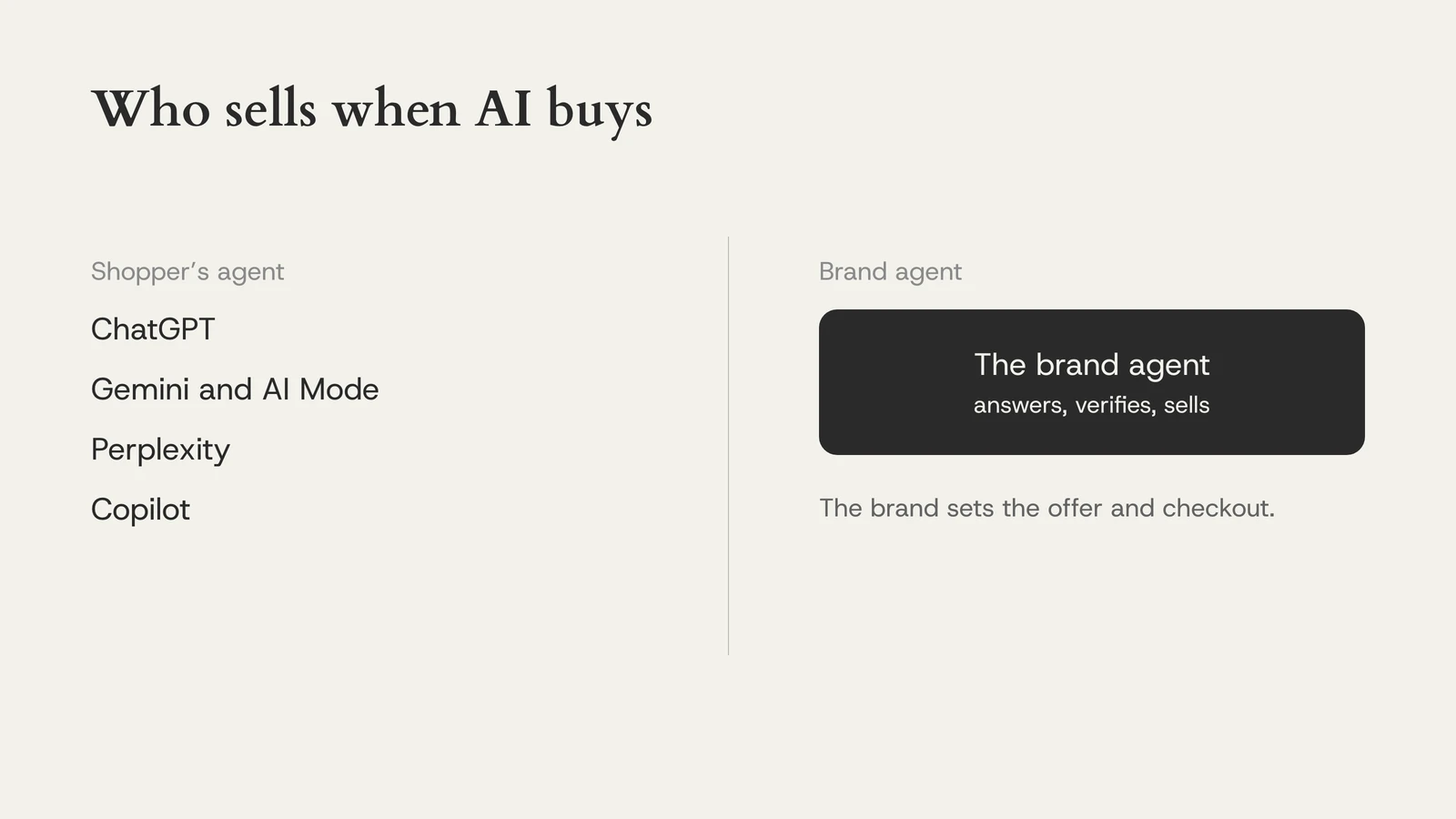
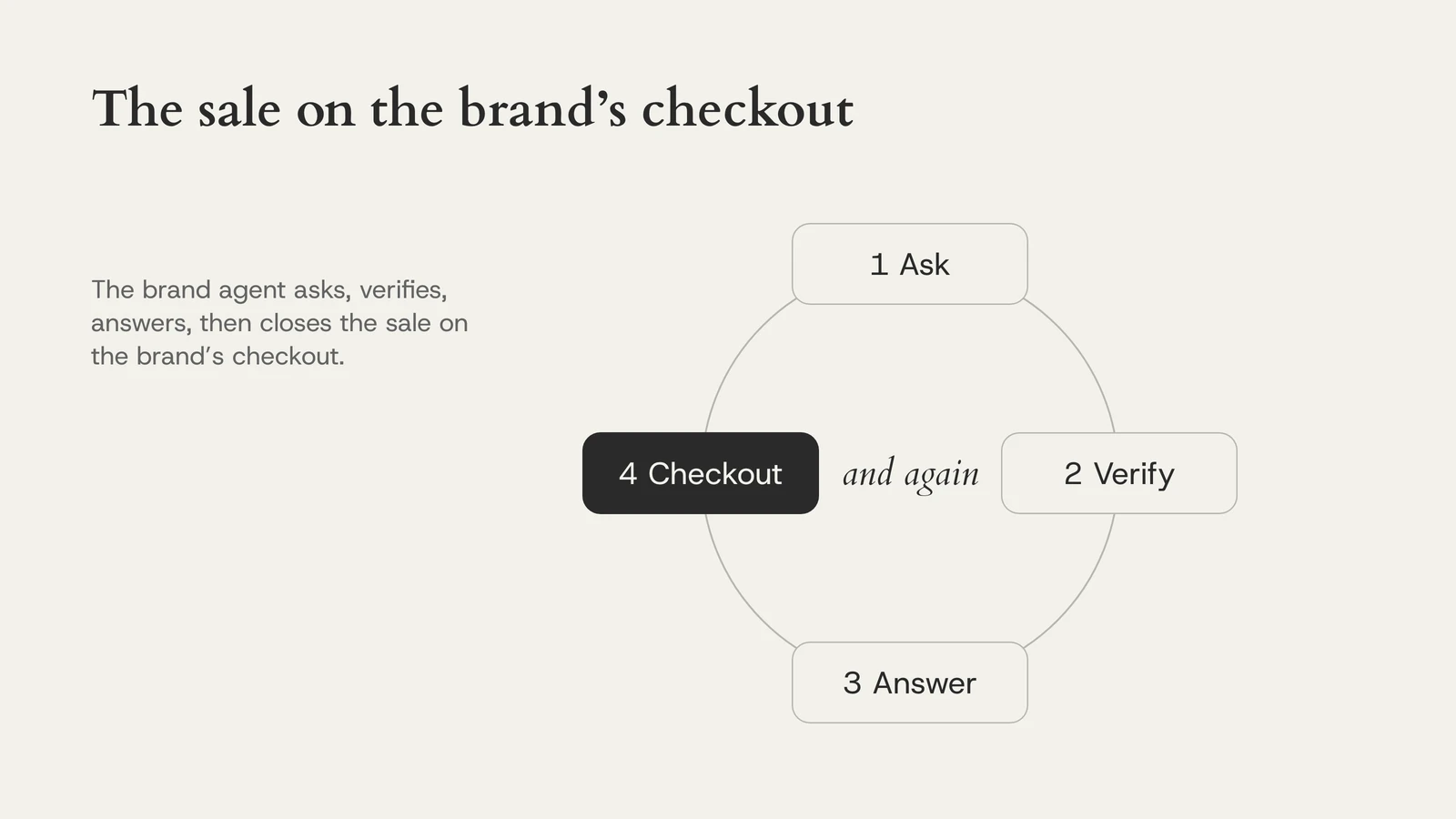
A brand agent is an AI agent that works for one brand, with a mandate to sell to people and to the AI shopping agentsSoftware agents that search, compare and complete purchases on a buyer's behalf. They read structured catalog data and transact through protocols like ACP and MCP.Read more that now shop on their behalf. It studies how the brand's category gets bought, readies the store so every product fact holds up at the source, sells inside rules the brand writes, and closes each sale on the brand's own checkout.
The term went mainstream in January 2026. Microsoft launched Brand Agents alongside Copilot Checkout on January 8, and Google switched on Business Agent inside Search days later, with Lowe's, Michaels, Poshmark and Reebok live at launch. In July, Salesforce's commerce release offered brands "AI agents you own" and announced native integrations with ChatGPT, Google Search and the Gemini app.
Those launches settle whether brands will have agents. They leave open the question this page answers: who does the agent work for?
What does "brand agent" mean?
In commerce software, a brand agent is an AI agent that represents one brand to buyers. Microsoft's Clarity team defined it on March 5, 2026 as "a conversational AI that lives on your website and represents your brand", guiding product discovery, answering questions and assisting with transactions. It is also called a brand AI agent, and the plural, brand agents, doubles as the name of Microsoft's product.
The same words carry other meanings, and search results mix them:
- A person. In events and licensing, a brand agent is a human: the promotional rep at an event, or the professional who licenses a brand's name to manufacturers.
- An ad format. Firsthand sells Brand Agents built for marketers and publishers: AI brand representatives that deliver a brand's knowledge on its site, across paid media and beyond.
- A chat widget. The name also gets stretched to cover any chat window on a store; Microsoft's own guide spends a section on why a brand agent is different from a chatbot.
This page uses the software meaning with two conditions attached. The agent's mandate is to sell, and its only principal is the brand.
Platform brand agents vs your own: what actually differs?
Start with what they share, because it is a lot. Google describes Business Agent as "like a virtual sales associate that can answer product questions in a brand's voice". Microsoft's Brand Agents run on the merchant's own Shopify or WooCommerce site, take written tone instructions, and are, in Microsoft's words, "deployed in hours". Brand voice and a place on the brand's own site are now table stakes. The differences sit further down the table.
| Google Business Agent | Microsoft Brand Agents | An agent that answers only to the brand | |
|---|---|---|---|
| Whose rules it runs under | Google's, on a results page where Google also sells ads | Microsoft's service terms | The brand's written mandate, and nobody else's |
| Where it answers | When people search your brand on Google and tap "Ask" | Your Shopify or WooCommerce site, plus a catalog copy in Microsoft Merchant Center that feeds Bing and Copilot | Wherever you sell: your site, the AI assistants, and any buyer's agent that calls your store |
| Brand voice | Yes: tone, welcome message, conversation starters | Yes: brand overview, offering, tone instructions | Yes |
| What it knows | Your Merchant Center data and website; training on brand guidelines and size guides is listed as coming soon | Your catalog, brand fields pre-filled by AI that you can edit, and how visitors behave on your site, through Clarity | Your catalog and your category: how it gets shopped, which facts decide a comparison, what competing offers say |
| How much of the job it does | Answers questions; performance insights and agentic checkout are listed as coming soon | Answers, guides visitors to checkout, reports agent-assisted sessions | The whole job: studies the market and the store from outside, readies the store at the source, sells |
| Selling to AI shopping agents | Not documented | Indirect: a catalog copy that Bing, Copilot and other Bing-grounded assistants can read | Direct: structured answers, and offers within its mandate |
| Who keeps what buyers asked | Performance insights are listed as coming soon | You get a dashboard; conversation content is also shared with Microsoft to operate and improve the service | You do: your knowledge stays yours, while category knowledge compounds across brands |
| Checkout | Agentic checkout is listed as coming soon | Your checkout | Your rails, with you as merchant of record |
| Availability, September 2026 | Rolling out in the US. Customizing it takes a US-based store, a verified Merchant Center account, at least 50 approved free listings and a claimed brand profile; until then, a standard Google-branded version shows | Beta, by approval, for Shopify and WooCommerce sites | No platform gate |
Sources: Google's Business Agent help page, Microsoft's Brand Agents overview and configuration guide, all read on September 24, 2026.
Read down the last column and three differences remain. None of them is about voice.
Independence. A platform's agent runs under the rules of a platform that also sells advertising. Google's answers on Google's own results page; Microsoft's lives on your site, but under Microsoft's terms, and its conversation content is shared with Microsoft. Google announced Business Agent in the same post as Direct Offers, a Google Ads pilot; Microsoft announced Brand Agents on its advertising blog. That is a fair business model and useful distribution. It also settles whose agent it is. Their agent works for the channel. Yours works for you.
The whole job. The platform versions work the conversation in front of them: they answer questions and, in Microsoft's case, guide the visitor to checkout. A brand agent does the whole job: it studies how the category gets shopped and reads the catalog from outside, the way a shopping agent reads it, readies the store at the source so the facts are right wherever they travel, and sells. After every change, it studies again.
Education in the category. An assistant trained on one catalog knows the products. A brand agent also knows the category: which questions decide a premium purchase, which facts a buyer's agent compares, where demand is moving. Installing an agent is becoming the easy part. On September 2, 2026, Anthropic published a blueprint with reference implementations of a shopping agent that a retailer runs in its own app or site, and a merchant agent for the team that runs the store, built to get a commerce agent running in days, and Shopify said it is building a reference storefront on it. When anyone can install an agent, what decides whether it sells is what it knows and whom it answers to. The standard to hold any brand agent to: installed in hours, educated for years.
None of this makes the platform agents a mistake. They prove the category exists, and they are counters worth claiming. The brand's own agent can stock each one with the same facts.
What does a brand agent do? One craft, three moments
The craft is easier to see on one product. Take a premium leather-goods brand, invented for this page, and its best-selling tote: $695, full-grain leather, three colors.
1. It studies the market
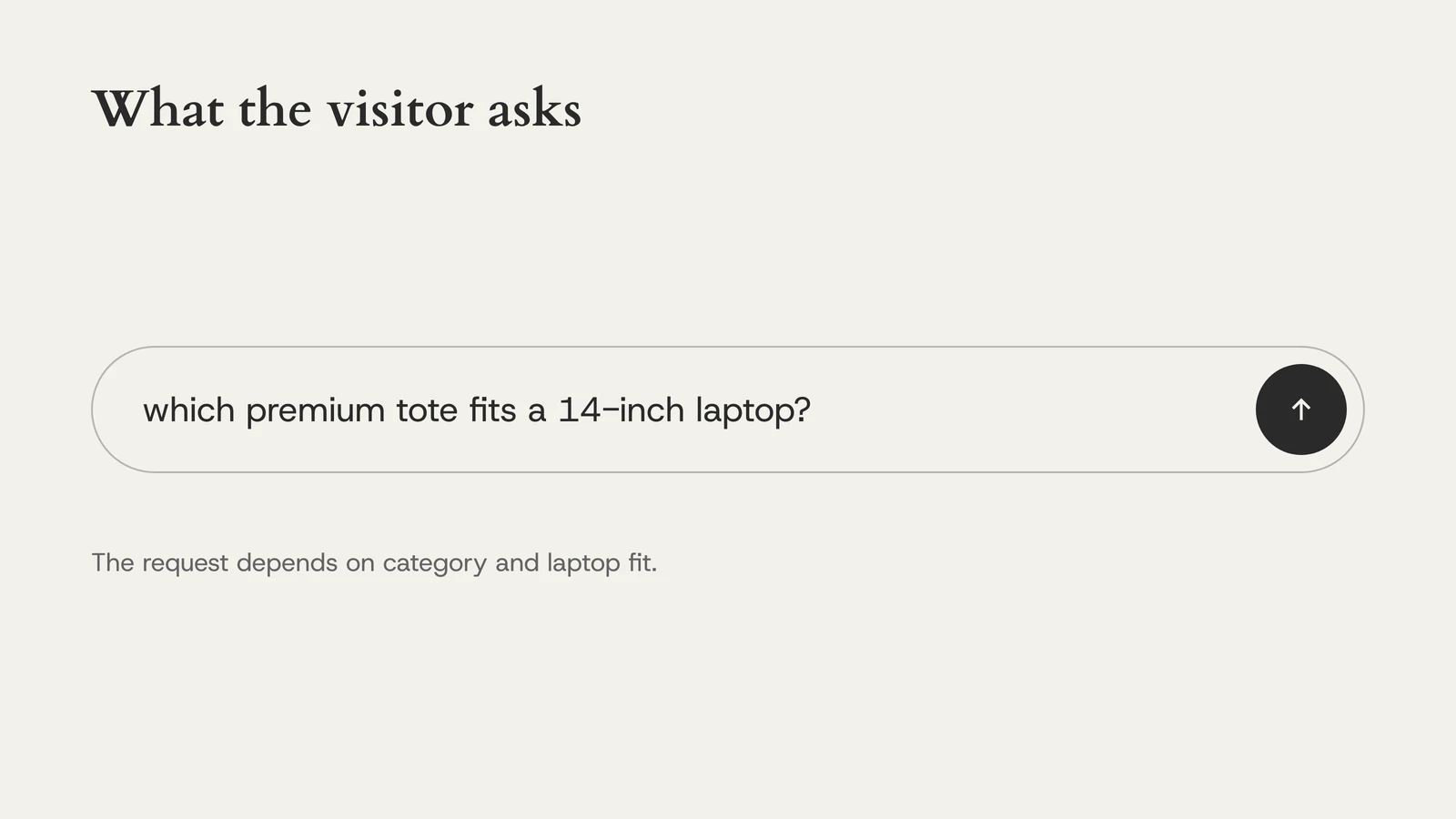
It starts outside the store. For premium totes, the questions that decide a shortlist are rarely about style: will a 14-inch laptop fit, what does the bag weigh empty, is the leather full-grain, will it arrive before a trip. Then it reads the brand's own catalog the way a shopping agent would and finds three gaps. The product page promises the tote "fits most laptops". The feed carries no interior dimensions. The structured dataMachine-readable schema.org markup (Product, Offer, AggregateRating) embedded in a page as JSON-LD. It is the canonical way to hand engines unambiguous product facts.Read more still shows last season's price of $650.
2. It readies the store at the source
It fixes each fact where the fact lives: in the system that the site, the feeds and every marketplace listing copy from. Interior size (13.5 by 10 by 5 inches), laptop fit (up to 14 inches), weight (2.4 pounds), leather type and the monogram option become fields. One price, $695, reaches the page, the feed and the markup. Each change is logged against a day-zero baseline and waits for the merchandiser's approval before it publishes.
3. It sells, to an agent and to a person
At 3 p.m., a shopping agent working for a buyer in Chicago sends a structured request: black leather tote, full-grain, fits a 14-inch laptop, under $700, delivered by Friday. The brand agent answers in fields: in stock in black, $695, fits laptops up to 14 inches, ships today, arrives Thursday, 30-day returns. Its mandate allows complimentary monogramming on full-price leather goods and rules out discounts on the current collection, so it offers the monogram and holds the price. The buyer's agent completes the purchase on the brand's checkout, and the brand stays merchant of record.
At 9 p.m., a visitor on the brand's site asks whether the tote takes her 16-inch laptop. It does not. The agent says so and shows the larger weekender that does, next to the same interior-size panel. A vague "fits most laptops" would have sold the wrong bag and invited a return; the honest answer sells the right one.
Then it studies again. The agent re-reads the catalog from outside, as a shopping agent would, compares it with the baseline, and hands the brand the questions buyers actually asked. Laptop fit keeps coming up, so it becomes a field on every bag in the range.
How does a brand agent sell to AI shopping agents and to people?
With an AI shopping agent, it sells the way a good counter sells to a professional buyer: fast, exact, and inside a brief. The standards are still settling, and the agentic commerce protocol map covers each layer. Four things happen in every sale.
Two mandates meet. The buyer's agent carries its shopper's instructions, and Google's Agent Payments Protocol (AP2) wraps them in signed mandates: an Intent Mandate records what the shopper asked for, and a Cart Mandate records the exact items and price the shopper approved. The brand agent carries the brand's mandate. The sale happens where the two overlap.
The questions arrive structured. The Universal Commerce Protocol, which Google launched on January 11, 2026 after co-developing it with Shopify, Etsy, Wayfair, Target and Walmart, covers catalog search and lookup, cart building, identity linking, checkout and order management. The Agentic Commerce Protocol, maintained by OpenAI and Stripe and still in beta, added cart, feed, orders, authentication and MCP support in its April 17, 2026 version. Either way, the buyer's agent asks for variants, prices, stock and delivery, and expects fields back.
Offers stay inside the brief. ACP's January 30, 2026 version added extensions, discounts and payment handlers, and the protocol lets a business accept or decline transactions per agent or per transaction. The capability is there; the mandate decides how it is used. A brand agent offers what the brand allows, such as a monogram, a bundle or a faster delivery, and nothing it was never authorized to give.
Checkout closes on the brand's rails. UCP, ACP, Google and Microsoft all say the merchant stays merchant of record. The checkout sequence from variant validation to order confirmation runs on the brand's systems, and the customer relationship stays with the brand.
Selling to people
People get the same competence in a different format: a page composed for the question, with product cards, a size panel or a comparison assembled from approved components and drawn from the same records the buyer's agent read. When a question goes beyond the record, a medical or legal one for instance, the agent hands it to a person on the brand's team. On the brand's own domain, this is the work of an agentic storefront.
How is a brand agent different from a shopper's agent, a chatbot or a monitor?
- The shopper's agent. Buyer agents work for the person buying. The brand agent sits on the other side of the same transaction, the sell side of agentic commerce.
- A chatbot. A chatbot waits for a question and stops when the session ends; a brand agent carries a standing mandate. Brand agent vs chatbot runs the full comparison.
- A monitor. A tool that reports how often AI mentions you watches the counter. A brand agent works it.
- A person or an ad unit. Promo reps, licensing agents and paid-media brand agents share the name and do a different job.
How do you evaluate a brand agent?
Seven questions sort any pitch, ours included. Ask them on the first call.
- Who does it answer to? One principal, the brand, or a channel with its own rules and its own ad business.
- Does it know the category, or only the catalog? Ask what it knows about how your category gets shopped before it reads a single product.
- Are facts fixed at the source? A fix made in one channel's copy is overwritten the next time the source syncs. Ask where the change is written, and who writes it.
- Can an AI shopping agent get a structured answer? Price, stock, variant, delivery and returns as fields, with no chat window in between.
- Who writes the offer rules? You should set, in writing, what it may offer and what it must never say.
- What does it measure, and from where? Your store read from outside, the way a shopping agent reads it, against a baseline taken before the first change.
- Where does the money move? Through your checkout, with you as merchant of record.
Before any vendor call, know where you start. The free report reads your catalog from the outside, the way a buying agent does. Nothing to install. No credit card.
Where Veliu stands
Veliu builds agentic selling for brands, the seller side of agentic commerce: a brand's own agent that sells to people and to AI shopping agents, and answers to the brand alone. The thesis is set out in the founding paper, and the Agentic Selling Manifesto makes the full argument.
What should a brand do this week?
- Claim the platform counters on purpose. Use the channel-by-channel eligibility and feed checks for selling through AI agents to verify your setup. On Shopify, check whether your store is enrolled in Copilot Checkout: Microsoft auto-enrolled Shopify merchants, with controls in Shopify admin, and eligibility is limited to English-language stores selling to US buyers. Check Business Agent eligibility in Merchant Center, and keep your Merchant Center feed consistent with your product pages. Both counters are worth having. Neither is your agent.
- Write the mandate on one page. Your voice, the claims you can prove, the offers you allow, the phrases you never want said, and the changes that need approval.
- Read your store from outside. Take your best seller and list what an AI shopping agent can verify about it today: price, stock, variant, delivery, returns.
Author: Veliu Editorial Team
Methodology note: Updated September 24, 2026, when the Veliu Editorial Team re-read every source linked above. The leather-goods brand, its prices and its measurements are an invented illustration. No figure in this article measures Veliu's own performance.
What changed in this update: a sourced comparison with Google's and Microsoft's agents, a worked example through the three moments, a section on selling to AI shopping agents and to people, and a seven-question checklist.
The next paper, when it is written.
One email per paper, and nothing else.
Subscribe