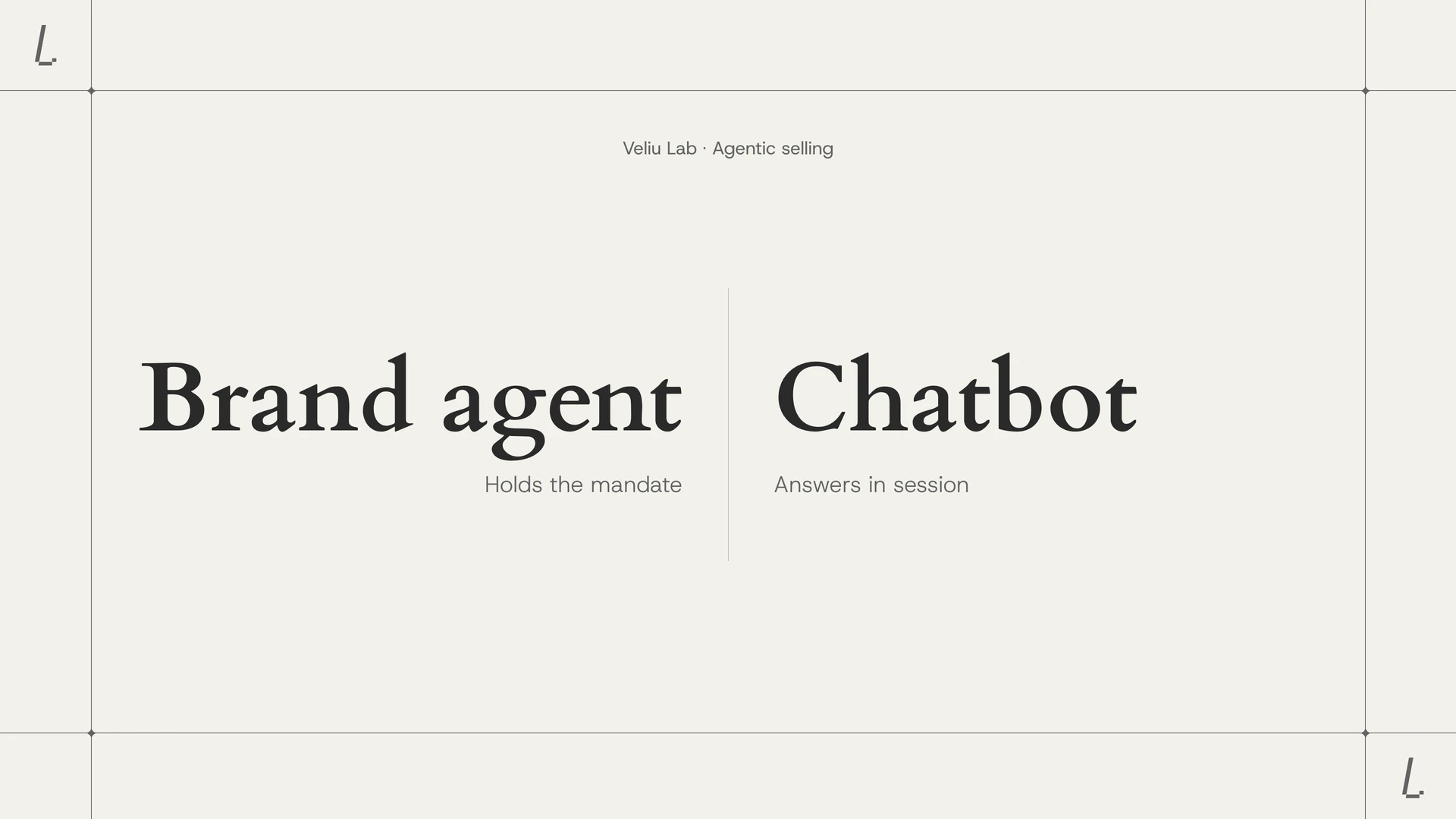
In brief. A chatbot answers questions inside a chat session and its work ends with the session. A brand agent carries a standing mandate to sell for one brand: it studies the category, keeps every product record current, composes the selling surface for visitors, and answers AI shopping agents machine to machine, with checkout on the brand's rails. A chatbot remains the right buy when the job is genuinely answering; it stops being enough when selling depends on what no session contains.
- A chatbot answers inside a session; a brand agent carries a standing mandate to sell that runs whether or not anyone is chatting.
- The session test separates them in eight rows: trigger, lifespan, surface, reader served, working material, output, accountability, and money.
- AI shopping agents never open a chat window, so a conversation-scoped tool cannot serve half of the new buying traffic.
- A chatbot remains the right purchase for genuine answering jobs; measure it as support software, and measure the selling mandate as selling.
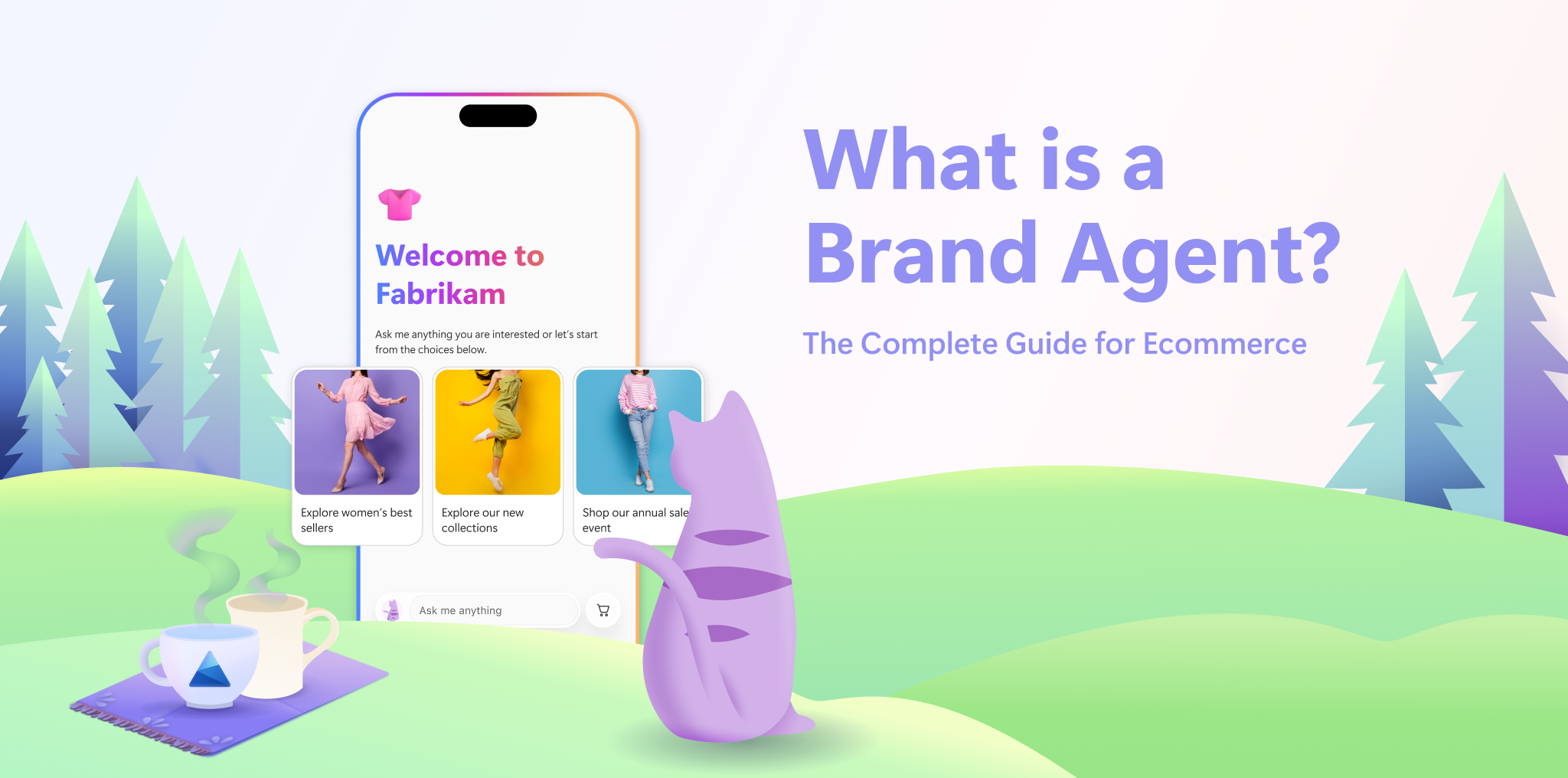
Microsoft's own guide to brand agents spends a full section separating them from chatbots, and the effort is justified: the two words now get attached to the same demo. A chat window opens, a brand-colored assistant says hello, and somewhere in the deck the vendor writes "brand agent" over what is, structurally, the chatbot the merchant already declined in 2023.
The distinction matters more than vendor vocabulary. ChatGPT, Gemini, Copilot, and Perplexity are turning shopping into a conversation the brand does not host, and the software a merchant puts on its own side of that shift either carries a selling mandate on behalf of the brand or waits for questions.
This comparison is for brands and ecommerce operators holding two similar-looking proposals. It gives one test set for telling the categories apart, shows where each belongs, and stays honest about the cases where a chatbot is exactly enough.
A chatbot is a feature. A brand agent is a mandate.
What separates a brand agent from a chatbot?
A chatbot answers questions inside a chat session, and its work ends when the session does. A brand agent carries a standing mandate to sell for one brand: it studies how the category gets shopped, keeps every product record current, composes the selling surface for visitors, and answers AI shopping agents machine to machine, with checkout on the brand's rails. The chat window is one tool inside that mandate, and the only tool a chatbot has.
Both can sit on the same storefront. Both can speak in the brand's voice. The difference is what happens when nobody is typing.
The session test: eight rows tell them apart
| Dimension | Chatbot | Brand agent |
|---|---|---|
| Trigger | A visitor's question | A standing mandate that runs daily |
| Lifespan | The session | Continuous: before, during, and after every visit |
| Surface | The chat window | The storefront, the feeds, and the external surfaces that read them |
| Reader served | People | People and AI shopping agents |
| Working material | A knowledge-base snapshot | The governed catalog: one record per product and variant, kept current |
| Output | Text answers | Composed selling surfaces, machine-readable answers, repaired records |
| Accountability | Conversation logs | A baseline, a change history, and approval gates on everything it alters |
| Money | Measured by deflection and tickets | Measured by selling, with checkout on the brand's rails |
The first row decides the rest. Software that activates on a question can only ever react; software with a mandate works the store whether or not anyone asked.
Where the chatbot frame came from, and why it persists
The frame is old. Chatbot vendors used "brand agent" for branded site avatars as far back as the 2010s, and the economics that funded a decade of chat widgets were support economics: deflect tickets, shorten queues, answer after hours. Useful work, priced as a cost saving.
The 2026 products inherit that frame. Microsoft's guide defines a brand agent as "a conversational AI that lives on your website and represents your brand by engaging users in real time, guiding product discovery, answering questions, and assisting with transactions", and lists the synonym cluster the term competes with, from AI Shopping Assistant to Conversational Commerce Agent. Every synonym on the list describes conversation. The product behind the guide keeps the same scope: per Microsoft's Brand Agents documentation, the assistant runs on the merchant's website, currently in beta for Shopify and WooCommerce stores.
That definition is coherent, and it is a chatbot's job description with better manners. What it never mentions is the half of commerce that no longer converses: the AI shopping agentsSoftware agents that search, compare and complete purchases on a buyer's behalf. They read structured catalog data and transact through protocols like ACP and MCP.Read more that retrieve product data, compare offers, and shortlist products without opening anyone's chat window. The buy side of agentic commerce does not chat. It reads.
A tool scoped to conversation cannot serve a reader that never starts one.
What a mandate looks like on an ordinary Tuesday
Follow one product through one day, at an invented outdoor brand selling a $248 waxed field jacket.
Morning, nobody watching. The agent re-reads the public catalog the way a shopping agent would and finds the jacket's feed price trailing yesterday's page update. It repairs the record against the governed source, logs the change against its baseline, and moves on. No session, no question, no chat.
Afternoon, a machine at the counter. A shopping agent working for a shopper somewhere retrieves the jacket's record, checks price, availability, and size structure, and puts it on a three-item shortlist. The brand agent's answer is machine to machine: current fields, valid variant, consistent offer—the seller obligations AI buying systems check first. The chatbot has nothing to do here; there is no conversation to have.
Evening, a person at the counter. A visitor asks for "a waxed jacket that survives a wet commute, under $250". The agent composes the selling surface from approved components: two product cards, a care panel, a size prompt. The conversation is one input; the composition, and every claim on it, traces to the canonical catalog an agentic storefront runs on.
One product, three moments, one session. A chatbot would have appeared in the third moment only, and only if the visitor clicked the bubble.
When a chatbot is enough
Honesty helps the comparison. A chatbot is the right purchase when the job is genuinely answering: order status, return policies, store hours, a small stable catalog where discovery is trivial. If the questions repeat and the answers live in a document, a well-built widget deflects them cheaply, and installing a mandate to solve a FAQ problem is overspending.
The chatbot stops being enough at the moment selling depends on things no session contains: catalog records and offer data that external AI systems can verify, surfaces that compose per visitor, answers for buyers that never open the widget, and a log of what changed in the store and why.
If the job is answering, buy the widget. If the job is selling, the widget is one tool short of the mandate.
Score your current tool against the five tests
The same five tests that separate a brand agent from a demo work as a chatbot audit. Run them on whatever currently greets your visitors, and write pass, fail, or unknown next to each row; an unknown you wrote down beats a pass you assumed.
| Test | The question | Typical chatbot answer | pass / fail / unknown |
|---|---|---|---|
| Mandate | Does it act on the store, or answer about it? | Answers only | |
| Ownership | Whose records and voice, exportable, on whose domain? | Vendor-hosted knowledge base | |
| Two buyers | Does it serve people and AI shopping agents? | People only | |
| Correction | Baseline, change log, approval gates? | Conversation logs only | |
| Rails | Where does the money move? | Not its concern |
A tool that fails all five can still be worth its subscription as support software. It should simply never be the line item labeled "our answer to AI shopping".
Where the brand agent fits at Veliu
Veliu is the brand agent that does the selling: it studies how the brand's category gets shopped, readies the store so every product fact survives a machine's reading, and sells to people and to the AI shopping agents that arrive, in the brand's voice. Conversation is one of its tools; underneath it, the agent reads the public catalog from outside the way a shopping agent does, adapts the on-site experience per visitor from permitted signals and approved components, answers agents machine to machine, and logs every change against a baseline with approvals the brand sets. Checkout stays on the brand's rails, from cart creation through order confirmation, with the brand as merchant of record. Veliu calls this discipline agentic selling for commerce: the seller side of agentic commerce.
What this means for you
- Rename the line items before comparing prices. A support widget and a selling mandate solve different problems at different price logics; forcing them into one bake-off buys the wrong thing efficiently.
- Ask the session question first. "What does it do when nobody is chatting" sorts every vendor deck faster than any feature grid.
- Check who it serves. If AI shopping agents cannot get a machine-readable answer from it, half of the new buying traffic walks past whatever you installed.
- Demand the log either way. Even a plain chatbot should show you what it told customers; anything that touches the store must show baseline, changes, and approvals.
- Keep the chatbot if it earns its keep. Deflected tickets are real value; just measure it as support, and measure the selling mandate as selling.
The concrete next step: run the five-test table on your current chat tool this week, and take the failed rows into your next evaluation call, ahead of any vendor deck.
Author: Veliu Editorial Team
Methodology note: Veliu Editorial Team reviewed Microsoft Clarity's brand-agent guide and Microsoft's Brand Agents documentation as available on August 10, 2026, and drew the category history from public chatbot-industry usage of the term. The comparison tables are editorial frameworks; the field-jacket walkthrough is an invented illustration, and no figure in this article measures Veliu's own performance.
The next paper, when it is written.
One email per paper, and nothing else.
Subscribe