

In brief. Getting found on ChatGPT can mean a brand mention, a Search citation, or eligibility for a shopping result. Improve the evidence available to each route: permit OAI-SearchBot where appropriate, publish answerable pages, use valid Product and Offer markup, and keep merchant feed data current where that integration applies. Then test citations, product cards, prices, stock, and variants on a dated US prompt set. GPTBot governs training access separately from ChatGPT Search crawling.
- Getting found on ChatGPT can mean a brand mention, a Search citation, or shopping eligibility, and each outcome uses different evidence.
- OAI-SearchBot governs a Search crawling route, while GPTBot has a separate role related to training access.
- Accurate pages, Product and Offer markup, and supported merchant feeds work best when identifiers, prices, stock, and variants agree.
- A dated prompt set turns AI findability from an impression into a repeatable operational check.
- Consistent product evidence can improve machine readability, while every engine retains control over retrieval, citation, and selection.
Learning how to get found on ChatGPT starts with separating brand mentions, Search citations, and shopping eligibility. A store can appear in a general answer while ChatGPT still misses its current price, available size, or correct product page.
For US ecommerce operators, those gaps affect whether a shopper can compare a real offer. ChatGPT, Gemini, Perplexity, Copilot, and AI Overviews can use retrieval and commerce data in different modes, so clear pages and consistent catalog evidence give them better material to interpret. Each engine still controls retrieval, citation, and selection.
This guide shows which artifacts support each route, how to check them, and how to run a repeatable US-market test.
Methodology note: the Veliu Editorial Team reviewed OpenAI bot and commerce documentation, schema.org specifications, and RFC 9309. The source set was last checked on June 17, 2026, and the article was updated on August 27, 2026. Commerce specifications change quickly, so verify current fields, delivery methods, and limits before implementation.
Verdict: “Found” has three measurable meanings
Getting found by ChatGPT means making suitable evidence available through the route used for a result. A cited guide commonly enters through web retrieval. A shopping card can draw on structured commerce data. A general mention may combine retrieved sources with background model familiarity.
| Meaning of “found” | Possible substrate | Evidence to prepare | Measurable check |
|---|---|---|---|
| General answer or brand mention | Retrieved pages, indexed sources, and background model familiarity | Clear first-party facts and credible third-party corroboration | Run fixed prompts and record the mention, claim, and supporting sources |
| ChatGPT Search citation | Search retrieval involving crawlers such as OAI-SearchBot | Accessible page with a direct answer and current evidence | Record the cited URL and passage, then check crawler access and logs |
| Shopping product result | Commerce data, merchant feeds, and supporting web evidence | Eligible item with valid identity, offer, image, shipping, returns, and variant facts | Check feed processing and item eligibility, then record observed product facts |
A brand mention proves only that the name appeared.
It does not establish that a specific SKU can be priced, compared, or purchased. Ask a second question: where should the brand be found? Editorial citations need pages that answer buying questions. Product discovery benefits from current item-level data, including accurate offers and variants.
OpenAI’s shopping-results documentation describes organic product selection and names factors such as relevance, price, quality, availability, and whether the merchant is the maker or primary seller. Current behavior varies by query and surface.
The six terms a merchant needs
- Retrieval at answer time: the engine searches or fetches current sources while preparing an answer.
- Citation: a link or attribution connecting an answer claim to a supporting page.
- OAI-SearchBot: OpenAI’s crawler for pages that may appear in ChatGPT Search results and citations.
- GPTBot: OpenAI’s crawler associated with model training, governed through separate controls.
- Structured data: machine-readable facts embedded in a page, commonly as JSON-LD using schema.orgMachine-readable schema.org markup (Product, Offer, AggregateRating) embedded in a page as JSON-LD. It is the canonical way to hand engines unambiguous product facts.Read more vocabulary.
- Merchant product feed: a structured catalog supplied to a commerce system with current item and offer details.
One more condition matters throughout this guide: source-of-truth divergence, which means the visible page, structured data, feed, and live commerce system disagree. A backpack priced at $205 in checkout, $185 in markup, and $195 in a feed has two conflicts before an engine forms an answer.
What you need before implementation
A non-technical ecommerce team can assemble this evidence pack. Each row produces a file, value, or check that another person can verify.
| Requirement | Artifact or value | Why it matters | Verification tool |
|---|---|---|---|
| Search crawler access | A robots.txt policy for OAI-SearchBot | Makes the intended Search crawling policy explicit | Browser fetch, server logs, RFC 9309 tester |
| Stable product URLs | An HTTP 200 page, suitable canonical handling, and no unintended noindex | Gives retrieval systems a usable URL and clear indexing signals | Response headers and rendered HTML |
| Visible product facts | Name, price, stock, variant, identifiers, shipping, returns, and updated date | Gives people and machines consistent evidence | Manual page review |
| Product structured data | Product with Offer; genuine AggregateRating data only when visible | Expresses identity and offer facts in machine-readable form | Schema.org Validator and Google Rich Results Test |
| Merchant feed | Current identity, description, URL, offer, image, and eligibility values | Supplies item-level facts through supported commerce integrations | Feed diagnostics and item status |
| Product identity | Valid GTIN, or MPN plus brand when no GTIN exists | Helps match the same product across sources | GS1 check and catalog audit |
| Variant relationships | Parent grouping plus size, color, capacity, or another distinguishing value | Reduces confusion between variants | Variant-family export |
| Dated test log | Query, UTC time, geography, surface, result, citation, and observed facts | Turns an impression into repeatable evidence | Spreadsheet or database export |
GTINThe GS1 Global Trade Item Number, the identifier that lets engines merge your offer with the same product sold elsewhere. A valid GTIN is numeric, 8 to 14 digits, with a GS1 check digit.Read more means Global Trade Item Number, the unique barcode number assigned to a product. MPN means Manufacturer Part Number, the maker’s own product identifier. Never invent either value: a false barcode can connect a size or color to the wrong item.
Step 1: Choose the ChatGPT surface first
Map each asset to its intended route. A guide titled “How should I clean a waxed-canvas bag?” belongs on an accessible web page that can support a Search citation. A specific $185 bag with olive and black variants needs accurate item-level commerce data for shopping eligibility.
How should a merchant choose the route? Use web pages for questions, explanations, comparisons, and policies. Use a supported merchant integration for current product identity, offers, availability, images, fulfillment, and eligibility; this map of what commerce protocols handle, and what merchants must still supply clarifies how feeds, checkout, buyer authorization, agent trust, and tool access fit together. Keep the same identifiers and facts consistent across both routes.
The appeal is obvious: one ChatGPT mention feels like proof that the work succeeded. The evidence does not support it. A brand-level mention reveals nothing about whether 4,800 items were processed, whether a medium variant is eligible, or whether the displayed price matches checkout.
Action: label every priority URL as informational, category, comparison, product, or checkout. Record its intended ChatGPT surface beside it.
Verdict: Search access and training access are separate
OpenAI documents different controls for Search and training in its bot documentation. A company that permits Search crawling while withholding GPTBot access can express that policy in robots.txt:
Crawler rules follow the Robots Exclusion Protocol standardized in RFC 9309. Place robots.txt at the site root, return HTTP 200, and check for contradictory rules introduced by plugins, content delivery networks, or staging settings.
Can a robots.txt block affect ChatGPT Search? Blocking OAI-SearchBot can prevent future crawling or inclusion through that crawler. Removal and recrawl timing remain under OpenAI’s control, so record the policy change and monitor server logs over time.
Check the page too. It should return HTTP 200, expose the answer and product facts in rendered content, and avoid an unintended noindex directive in HTML or the X-Robots-Tag header. A self-referencing canonical is a useful consolidation practice, although it is not a universal requirement for indexability or citation.
ChatGPT-User handles user-triggered visits, such as a request to open a particular URL. That function differs from OAI-SearchBot’s Search crawling role.
Verification: fetch robots.txt from outside the company network, inspect server logs for OAI-SearchBot, validate the visitor against OpenAI’s current documentation, and request the preferred product URL without cookies. Save the status code, canonical target, robots directives, rendered text, and UTC test time.
Independent, answerable facts make pages more citable
A useful product page answers one buying question with visible evidence. For a carry-on backpack, that may include capacity, external dimensions, laptop fit, empty weight, material, care, warranty, and available variants.
Generic copy says a bag is “premium” and “perfect for travel.” Evidence-led copy says the Northline Ridge holds 35 liters, measures 21 × 13 × 8 inches, fits laptops up to 16 inches, weighs 2.8 pounds, and includes a 3-year repair warranty.
Specific facts give retrieval systems clearer material to interpret, although extraction and citation remain engine decisions.
What makes a product passage answerable? Name the exact model, intended use, measurable constraint, and date checked. “Fits laptops up to 16 inches; dimensions checked June 17, 2026” can answer a buyer’s question. “Designed for modern lifestyles” cannot resolve fit.
Use 20 real questions from support, search, and sales records. Each should map to a visible passage containing the fact needed for an answer. Technical products and regulated claims may require longer evidence blocks, references, or testing details.
Step 3: Publish valid Product and Offer markup
JSON-LD is a script block that expresses page facts using schema.org vocabulary. The example below includes identity and an offer. Replace every value with current information visible on the same page.
The sample GTIN is illustrative. Production data requires the manufacturer-assigned number and valid check digit. When the product has no GTIN, use a genuine MPN together with the brand name.
What does schema validation prove? It shows whether a testing tool can parse the syntax and recognize supported properties. It does not establish factual accuracy, Search inclusion, citation, or a shopping result. Compare every marked-up value with the visible page and live commerce system.
Add AggregateRating only when genuine underlying reviews are visible to shoppers. Use priceValidUntil only for an offer that expires on a known date, then update or remove it promptly. A valid script showing $185 still fails the buyer’s truth test when checkout shows $205.
The schema.org Product and Offer references define the vocabulary. Test the implementation with Schema.org Validator and Google Rich Results Test.
Verdict: A merchant feed opens a distinct shopping route
OpenAI’s live product-feed specification groups required and optional product attributes across identity, offers, media, fulfillment, and eligibility fields. Use the current specification during implementation because requirements can change.
A strong item record carries a stable item ID, title, description, URL, brand, current price, availability, image, seller information, and accurate eligibility settings. It should also include valid identifiers, variant details, additional images, shipping, returns, and rating evidence when supported and applicable.
Does every ChatGPT shopping appearance require a merchant feed? A supported merchant feed is one route to product discovery and eligibility. Organic web results and commerce integrations can use different paths, so a feed should not be described as a universal prerequisite for every product-related answer.
A size-8 red shoe needs its own accurate item record. The size-9 red shoe needs another, and both should remain connected to the same variant family. Ambiguous variants or missing currency can reduce matching and comparison confidence even when an engine can infer part of the offer; the same risks are detailed in Perplexity’s feed and landing-page consistency requirements.
Follow the secure delivery method designated in the current onboarding arrangement. OpenAI’s product-feed specification states that supported integrations may refresh about every 15 minutes; verify the current limit before implementation.
Verification: save the delivery timestamp, processing result, item-level errors, eligibility status, and accepted-item counts by variant family. Reconcile those values with the current sellable catalog.
Agreement across four surfaces is the truth test
Run a completeness matrix across at least 10 representative SKUs: a bestseller, sale item, out-of-stock item, product without a GTIN, and multi-variant family should all appear.
| Surface | Identity | URL | Image | Price | Stock | Variant | Identifier | Shipping | Returns |
|---|---|---|---|---|---|---|---|---|---|
| Visible page | ☐ | ☐ | ☐ | ☐ | ☐ | ☐ | ☐ | ☐ | ☐ |
| JSON-LD | ☐ | ☐ | ☐ | ☐ | ☐ | ☐ | ☐ | ☐ | ☐ |
| Merchant feed | ☐ | ☐ | ☐ | ☐ | ☐ | ☐ | ☐ | ☐ | ☐ |
| Live commerce system | ☐ | ☐ | ☐ | ☐ | ☐ | ☐ | ☐ | ☐ | ☐ |
| Observed ChatGPT result | Pending | Pending | Pending | Pending | Pending | Pending | Pending | Pending | Pending |
Mark each tested cell present, missing, stale, conflicting, or inapplicable. The blank template contains no invented observations.
How do you measure stale product data? Record four timestamps: source update, visible-page update, feed acceptance, and observed engine result. The intervals reveal propagation latency, which is the delay between changing a fact and seeing it downstream.
This closes the first loose thread. ChatGPT may recognize the brand while missing the current size or price because one downstream surface still carries yesterday’s facts.
Independent corroboration can strengthen the evidence set
A company’s domain establishes first-party product facts. Named editorial reviews, trade coverage, accurate retailer listings, public warranty policies, and consistent company profiles can add independent context around use, quality, and reputation.
For example, a manufacturer may state that a jacket uses a three-layer waterproof fabric. A named outdoor publication can test the jacket in sustained rain and publish its conditions. Those sources cover product specification and observed performance.
OpenAI says product selection can consider relevance and quality, while the weights remain proprietary. Independent sources may strengthen the evidence available to retrieval systems, with no fixed effect on citation or selection.
Mass directory submissions add low-context repetition. Synthetic reviews can corrupt the evidence and may violate platform or consumer-protection rules. Give legitimate reviewers exact model names, current specifications, canonical URLs, and a contact for corrections.
For a broader account of feeds and structured pages, read generative engine optimization for ecommerce.
Verdict: Consistent evidence improves AI findability
ChatGPT, Gemini, Perplexity, Copilot, and AI Overviews can retrieve product evidence while helping shoppers research and compare, although modes and data sources differ. Feeds, schema.org markup, accurate identifiers, and current offers can make a catalog easier to interpret and cite.
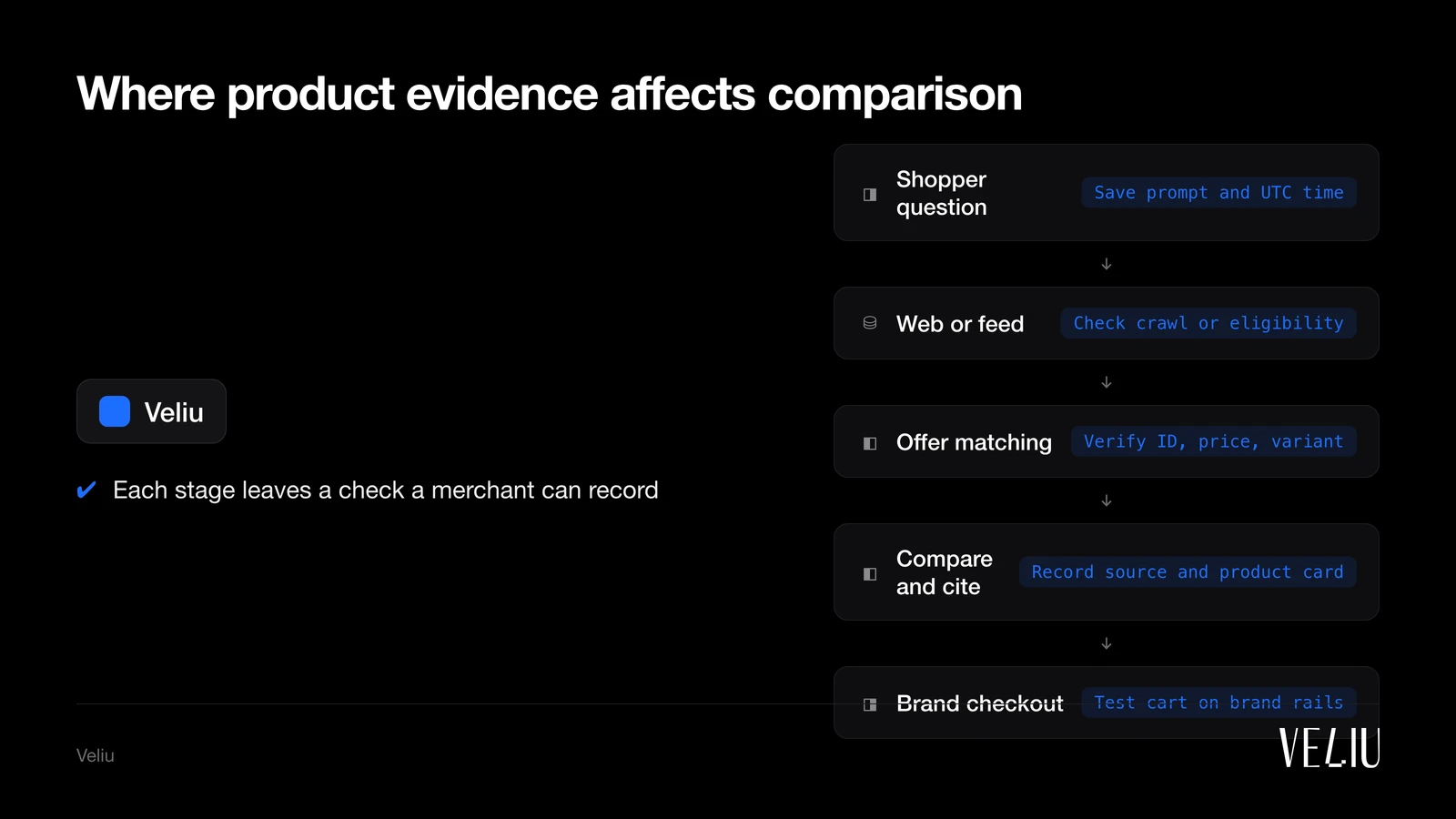
A shopper might ask for “a 35-liter carry-on backpack under $220 that fits a 16-inch laptop.” Retrieval can pull from pages or commerce data. Identity and offer matching connect the request with a variant, price, and stock state. The engine may then cite a page or show a product result.
The commercial consequence arrives early.
A missing currency or ambiguous variant can make the offer harder to compare with confidence. This seller-side stake sits at the center of Agentic Commerce: Who Sells When AI Buys?.
Step 6: Verify results with a dated US test
One prompt result is anecdotal. A stable prompt set shows whether access, citations, product cards, and factual accuracy change over time.
Use four intent groups:
- Informational: “How do I clean a waxed-canvas backpack?”
- Category: “What should I look for in a carry-on backpack for a 16-inch laptop?”
- Comparison: “Compare 35-liter carry-on backpacks under $220.”
- Product-specific: “Is the Northline Ridge 35L in olive available, and what does it cost?”
For every run, record the exact prompt, ISO date, UTC time, US test location or method, login state, displayed model or surface, citation URL, cited passage, product-card presence, observed offer, live source-of-truth offer, and a screenshot or export.
What makes a ChatGPT visibility test repeatable? Keep the prompt wording, geography, login state, and surface label stable. Save the response and compare every displayed price, currency, stock status, and variant with the live commerce system at that time.
Pair prompt testing with technical checks. For a change-by-change process, align pages, product data, and feeds with a frozen prompt test. Confirm OAI-SearchBot policy, page response, rendered facts, structured-data validation, feed processing, item eligibility, and agreement across the page, markup, feed, and live system.
Run the set monthly and after major catalog or feed changes. Segment results by intent so an increase in informational citations does not conceal missing product eligibility. For a focused measurement workflow, use the ChatGPT brand visibility test.
Common failure modes have observable causes
The page loads, while Search crawling is blocked
A browser can load a page even when robots.txt blocks OAI-SearchBot. Test the named user-agent and exact preferred URL. A block can prevent future crawling or inclusion through that route.
Valid schema carries a conflicting offer
A validator can approve JSON-LD syntax while the price differs from the visible page. Compare marked-up values with checkout before celebrating a green test.
A product page has no confirmed shopping eligibility
Open-web presence and merchant integration status are separate. Check feed processing and item-level eligibility where a feed integration applies.
Ten hero products conceal a weak long tail
Flawless bestsellers can hide missing identifiers, images, shipping terms, or variants across thousands of products. Report completeness across sale items, low-volume variants, and discontinued stock too.
llms.txt distracts from the catalog
llms.txt is an optional Markdown content map proposed in 2024. It does not grant crawler access, carry shopping transactions, or have confirmed ranking benefits from a major AI vendor. Prioritize accessible pages, consistent product data, structured markup, and supported commerce feeds.
What to do next
- Label each priority asset as an informational citation target, shopping item, or checkout-ready offer.
- Audit OAI-SearchBot and GPTBot separately according to the company’s policy.
- Compare the visible page, JSON-LD, feed, and live system across representative variants.
- Run a dated monthly US prompt set and save citations, product cards, offers, and screenshots.
Veliu’s brand agent studies the market, readies the store, and sells to people and to the AI shopping agentsSoftware agents that search, compare and complete purchases on a buyer's behalf. They read structured catalog data and transact through protocols like ACP and MCP.Read more that arrive. It uses catalog retrieval, normalization, feeds, and commerce endpoints to answer with the correct price and a valid variant. On the brand’s site, it can compose the selling experience from permitted signals and approved components, communicate with shopping agents machine to machine, and return the questions customers asked. Checkout stays on the brand’s rails through product validation, cart creation, shipping, tax, payment authorization, and order confirmation.
On Monday, choose 10 representative SKUs and record the page, markup, feed, and checkout price for each one before changing anything.
The next paper, when it is written.
One email per paper, and nothing else.
Subscribe