In brief. To sell on ChatGPT Shopify, confirm current channel eligibility, then verify every sellable variant across identifiers, price, stock, shipping, returns, and checkout. Product discovery and transaction eligibility are separate, so test both from outside Shopify before launch. ChatGPT controls its own product selection and recommendations.
- Store-level ChatGPT access still requires product-level verification for every sellable Shopify variant.
- Discovery eligibility and checkout eligibility are separate, so a visible product can still fail before an order completes.
- Price, stock, identifiers, shipping, and returns should agree across the public page, applicable structured data, and the observed commerce record.
- An outside-in audit with exact variants and real US ZIP codes reveals defects that Shopify admin checks can miss.
- AI shopping engines control their own selections, while complete current product facts make a catalog easier to read and verify.
A missing size-level barcode can stop a sellable variant from resolving correctly even when its Shopify product page looks complete. To sell on ChatGPT Shopify, check that ChatGPT is switched on under Sales channels > Agentic in your Shopify admin, then verify each variant’s identifiers, price, stock, shipping, returns, and checkout path. Shopify lists agentic storefronts as active by default for eligible stores, opens the ChatGPT channel to Shopify Catalog merchants selling to US buyers, and completes each ChatGPT purchase on your own online store checkout, inside ChatGPT’s in-app browser or a new tab (Shopify Help Center; Shopify).
ChatGPT, Gemini, Perplexity, Copilot, and Google AI Overviews may use different combinations of merchant feeds, structured product data, and public pages. For a merchant, the consequence is practical: a black shoe in size 8 needs its own current facts before a buying engine can answer a specific request confidently.
Discovery and transaction eligibility are separate. A product may be readable before it can complete an order, and each engine controls its own retrieval, selection, and recommendations.
This six-check worksheet covers access, product records, offer consistency, fulfillment, checkout, and an outside-in test. For stores outside Shopify, the general version is how to sell on ChatGPT.
Can your Shopify store sell on ChatGPT today?
Shopify and OpenAI can change market coverage, policies, integration controls, and admin labels. Check Shopify’s current sales-channel documentation and OpenAI Commerce documentation on launch day. Treat a saved admin path as a historical reference.
Inspect these ten areas:
| Requirement | Place to inspect | Why it matters | Pass condition |
|---|---|---|---|
| Store and market eligibility | Shopify store details, Markets, and the current eligibility notice | Access may depend on location, buyer market, category, policy status, and payment setup | Shopify confirms eligibility for the intended US market |
| ChatGPT commerce control | The current Shopify sales-channel or commerce-integration settings | Labels and participation controls can change | The intended connection is active under the control mode shown in current documentation |
| Accessible product URLs | Public URL, HTTP response, canonical tag, and robots.txt | Public retrieval works better when pages are accessible and canonical signals are consistent | Sampled URLs return a successful response, identify the preferred URL, and permit the intended crawler |
| Product structured data | Rendered source with schema.org Product and an applicable Offer | Markup gives machines explicit identity and offer facts | Recommended markup validates and matches visible content |
| Reviews, when applicable | Visible reviews and corresponding markup | AggregateRating is optional and needs eligible visible support | Rating markup appears only when the page supports it |
| Variant identifiers | Variant and receiving channel records | Identifiers distinguish products and sizes across catalogs | Every sellable variant has a genuine identifier strategy |
| Complete variants | Variant ID, options, values, and family relationship | A parent record may not resolve a requested size or color | Every sellable combination has a complete record |
| Current offer | Currency, price, and availability | Buyers need an exact offer | Page, markup, and channel record agree at the recorded time |
| Shipping and returns | Shipping profiles, US zones, rates, and return terms | A readable item may still fail for the buyer’s ZIP code | Test addresses receive valid options and applicable terms |
| Working checkout | Cart, tax, shipping, payment, confirmation, cancellation, and refund path | The transaction must survive every handoff | A controlled test order completes for each sampled scenario |
A channel toggle opens a lane, while item readiness still requires variant-level verification.
Plain-language terms prevent setup mistakes
- Agentic sales channel: a commerce connection that can make eligible products available to AI shopping experiences.
- Product feed: a structured catalog connection carrying product, variant, price, stock, image, and eligibility facts.
- Structured data: machine-readable facts embedded in a page, commonly schema.orgMachine-readable schema.org markup (Product, Offer, AggregateRating) embedded in a page as JSON-LD. It is the canonical way to hand engines unambiguous product facts.Read more JSON-LD.
- Variant: one sellable option combination, such as a black shoe in size 8.
- Identifier: a stable product code such as a GTINThe GS1 Global Trade Item Number, the identifier that lets engines merge your offer with the same product sold elsewhere. A valid GTIN is numeric, 8 to 14 digits, with a GS1 check digit.Read more, SKU, or manufacturer part number.
- GTIN: Global Trade Item Number, the unique number represented by UPC, EAN, and related barcodes.
- Discovery eligibility: a platform’s permission for a product record to participate in retrieval.
- Checkout eligibility: a platform’s permission for an eligible item to enter its supported transaction flow.
- Merchant of record: the party contractually responsible for the sale, including payment, tax, compliance, refunds, and chargebacks; another provider may perform physical fulfillment.
OpenAI documents separate crawler roles. OAI-SearchBot supports ChatGPT Search indexing, while GPTBot concerns model training; commerce-feed participation follows its own integration and policy rules.
1. Store access still leaves product-level work
Open Sales channels > Agentic in the Shopify admin and confirm that ChatGPT is enabled. ChatGPT has no separate direct-checkout toggle, because its checkout happens on your own online store; the controls that matter are whether products reach the channel and whether order data is shared with ChatGPT. Record the displayed state, supported market, and policy status because these details determine where exclusions and changes appear.
Check five prerequisites:
- Store: the account is active and eligible for the connection.
- Geography: the store serves the supported US market and the intended buyer address.
- Category: the products comply with current platform, payment, and destination rules.
- Policy: claims, privacy terms, returns, and prohibited-product rules are satisfied.
- Payment: the approved checkout route works for the target market.
A visible toggle confirms store-level access only. Product-level eligibility and offer completeness still require verification.
OpenAI’s public product-feed specification includes separate fields for search and checkout eligibility. That separation means an active connection can still contain products that are pending, excluded, incomplete, or unavailable for a transaction.
| Status | Meaning | Merchant action |
|---|---|---|
| Eligible | The observed record can participate in the stated function | Continue to variant and checkout tests |
| Pending | Processing, review, or synchronization is incomplete | Record the time and recheck the named surface |
| Excluded | A product, market, category, or policy condition prevents participation | Inspect the stated reason and correct the responsible source |
| Unavailable | No reliable observation is accessible | Preserve the gap and escalate through the documented support route |
Assign one launch owner. Commerce, legal, catalog operations, and payments may contribute, while one named person records the final decision.
2. Product appearance does not prove checkout readiness
Discovery asks whether ChatGPT can retrieve and consider a record. Checkout asks whether the selected variant, destination, cart, payment, and order can proceed.
Inspect publication, US-market availability, product and variant status, plus any search or checkout controls exposed by the live integration. The OpenAI product-feed specification distinguishes search eligibility from checkout eligibility and makes checkout dependent on search eligibility.
Test one exact request: “Black trail shoe, women’s size 8, delivered to 10001.” Record whether ChatGPT identifies the item, resolves size 8, quotes the observed price, reports availability, and reaches the supported checkout route.
One missing stage fails the end-to-end test.
Catalog, checkout, and payment are separate concerns in agentic commerce protocols. The agentic commerce protocol comparison maps those handoffs in merchant terms.
3. Every sellable variant needs its own facts
Audit child variants because a polished parent page can hide the launch defect. For every sellable size or color, verify a stable variant ID, SKU, genuine GTIN when assigned, or a manufacturer part number paired with the company name when appropriate.
Never fabricate a GTIN. Adding zeroes to force a barcode into another length can invalidate its GS1 format and check digit.
Then inspect the title, description, preferred product URL, image, option names, family relationship, condition, price, currency, and market-specific availability. A color change that materially alters the product should also resolve to the correct image.
Consider a shoe in sizes 8 and 9. Size 8 costs $120 and has four units; size 9 costs $96 and is out of stock. A parent record that says “$96 to $120, available” cannot answer which size the buyer can purchase.
| Fact | Size 8 | Size 9 |
|---|---|---|
| SKU | TRAIL-BLK-8 | TRAIL-BLK-9 |
| GTIN | Assigned size-8 GTIN | Assigned size-9 GTIN |
| Price | USD 120.00 | USD 96.00 |
| Availability | https://schema.org/InStock | https://schema.org/OutOfStock |
| URL | Resolves the size-8 selection | Resolves the size-9 selection |
This closes the opening problem. A missing size-level barcode is one symptom of sellable children that remain ambiguous inside an apparently complete parent product.
4. Page, markup, and channel data should agree
Compare the visible Shopify page, rendered JSON-LD, and commerce-channel record for the same variant at the same time. Price, currency, stock, URL, image, identifier, shipping, and return facts should agree wherever each surface carries them.
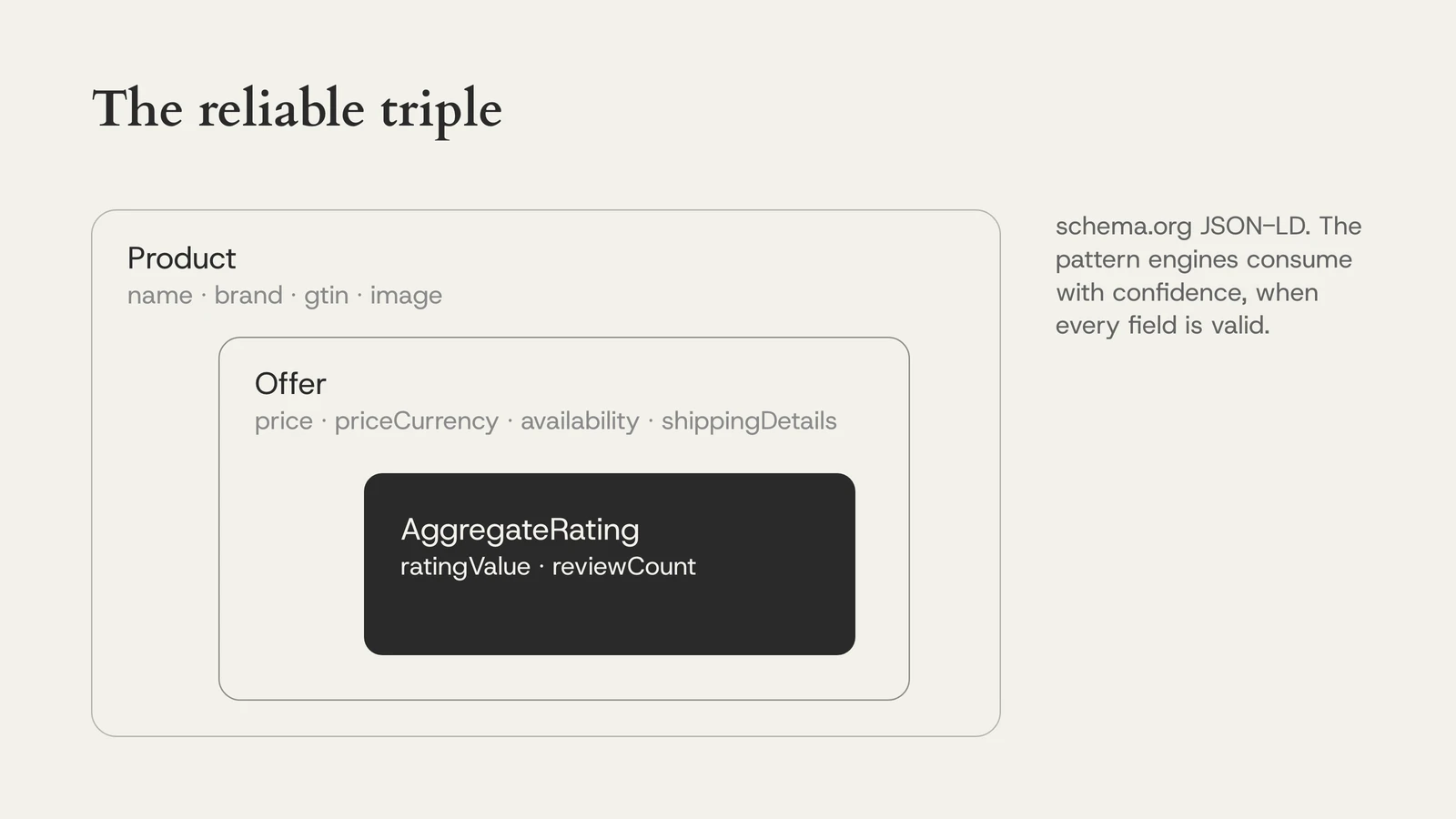
JSON-LD is a machine-readable script embedded in a page. A typical product record uses schema.org Product for identity and Offer for sellable terms; AggregateRating applies only when eligible reviews and ratings are visibly supported.
Google Merchant Center gives merchants a blunt operational rule: “The price in your product data should match the price on your landing page.” The same consistency check is useful across any commerce connection, even though processing behavior varies by platform.
Feeds are intended to carry frequently changing commerce facts and can be fresher than a crawled page, depending on update and processing cadence. A theme or app may render JSON-LD on another schedule, so one size can be in stock in Shopify, out of stock in page markup, and stale in a receiving channel.
That disagreement can contribute to item errors, suppression, or outdated answers. Record the observed effect, and treat any selection formula as platform-specific: platforms disclose different levels of detail about their systems.
Run the comparison after promotions, bulk edits, theme releases, inventory-app changes, and market-pricing updates. The Google Shopping feed consistency audit provides a related field-by-field worksheet.
5. Shipping and checkout need real-address tests
Use the exact variant from the discovery test with at least two US addresses. Proceed through tax, shipping options, discounts, inventory reservation, payment, confirmation, cancellation, and the displayed refund route.
A Manhattan ZIP code and a rural Alaska ZIP code may produce different results. A profile can serve 10001 while excluding another destination because of carrier coverage, item weight, or a missing zone.
Responsibility follows the live contracts and merchant-of-record arrangement. When checkout remains on the company’s approved rails and the company remains merchant of record, it retains the authoritative order and the applicable responsibilities for payment, taxes, customer terms, refunds, and related compliance; fulfillment may still be performed by another party.
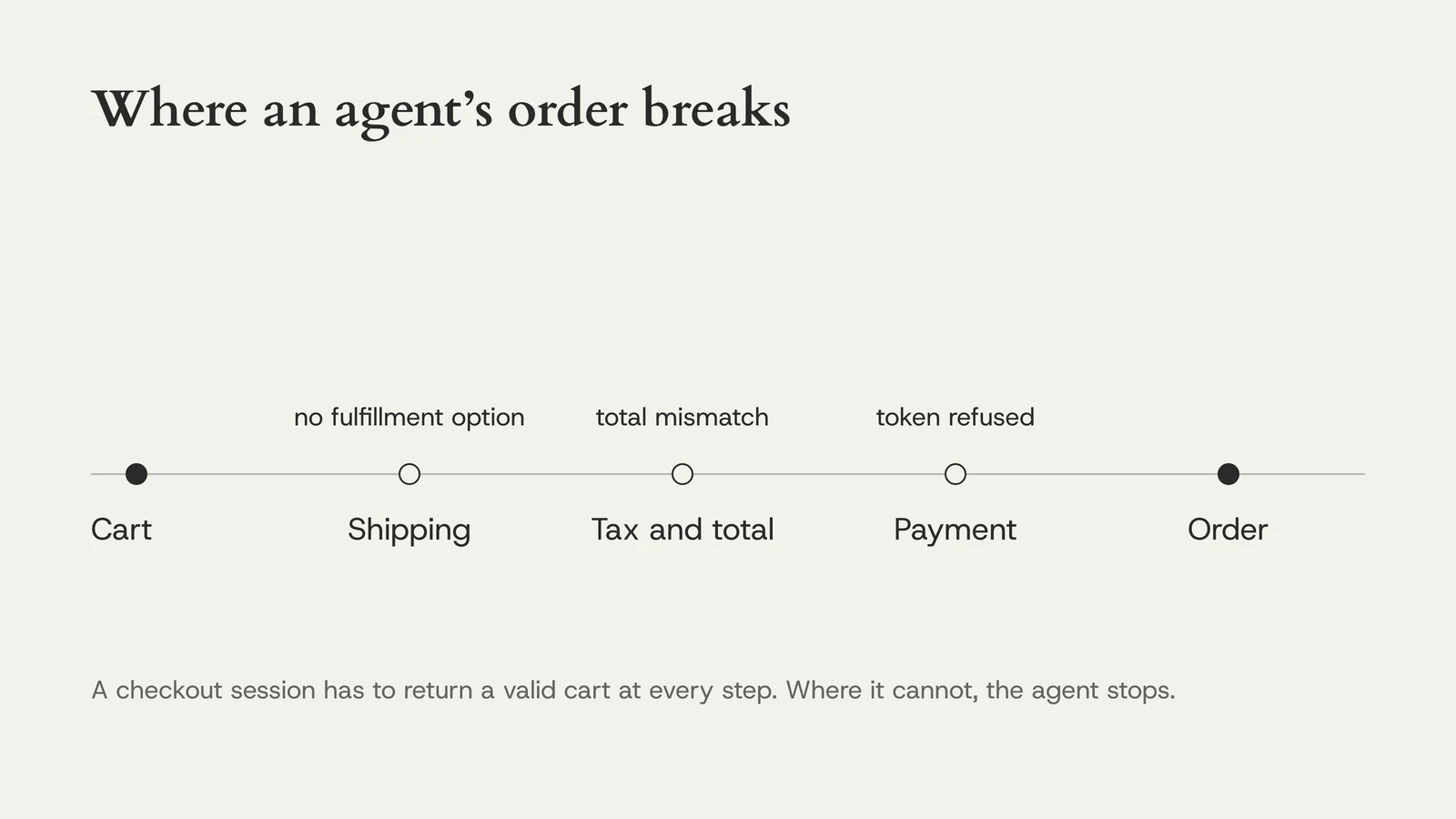
If an implementation exposes Agentic Commerce Protocol endpoints, verify that every response returns the authoritative cart. Idempotency means safely repeating the same request creates one intended action, so the same idempotency key should not produce duplicate sessions or orders.
Test six transitions:
- selected variant to validated cart;
- cart to destination-specific shipping choices;
- shipping choice to tax and total;
- total to payment authorization;
- payment to one order confirmation;
- cancellation or refund request to the published route.
The expensive defect often arrives late. A product may qualify for discovery and still fail when a ZIP code, discount, inventory reservation, or shipping method reaches checkout.
6. An outside-in audit shows what buyers can reach
An authenticated Shopify API view shows the merchant system’s internal state. An outside-in test shows what ChatGPT can read from the public side. Veliu’s free report reads a sample of your catalog that way, as a shopping agentSoftware agents that search, compare and complete purchases on a buyer's behalf. They read structured catalog data and transact through protocols like ACP and MCP.Read more would.
Choose five commercially important variants and five long-tail variants across categories, prices, stock states, and shipping profiles. Record the market, date, device, account context, source URLs, prompts, addresses, and whether each observation came from search or a buying flow.
Then run four stages:
- Fetch: request each public page, follow redirects, record the final status, inspect the preferred URL signal, and examine rendered HTML.
- Compare: validate applicable
ProductandOffermarkup, then compare identifiers, price, currency, stock, image, shipping, and returns with Shopify and the observed channel record. - Transact: run answer and purchase-path tests for the exact variant and ZIP code.
- Record: label every check pass, warning, fail, or unavailable, preserving the observed value and URL.
Inspect robots.txt using RFC 9309 rules. A self-referencing canonical is a useful consistency practice, while accessibility and crawler permission matter more directly for page retrieval; feed-based commerce participation may follow a separate path.
Test externally after every material launch change.
Admin-only checks can miss blocked crawlers, broken preferred URLs, stale rendered markup, public image failures, and destination-specific checkout defects. Those are conditions an outside buyer may encounter.
Complete product data improves AI findability across ChatGPT and Gemini
ChatGPT, Gemini, Perplexity, Copilot, and Google AI Overviews may use merchant feeds, structured product data, public pages, or partner connections, depending on the engine and integration. Clean records make exact facts easier to read and verify, while each engine retains control over retrieval, selection, and recommendations.
The merchant’s stake sits between the question and the order. A current variant with a valid identifier, exact price, accurate stock state, and actionable checkout can enter a system’s consideration process more cleanly than an ambiguous parent-only record.
Feeds can carry changing commerce facts. Schema.org gives page retrieval a machine-readable description. Public pages provide visible corroboration and a route to the company’s domain.
Together, these surfaces can help answer a concrete question: “Is size 8 available for $120, and can it ship to 10001?”
This is the seller side of agentic commerce: the buyer delegates the search, while the merchant prepares product and checkout facts another machine can interpret and act on.
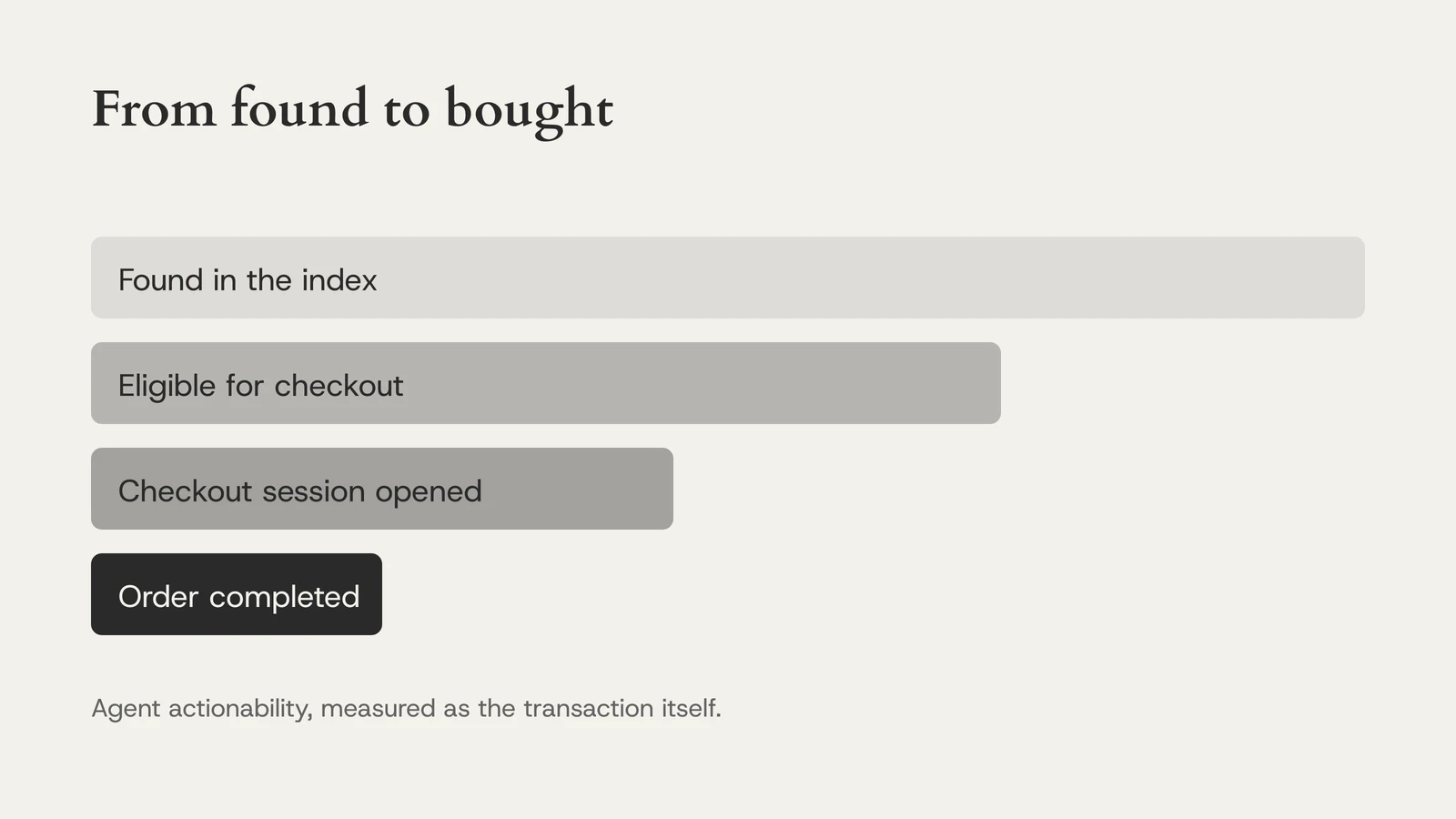
Measure facts and completed actions
A single visibility score cannot show whether size 8 has the right price or ships to the buyer. Use measurements tied to variants and actions.
| Check | Measurement | Method |
|---|---|---|
| Identifier validity | Share of sampled variants with an appropriate valid identifier | Compare with manufacturer or GS1 records |
| Structured-data validity | Share with applicable valid markup matching visible content | Render and compare field by field |
| Surface agreement | Agreement rate for price and availability | Compare one variant at one recorded time |
| Shipping coverage | Share of tested variant and ZIP pairs returning a method | Use a fixed address set |
| Product inclusion | Eligible, pending, excluded, or unavailable | Preserve the observed channel status |
| Retrieval access | OAI-SearchBot allowed or blocked | Parse public robots.txt and check edge rules |
| Propagation latency | Time from a controlled change to each external surface | Timestamp one price or stock update |
| Answer accuracy | Correct observed facts divided by tested facts | Use fixed prompts for variant, price, and stock |
| Checkout continuity | Completed sessions divided by tested scenarios | Run controlled checkout tests |
Define source-of-truth divergence rate as mismatched facts divided by facts checked. Four mismatches across 80 price, stock, identifier, and URL comparisons produce a 5% observed divergence rate.
Keep the numerator visible.
The methodology uses ten variants, split between five commercially important items and five long-tail items, tested in the US market at recorded times. Its main limitation is sample size: ten variants can expose operational defects but cannot represent every catalog item, buyer context, or engine decision.
Publish a dated readiness matrix
The proof artifact should let another operator reproduce the audit. Write unavailable wherever evidence or access is missing.
| Check | Shopify page | JSON-LD | Channel record | Outside-in ChatGPT test |
|---|---|---|---|---|
| Discovery access | URL and status | Applicable markup | Observed inclusion status | Retrieved, absent, or unavailable |
| Identifier | Visible SKU when shown | sku, gtin, or applicable alternative | Matching identifier | Correct product identity |
| Variant | Options resolve | Variant offer resolves | Variant and family relationship | Requested size or color resolves |
| Price | Amount and currency | price, priceCurrency | Current amount and currency | Quoted amount recorded |
| Stock | Visible state | Schema.org availability | Current availability | Requested state recorded |
| Shipping | Terms or calculator | shippingDetails when present | Available channel facts | Test ZIP result |
| Returns | Visible policy | hasMerchantReturnPolicy when present | Available channel terms | Policy path observed |
| Image | Current image | Matching image URL | Matching image URL | Displayed image recorded |
| Checkout | Cart works | Offer URL resolves | Observed eligibility | Cart or checkout result |
Add the audit date, market, sample logic, device or account context, prompts, addresses, source URLs, and known limitations. Classify product categories in plain language as exact, plausible broader category, or too broad to compare.
That last label matters. Turning “women’s waterproof trail shoes” into “apparel” removes the attributes needed to answer the original request.
Common failures point to a specific owner
The connection is active, but products are excluded
Check market, category, policy, publication, and item-level status. Ecommerce operations owns the first investigation, with legal or payments support when the displayed reason concerns policy.
ChatGPT finds the product but cannot resolve size 8
Compare the Shopify variant ID, SKU, genuine GTIN or appropriate alternative, option values, family relationship, and variant URL. Catalog operations owns the correction.
The page says $120 while markup says $96
Timestamp the page, JSON-LD, and channel record for one variant and currency. Theme markup, market pricing, scheduled exports, and app caches are common places to inspect.
Stock reaches one surface late
Make one controlled inventory change and measure when it appears in Shopify, the public page, JSON-LD, the channel record, and the outside-in test. Integrations or platform engineering owns the delay analysis.
A crawler rule blocks more than intended
Inspect explicit rules for OAI-SearchBot and GPTBot, then check firewall or edge behavior. Technical SEOSearch Engine Optimization: earning visibility in classic search results through content, links and technical site health. In 2026 it remains the base layer that AI search builds on.Read more or infrastructure owns the correction.
Shipping fails for one ZIP code
Test the exact variant and failing address, then inspect its shipping profile, zone, weight, and carrier restrictions. Fulfillment operations owns the fix.
The authoritative cart changes during checkout
Compare each returned cart state and verify idempotent behavior. Checkout engineering and payments own unexpected changes in price, quantity, discounts, shipping, or totals.
Readiness is where the seller side starts
A variant audit makes the store readable. Veliu’s thesis is that selling to ChatGPT buyers also needs a brand agent, one that works only for the brand: it studies the market, readies the store at the source, sells to people and to the AI shopping agents that arrive, and measures what they read from outside. Checkout stays on the brand’s rails.
We set out the thesis in our founding paper.
Make variant checks the release gate
Assign one owner for eligibility. Block launch when identifiers, options, price, stock, URLs, shipping, or returns disagree across observed surfaces.
After every material price, inventory, theme, or integration change, timestamp when the new fact reaches the public page, JSON-LD, commerce connection, and ChatGPT test. Run answer and purchase-path tests on both commercially important and long-tail variants with real US ZIP codes.
Make the ten-variant, two-ZIP test a required release check before announcing the channel.
The next paper, when it is written.
One email per paper, and nothing else.
Subscribe