
In brief. To sell on ChatGPT, a US merchant may need an eligible product source, stable product and variant identifiers, synchronized price and availability, accessible product and policy pages, a supported checkout path, and repeatable end-to-end tests. Exact requirements vary by program, platform, category, and integration.
- Confirm geography, category, platform, and enrollment before budgeting a ChatGPT commerce launch.
- Give every purchasable variant a stable identifier and preserve it from product answer through order confirmation.
- Measure price and stock propagation across the commerce platform, page, structured data, product source, response, and cart.
- Test 11 distinct scenarios and retain evidence for acceptance, accuracy, payment, and order state.
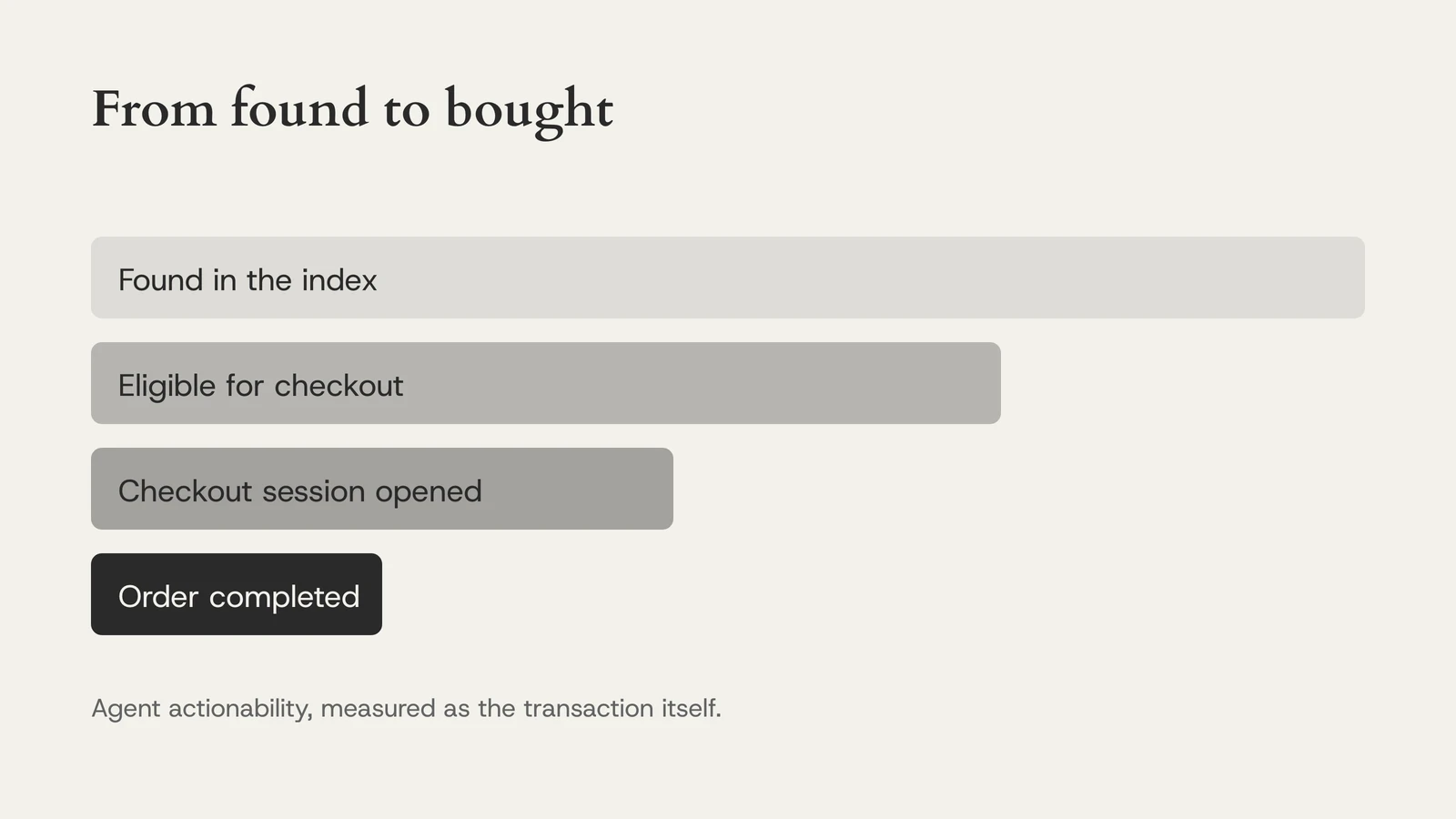
- Treat product appearance and completed checkout as separate measurements.
A wrong size can end an order before payment begins. To sell on ChatGPT, a US merchant may need an eligible product source, stable product and variant identifiers, synchronized price and inventory, accessible product and policy pages, a supported checkout path, and repeatable tests from product answer through order confirmation.
ChatGPT can use structured commerce data to answer shopping questions and support available buying flows. Gemini, Perplexity, Copilot, and AI Overviews also use varying combinations of indexed pages, structured markup, partner data, and feeds, depending on the product and feature. For a merchant, the practical stake is simple: accurate product facts are easier for machines to read and carry into a valid purchase journey.
This guide gives ecommerce founders six operational checks. It covers a standard item, a sale item, difficult stock states, variants, payment failures, and duplicate requests, while keeping every requirement tied to the current program and integration.
What should you confirm before testing ChatGPT commerce?
Start with OpenAI’s current commerce documentation and product-feed specification. Program access, supported platforms, categories, geographies, fields, and delivery methods can change, so record the source URL and access date for every launch decision.
As of September 21, 2026, public documentation should be checked for the merchant’s specific setup before implementation begins. A Shopify-managed route may assign different responsibilities from a direct integration.
| Readiness item | What to confirm | Shop-level failure |
|---|---|---|
| Program access | Geography, category, platform, and enrollment path | A valid feed has nowhere to be submitted |
| Product source | Current schema, required fields, and documented delivery method | A $129 shoe remains listed after it sells out |
| Stable identifiers | Persistent item and variant IDs | A black size 9 becomes a white size 10 during checkout |
| Public pages | Accessible product, shipping, return, and policy information | The answer cites a price that the landing page cannot support |
| Commerce path | Supported cart, payment, and order responsibilities | The selected variant disappears when the cart opens |
| Test evidence | Feed, page, cart, payment, and order records | A successful bestseller hides failures in the long tail |
Freeze the documentation you used.
That simple habit prevents a later protocol change from being mistaken for a merchant implementation defect.
Plain-language terms for the six checks
- Product feed: a structured file or connection carrying item facts such as title, price, stock, image, seller, and eligibility.
- Source of truth: the system whose current value wins when two records disagree.
- GTIN: Global Trade Item Number, the manufacturer-assigned barcode identifier for a product.
- MPN: Manufacturer Part Number, an identifier that may be used with the manufacturer or company name when no GTINThe GS1 Global Trade Item Number, the identifier that lets engines merge your offer with the same product sold elsewhere. A valid GTIN is numeric, 8 to 14 digits, with a GS1 check digit.Read more has been assigned and the active specification permits it.
- Variant: one purchasable version of a product, such as a black shoe in size 9.
- Structured data: machine-readable facts embedded in a page, commonly using schema.orgMachine-readable schema.org markup (Product, Offer, AggregateRating) embedded in a page as JSON-LD. It is the canonical way to hand engines unambiguous product facts.Read more vocabulary.
- ACP: Agentic Commerce Protocol, a public specification whose components and supported operations must be checked against the version used by the integration.
- Delegated payment: a flow in which a limited payment credential authorizes a defined purchase without exposing raw card details to every participant.
- Agent view: what an external shopping agentSoftware agents that search, compare and complete purchases on a buyer's behalf. They read structured catalog data and transact through protocols like ACP and MCP.Read more can retrieve from public pages, feeds, and supported commerce interfaces.
For the wider standards landscape, see the Agentic Commerce Protocol map.
1. One reliable product source prevents stale offers
Map every sellable item to the fields required by the active OpenAI product-feed specification. A typical implementation will work with stable identifiers, titles, descriptions, URLs, images, company or manufacturer information, prices, availability, and seller details, while the current specification remains authoritative for exact labels and conditions.
Use the documented delivery method for the merchant’s approved integration. Record the export time, submission result, and the moment a changed item becomes visible in the relevant commerce response; avoid assuming a transport method or refresh cadence applies across every onboarding route.
Picture four connected stations: commerce platform, product source, ChatGPT shopping surface, merchant checkout. A stale stock value at station two can leave a working checkout unused or expose an unavailable item.
A public product page still matters because it provides a canonical destination, visible terms, and corroborating facts. Feed-based participation can add separate fields, controls, and update processes.
The appeal is obvious: if a page is indexed, the product should be ready to sell. The documented commerce flow requires additional product and eligibility data for participating integrations, so indexing alone does not complete the operational job.
Do next: change one test SKU from in stock to out of stock, then timestamp the commerce platform, page, structured data, feed output, submission result, and returned commerce response.
2. Stable variant IDs keep the requested size intact
Give each purchasable variant a persistent identifier. If a manufacturer assigned a GTIN, preserve the exact number and validate its check digit; GS1 documents the identifier family and its 8, 12, 13, and 14-digit formats in its GTIN guidance. Never invent a barcode for an item that lacks one.
A shoe in black, size 9 can have a different image, price, URL, and stock state from the same model in white, size 10. Each sellable choice therefore needs enough information to survive the journey from product answer to cart.
This anonymized example illustrates the merchant problem; field names and accepted values must follow the current specification. If a shopper requests black size 10, the response and cart should preserve that exact unavailable choice instead of silently substituting black size 9.
Do next: sample one product family with at least three variants and compare identifier, size, color, image, URL, price, and stock at every handoff.
3. Price and stock must agree through the cart
Compare each tested offer across the commerce platform, feed, landing page, on-page structured data, and cart. A sale item priced at $84 should retain the same currency, validity, stock state, and purchase conditions through the journey.
JSON-LD is a machine-readable script embedded in a page. A schema.org `Offer` can describe price, priceCurrency, and availability, giving systems a clear representation of the visible offer.
A date field deserves careful handling. If priceValidUntil is used, an expired date may cause some consumers of the data to treat the offer as stale, so test how the relevant integration handles it and remove unsupported assumptions from the launch report.
Google’s Merchant Center guidance gives a useful operational analogy: submitted data and landing pages can produce item issues when they disagree, and Google may apply automatic updates in some cases. Google’s product-data consistency guidance governs Google’s system; OpenAI’s documentation governs ChatGPT participation.
The slowest handoff sets the risk window.
At 10:07 a.m., mark a controlled test SKU out of stock. Record when the page, structured data, feed, accepted submission, and test response change, then restore the item through the normal workflow.
Do next: assign an owner to every value and document which system is authoritative for price, inventory, shipping, and returns.
4. Eligibility needs a product-by-product decision
Use the eligibility controls documented for the active program. Confirm their exact names, allowed values, and dependencies in the current product-feed specification because these details can change across versions and onboarding routes.
A regulated item, preorder, oversized shipment, or product restricted in several states may require different search or checkout treatment. For example, a wine bottle may have complete product data while destination rules still prevent a valid purchase in one state.
OpenAI states that organic product results are “selected independently by ChatGPT and are not ads, nor influenced by any OpenAI partnerships.” Its shopping-results documentation names factors that can include relevance, price, availability, quality, and whether the merchant is the maker or primary seller.
Public OpenAI materials available on September 21, 2026 do not provide a complete weighting formula for every shopping result. Enrollment, advertising, and technical readiness serve separate operational purposes.
Do next: approve eligibility by product class, then test one restricted product, one preorder, and one unavailable variant.
5. Checkout must preserve the selected product and total
Document the checkout lifecycle and supported operations from the exact ACP or platform version used by the merchant. Responsibility boundaries can differ by integration, so the implementation record should identify who controls the cart, inventory check, tax, shipping, payment result, and order state at each step.
The practical sequence is shopper intent, checkout session, current cart, payment authorization, and order confirmation. At every handoff, verify the item ID, variant, quantity, currency, shipping choice, and total.
Security controls also need endpoint-level scope. Record the required authentication, replay protection, request identifiers, signatures, timestamps, version headers, and retry behavior beside the specific component that defines each control; avoid treating controls from separate protocol surfaces as one universal list.
A duplicate request offers a concrete test. Send the same approved test operation twice according to the integration’s retry and idempotency rules, then confirm that one intended purchase produces one logical order.
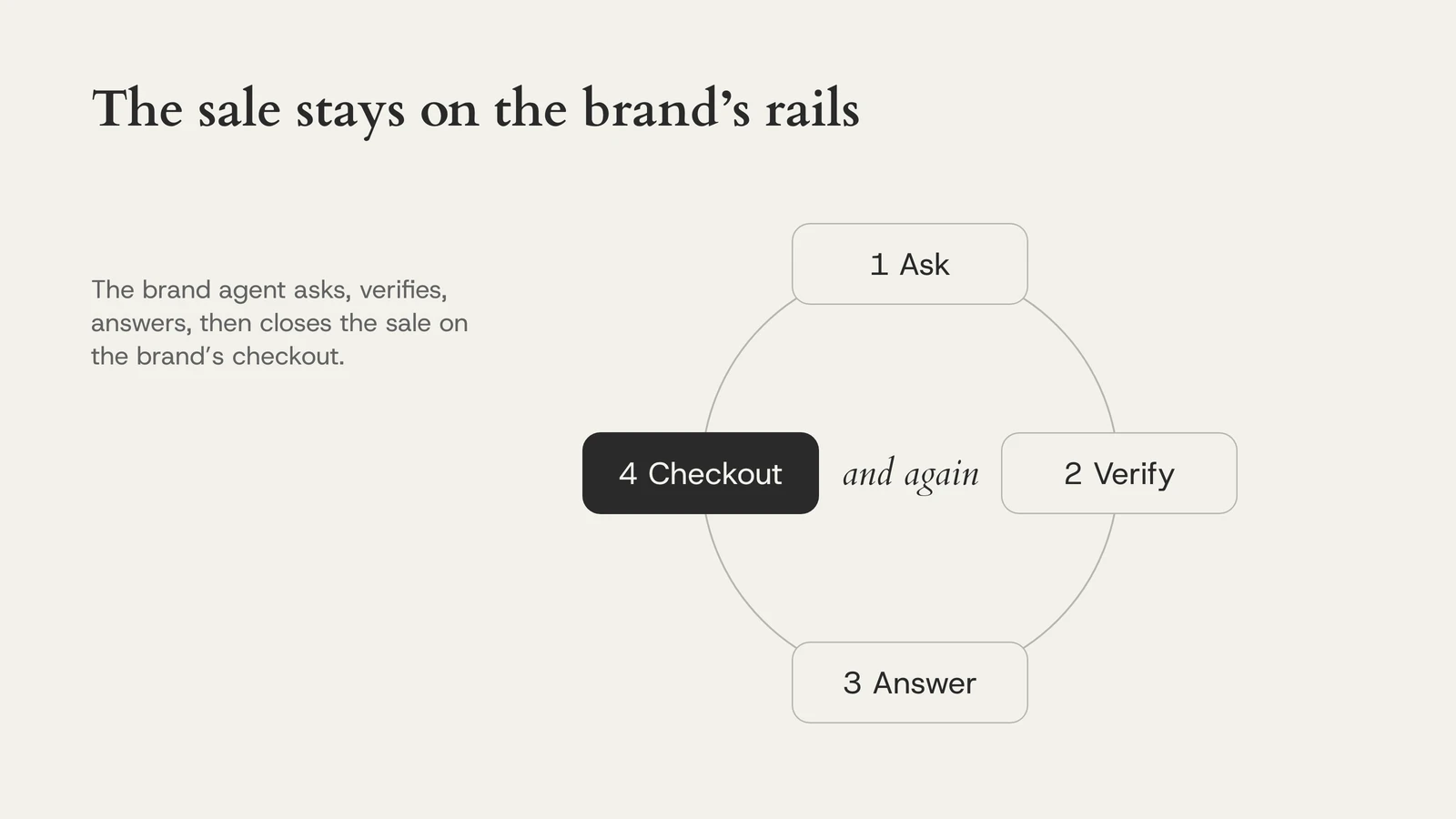
For applicable merchant-hosted integrations, the company remains merchant of record and checkout stays on its rails. Current availability can vary by geography, platform, merchant, and approved integration, so verify first-party documentation before committing engineering work.
The lifecycle is covered in more depth in what agentic checkout requires.
Do next: test a changed total, an unavailable size, a declined payment, an expired request, and a duplicate request in an approved test environment.
6. Eleven scenarios expose distinct operational risks
Use a purposive set of 11 scenarios because each one targets a different failure mode. This is an editorial testing framework, and it does not claim superiority over every other sample design.
| Scenario | Required pass condition |
|---|---|
| Standard item | Correct item, price, stock, cart, and confirmation |
| Sale item | Sale amount and validity agree across source, page, and cart |
| Out-of-stock item | The flow blocks an invalid purchase |
| Preorder | Availability date and terms remain clear |
| Variant product | Requested size and color survive every step |
| Product without a GTIN | The permitted identifier treatment is used |
| Restricted destination | Shipping rules apply before completion |
| Declined payment | No paid order is created |
| Duplicate request | One intended purchase produces one logical order |
| Changed cart total | The current total receives valid authorization |
| Cancellation or support handoff | The supported order state and next action are recorded |
For each run, retain the source value, page value, returned answer, selected variant, final cart, payment result, and order outcome. Add a screenshot, redacted response, or log reference that another operator can inspect.
Missing means missing.
If a response omits availability, record “not returned.” Product appearance alone cannot substantiate an in-stock finding.
Methodology note: Veliu Editorial Team created this purposive matrix of 11 operational scenarios and six observed surfaces: product source, page, structured data, checkout, payment, and order state. Run it on a recorded test date with a frozen documentation version. Results describe the sampled products and implementation at that time; they do not estimate how often ChatGPT will surface a product.
Why does accurate commerce data matter when an agent buys?
ChatGPT, Gemini, Perplexity, Copilot, and AI Overviews can use different combinations of feeds, schema.org markup, partner catalogs, indexes, and live pages when producing product answers. Each system and feature has its own access, selection, and citation behavior.
A clean product record can make an offer easier to read, compare, and cite. The shopping surface still controls which products it selects and how it orders them.
Return to the black size 10 shoe. Its title matches the request, yet variant-level stock shows that the requested combination lacks a valid purchase path; the black size 9 and white size 9 remain separate options with their own facts.
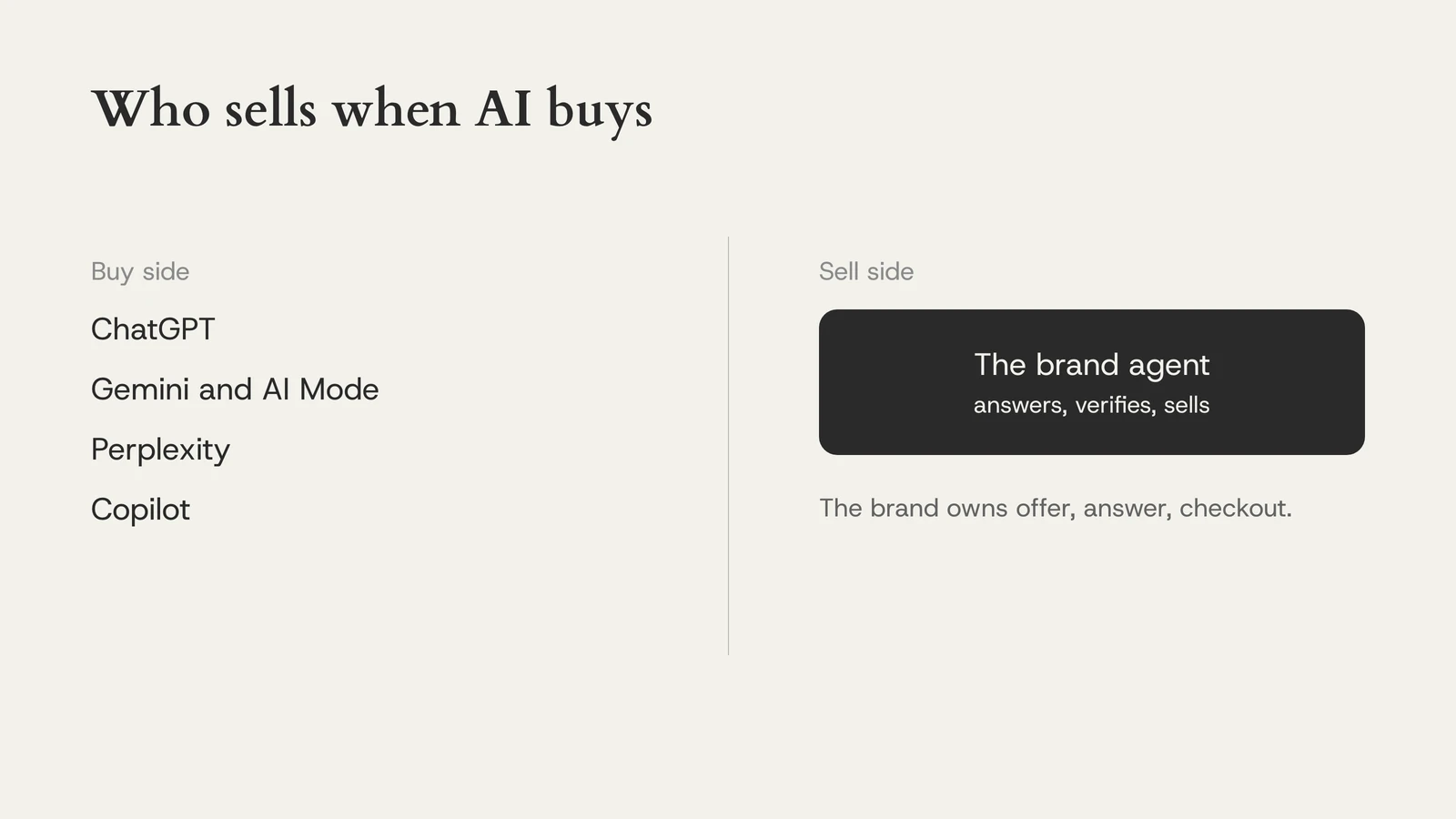
This is the seller side of agentic commerce: shopping agents act for buyers, while the merchant’s systems present accurate choices and complete supported transactions.
Choose the listing path that matches your store
Merchants generally begin with one of three routes:
- Supported commerce platform: check the platform’s current ChatGPT documentation, confirm merchant and category eligibility, review generated product data, and test custom variants and policies.
- Approved direct integration: use OpenAI’s current commerce and feed documentation, follow the documented submission route, validate records, and implement only the commerce functions available to that merchant.
- No current enrollment route: keep pages, structured data, product facts, and checkout accurate while monitoring OpenAI and platform documentation.
Public documentation available on September 21, 2026 does not establish universal access or a fixed onboarding timeline for every merchant. Budget the launch only after geography, platform, category, and enrollment are confirmed.
Measure acceptance, accuracy, and completed orders separately
A system can accept a record while returning the wrong variant. It can also return the correct variant while checkout fails.
| Measure | Method | Evidence |
|---|---|---|
| Product-source acceptance | Record accepted and rejected items | Submission result and source version |
| Required-field completeness | Divide complete sampled SKUs by all sampled SKUs | Field-level sample export |
| Identifier validity | Validate assigned GTINs and permitted alternatives | Validator output and source record |
| Variant accuracy | Compare requested choice with response and cart | Query, item ID, and cart record |
| Price accuracy | Compare response and cart with the current source value | Timestamped source, page, and cart |
| Availability accuracy | Compare returned state with inventory and page state | Inventory log and response |
| Propagation latency | Time a controlled change across each handoff | Timestamped change log |
| Duplicate handling | Repeat an approved test request under documented rules | Order count and redacted responses |
| Payment result | Test approved and declined outcomes | Payment-provider result and order state |
| Order confirmation | Match item, variant, total, and payment | Order record and confirmation payload |
Label every result with the test date, source or specification version, sample definition, and evidence location. A 100% price-accuracy result across 10 sampled SKUs describes those 10 SKUs on that date.
The operational handoff starts with one owner
Assign one accountable owner for consistency across the commerce platform, product source, page, structured data, cart, and policies. Give that owner named contacts for inventory, payments, fulfillment, and customer support.
Then repeat the 11-scenario matrix after a price rule, inventory connector, policy, specification, checkout component, or platform changes. The earlier wrong-size problem closes here: the identifier preserves the requested variant, the stock check rejects an unavailable combination, and the recorded order confirms what the shopper authorized.
Veliu’s brand agent studies the market, readies the store, and sells to people and to the AI shopping agents that arrive. Catalog normalization, feeds, and commerce endpoints support accurate prices and valid variants; on the brand’s domain, approved components and permitted signals can shape the selling experience, answer shopping agents machine to machine, and return the questions customers asked. Checkout stays on the brand’s rails for supported merchant-controlled integrations.
Run the controlled out-of-stock test at a recorded time today, and keep the six timestamps with the launch ticket.
The next paper, when it is written.
One email per paper, and nothing else.
Subscribe