

In brief. An agentic storefront is a conversational shopping experience layered onto an existing ecommerce site. It interprets a shopper’s question, retrieves current facts from a canonical catalog, and assembles relevant cards, comparisons, and explanations, while each AI engine retains control over its own selections and citations.
- An agentic storefront can only present dependable choices when product identities, variants, prices, stock, and categories are current and explicit.
- A polished conversational interface cannot repair a detached size variant or conflicting offer price at response time.
- Structured canonical records can make products easier for AI engines to read and match, while each engine controls selection and citation.
- The safest launch starts with one measurable shopping question tested against 25 live SKUs.
An agentic storefront is a store experience that assembles approved selling components around each visitor’s request, serving people and AI buying agents on the brand’s own domain. On a merchant site, it turns shopper questions into product cards, comparisons, and explanations using current canonical catalog data, meaning one governed product record for each identity and variant.
When size, price, stock, or variant relationships are wrong, those errors can surface directly in the buying journey. A blue age-7 sweatshirt detached from its parent product may appear as a separate item, lose its other colors, or show the parent’s stock instead of the child variant’s availability.
For ecommerce founders, the task is practical: give every product identity, variant, price, stock state, size, and category one current meaning. That structure can also make the catalog easier for ChatGPT and Gemini to read and match, while each engine retains control over what it selects or cites.
The essential agentic storefront terms
An agentic storefront is a store experience that assembles approved selling components around each request, using questions, permissioned context, and current catalog facts, and serving both human shoppers and AI buying agents. This is a working definition for unsettled 2026 terminology, and implementations carrying the label can differ.
The experience commonly starts from an existing storefront with navigation, category pages, accounts, and checkout still available. A shopper might ask, “What fits a 7-year-old who loves drawing?” The system then narrows available products by age, size, activity, stock, and compatible accessories when those fields exist.
That boundary matters.
Generative UI, or a user interface assembled from brand-approved components for the current request, might show three product cards plus a care comparison and size filter; the composition itself, and where it must stop before checkout, is the generative UI question. Customer context means permissioned information such as purchase history or a known size; an 11-month-old size should remain visible and correctable.
Canonical catalog means one current, normalized record for each product identity, including explicit parent and variant relationships. “ACME Kids Tee,” “Acme kids t-shirt,” and its red size-7 child must resolve to the correct shared product and sellable variant.
Shopping agent means software that can interpret intent, retrieve and compare products, assemble a cart, or coordinate checkout through available catalog and transaction interfaces. A generated cart still fails when it contains an unavailable child stock keeping unit, or SKU, the merchant’s internal product code.
Verdict: the interface and catalog form one stack
The shopper-facing layer renders cards, filters, and explanations. The machine-readable layer can expose feeds, schema.orgMachine-readable schema.org markup (Product, Offer, AggregateRating) embedded in a page as JSON-LD. It is the canonical way to hand engines unambiguous product facts.Read more markup, and clean product records to retrieval or shopping systems associated with ChatGPT, Gemini, Perplexity, and Copilot, although exact inputs and ingestion paths differ by engine.
| Layer | Primary user | What it provides | Failure when data is weak |
|---|---|---|---|
| Conversational storefront | Customer | Product cards and guided comparisons | Wrong size or irrelevant products |
| Machine-readable catalog | Retrieval and shopping systems | Feeds, schema.org fields, clean records | Products become harder to match accurately |
The appeal is obvious: add a conversational box and call the work complete. The evidence does not support it: the OpenAI product feed specification, Google Merchant Center product data specification, and schema.org Product vocabulary require explicit fields for products, identifiers, offers, and relationships.
Schema.org defines an Offer as “an offer to transfer some rights to an item or to provide a service.” That distinction is blunt and useful because a product identity and its current price, currency, and availability are separate facts that must still connect correctly.
The operating goal is a defensible shortlist
Count the actions between “Which jacket is waterproof in size 8?” and a set of eligible products. Then measure how many presented claims are supported by current fields for size, material, availability, and price.
Accuracy needs its own measure.
Track wrong-price and wrong-stock incidents per 1,000 generated product presentations, plus catalog coverage for identity, variants, size, price, availability, and taxonomy, meaning the standard category hierarchy used to classify products. A fast journey built on an old stock field remains a failed journey.
The terminology is still unsettled in 2026. “Agentic storefront” can describe a merchant-site experience or product availability in external AI channels, so a team should name the surface it is building before choosing software and metrics.
Five steps connect the question to catalog truth
A practical implementation keeps the familiar entry point, interprets the shopper’s request and permitted context, converts intent into catalog constraints, retrieves eligible canonical records, and composes the comparison interface.
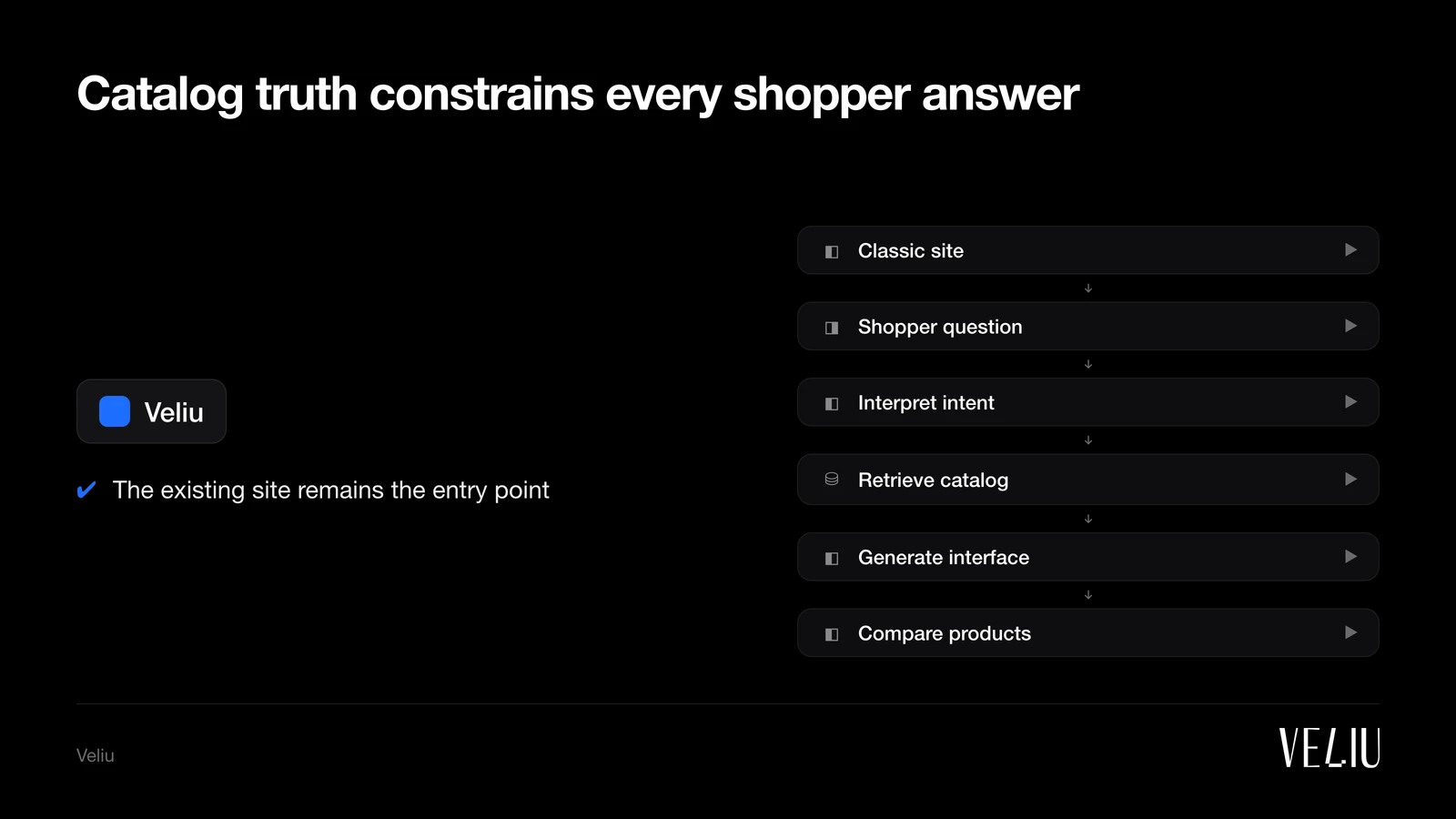
A known-SKU shopper may use search. Someone asking for “a washable gift for a child who draws on every surface” benefits from guided interpretation because the request spans age, activity, care instructions, stock, and accessory compatibility.
Use context to narrow the catalog while keeping every product fact grounded in approved data. If a parent bought newborn clothing 7 years ago, current age and confirmed size can narrow results, but purchase history cannot create a missing care instruction or infer live stock.
Questions then become field checks. “Which is machine-washable?” maps to approved care data, while “What fits a 7-year-old?” maps to age range, size, and availability; when a required field is absent, the interface should state that gap or omit the unsupported claim.
This is where prose meets inventory.
A comparison request may produce three cards with care, size, price, and stock columns. Each card still needs the correct child variant, image, currency, current offer, and available size before its polished layout is useful.
Catalog accuracy sets the boundary
Price, stock, parent-variant relationships, size, identifiers, attributes, and taxonomy alignment define what the interface can safely present. Consider an illustrative backpack priced at $42 on its page and $37 in its feed: if retrieval uses one source while checkout uses the other, the customer receives a confident wrong price.
Google documents feed and landing-page consistency because mismatches can cause item-level issues. The same mechanism applies to availability, since a parent marked in stock does not establish that its green size-7 child SKU is available.
Audit one customer journey against this matrix before designing more interface states:
| Catalog dimension | Required source | Shopper failure | Diagnostic |
|---|---|---|---|
| Product identity | Brand, model, SKU, GTIN or MPN | Duplicate or merged products | Identifier validity |
| Parent and variant | Parent ID and child attributes | Wrong color or size | Orphan-child count |
| Price and currency | Governed offer source | Wrong checkout price | Cross-surface divergence |
| Availability | Inventory system | Unavailable card shown | Update latency |
| Size and fit | Product data and size guide | Unsuitable shortlist | Coverage by category |
| Taxonomy | Standard category mapping | Irrelevant matching | Mapping confidence |
| Images | Approved image source | Wrong variant image | Image-to-SKU check |
Stable identity comes first
Confirm brand, model, SKU, and GTINThe GS1 Global Trade Item Number, the identifier that lets engines merge your offer with the same product sold elsewhere. A valid GTIN is numeric, 8 to 14 digits, with a GS1 check digit.Read more, the globally unique barcode number, when the manufacturer assigned one. Where no GTIN exists, use MPN, the manufacturer part number, with the brand.
A fabricated barcode can cause an offer to be matched or merged with the wrong product, depending on the platform. Test awkward cases too: a red size-6 pajama set and a red size-7 pajama top share words while remaining separate sellable units.
Offers must agree across surfaces
Compare the visible page, schema.org markup, feed, and commerce endpoint for price, ISO currency code, and the schema.org availability value. Contradictions can trigger item-level disapproval, automatic correction, or weaker visibility for affected offers, with consequences varying by platform.
Choose a maximum update delay for each surface. A limited-stock fashion drop and a made-to-order table carry different risks, so record timestamps and test the slowest destination.
Taxonomy needs reviewable confidence
Google Product Taxonomy alignment gives a product a standard category path. Grade every mapping by confidence, from a full exact-path match down to unresolved, and send ambiguous products to human review; a confidence grade describes the mapping and does not establish external performance.
An unresolved art kit needs review. An exact path indicates a precise category-path match inside that grading, while each destination still controls its own use of the record.
That closes the backpack problem raised earlier: the governed $42 offer must reach the page, feed, markup, and endpoint within the merchant’s chosen update limit. One price, one identified variant, every relevant surface.
Why this decides whether AI agents can buy from you
ChatGPT, Gemini, Perplexity, Copilot, and AI Overviews increasingly use structured product information from feeds, schema markup, merchant catalogs, or web indexes, but the source mix and ingestion route vary by platform. Accurate normalized records can be easier to retrieve, match, and cite because identity, category, price, and availability are explicit. The traffic is no longer marginal: Adobe Analytics measured AI-referred visits to US retail sites up 393% year over year in Q1 2026, converting 42% better than non-AI traffic in March 2026, while product detail pages scored worst of all retail page types on machine readability.
This is the catalog foundation of generative engine optimization for ecommerce. Veliu approaches it through Agentic Selling, the seller-side discipline within agentic commerce: the brand agent studies how the category gets shopped, prepares the storefront so every record holds up, and sells to people and to AI buying agents on the brand’s own domain, with catalog readability and taxonomy alignment handled as part of that preparation. Merchants govern product data, prices, merchandising, and reviews, while engines decide what they display.
The operational benefit remains correction. When one size changes stock, a merchant can update the identified child offer and measure propagation across surfaces instead of searching through conflicting descriptions.
Measurement must separate accuracy from external visibility
Measure factual quality inside the merchant experience separately from presence in external AI answers. The latter is observable through repeated tests, while the engine controls selection and citation.
| Metric | Definition | Decision enabled |
|---|---|---|
| Supported-field coverage | Presented claims backed by current fields | Block unsupported answer types |
| Wrong-fact rate | Incorrect price, stock, or specification presentations | Repair the riskiest field |
| Source divergence | Disagreement across page, feed, markup, or endpoint | Fix the failing source |
| Propagation latency | Time from a change to each surface | Assign refresh ownership |
| Successful shortlist rate | Sessions returning valid eligible options | Improve retrieval or coverage |
| External answer presence | Appearance in a fixed prompt set by engine | Observe AI visibility |
Methodology note: test 30 real store questions in one category, record the engine, date, catalog version, expected fields, and observed products, then compare every claim with the live source of truth. This sample diagnoses local failures; it cannot establish catalog-wide performance or predict future engine behavior.
The most common implementation mistakes
Starting with cards before catalog cleanup hides identity and offer defects until customers see them. Collapsing parent and child availability can then show an in-stock jacket whose requested size has sold out.
Uncorrectable context creates a second failure. A remembered size needs permission, a visible effect, and a correction control because last year’s size may be stale today.
Price divergence is equally concrete: the page, feed, schema, and endpoint need an authoritative offer source and currency. Session length alone cannot show whether those facts were correct.
Shopify made the term a default-on feature
Since March 24, 2026, “agentic storefronts” is also a live Shopify feature: catalog syndication to ChatGPT, Google AI Mode and Gemini, Microsoft Copilot, and Meta, active by default for eligible stores under Shopify’s Agentic Storefronts Supplemental Terms. Where the buyer pays differs by channel: ChatGPT purchases complete on the merchant’s own store, while Copilot and Google AI Mode run an embedded direct checkout, and Shopify’s agent documentation exposes the whole catalog to agents from a single endpoint. Verify the enabled channels, the per-channel toggles, and the current first-party documentation inside your own admin before implementing a dated setup path.
The distinction affects measurement. A merchant-site experience can be tested against its own product records, while an external AI channel also depends on the destination’s ingestion, eligibility, and selection rules.
Verdict: start with one testable shopping journey
- Choose a question such as “Find an in-stock, machine-washable coat in size 8.”
- Check identity, variant, care, size, price, currency, availability, and taxonomy across 25 live SKUs.
- Establish governed product and child-variant records for the fields that fail.
- Compare page, feed, schema, and endpoint after each price or stock change.
- Permit the generated interface to present claims supported by current approved fields.
The next operational step is to run that size-8 coat question against 25 live SKUs and repair every unsupported field before expanding the interface.
Authors: Elyas Tirit, Founding Designer & Builder at Veliu, and Azra Hadziabdic, Co-Founder & Founding Product Engineer at Veliu. Updated August 10, 2026.
The next paper, when it is written.
One email per paper, and nothing else.
Subscribe