
In brief. A credible agentic storefront does not generate an unconstrained ecommerce application for every shopper. It selects and configures brand-approved components using permissioned customer context and canonical product data. Shoppers must be able to inspect and correct remembered context, while price, stock, cart, consent, payment, and checkout remain governed by deterministic rules.
- An agentic storefront should select from thousands of brand-adaptable, domain-agnostic components because bounded composition reduces runtime code failure and hallucination risk.
- Google Research’s Generative UI beat standard markdown in 82.8% of retained LMArena pairwise comparisons, while human-expert websites beat Generative UI in 56.0% and generation speed was excluded.
- A remembered size, prior purchase, scroll, or click may change the next component only when that context is permissioned, visible, and correctable before it changes a shortlist.
- A product card cannot repair missing care data, an orphaned size variant, or conflicting prices because each generated claim still requires an explicit, current catalog field.
- ChatGPT, Gemini, Perplexity, Copilot, and AI Overviews can more readily read and match products when identity, variants, offers, availability, and taxonomy are structured, while each engine controls selection and citation.
Google Research’s generated interfaces beat standard markdown in 82.8% of retained LMArena pairwise comparisons, but that result does not justify generating an ecommerce stack at runtime. A storefront carries prices, stock, consent, payment, and identity state that a visually persuasive interface can still mishandle.
For merchants, the design question is therefore narrower: how can ChatGPT, Gemini, Perplexity, Copilot, AI Overviews, and a merchant’s own adaptive storefront consume the same product truth without giving a model unchecked control? The operating boundary is clear: agents may compose presentation while governed systems retain commerce state.
This paper presents my design position alongside five cited sources published from November 2025 through July 2026, including Google Research evaluations of 92 retained LMArena prompts and 64 manually selected information-seeking queries.
The agent should compose a storefront from governed components
My central design stance is dynamic bounded composition. The agent has “thousands of agnostic pre-components” and chooses in real time what to show, which data to place inside each component, and which approved layout suits the task.
That distinction matters.
A domain-agnostic component is a reusable interaction pattern, such as a comparison grid, size selector, product carousel, or care panel, whose content and visual tokens can be adapted to a brand. The agent can select three coat cards and add a size filter, but it does not invent a new cart implementation or unreviewed JavaScript for every request.
The popular belief is that a truly generative storefront must code the entire experience from scratch. The evidence challenges that belief: Google Research’s implementation required detailed system instructions, tool access, and post-processors that repaired JavaScript parsing, CSS, HTML, API, citation, and hallucinated-asset problems.
My component grammar applies the same lesson to commerce with equal effectiveness, greater safety, and tighter control over the brand.
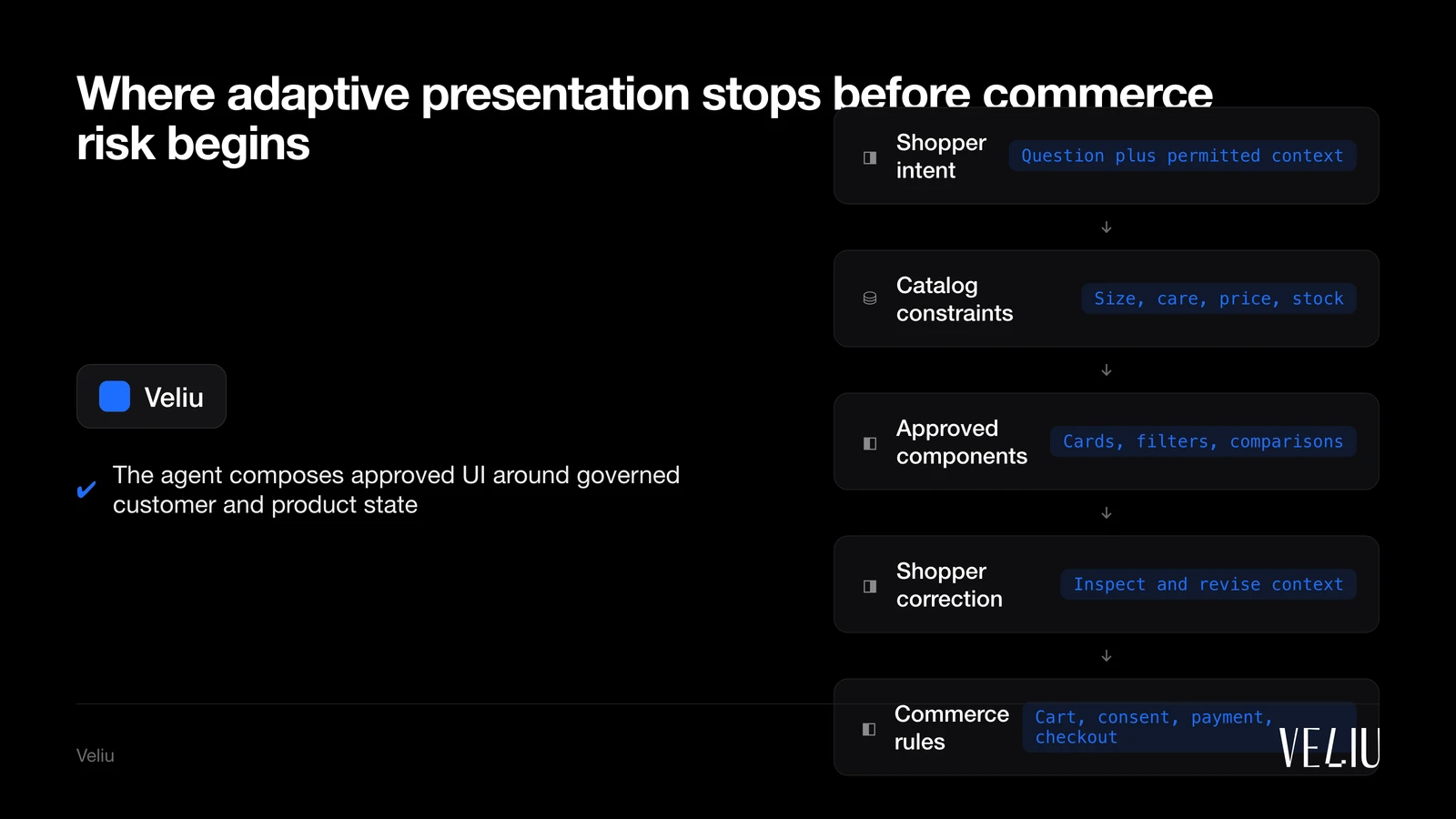
The component library still needs breadth. A fashion merchant may need a virtual try-on panel, a prior-purchase pairing, and a cross-sell layout, while a tile seller may need a quantity calculator. The grammar governs which structures are available and which fields each structure is allowed to claim.
Behavioral signals should change the interface only under shopper control
Prior purchases, dwell time, scrolling, clicks, carousel engagement, cross-sell layouts, and virtual try-on can all provide signals that influence the next interface. A shopper who repeatedly engages with carousels may see another carousel, and a past fashion purchase may support a pairing view with a current item.
Observation alone is insufficient permission.
A remembered size can narrow a shortlist only if the interface shows that memory, identifies its source or age when available, and provides an immediate correction control.
The agent should ask for the shopper’s size before generating the interface or state in the results overview, “I selected these products in size Y. Let me know if you need a different size.”
Generative UI is persuasive, but it is not yet a safe checkout substrate
Google Research evaluated 100 randomly sampled LMArena prompts, removed 8, and sent each pairwise result to 2 human raters. Generative UI beat standard markdown in 82.8% of comparisons, while human-expert websites beat Generative UI in 56.0%; a separate set contained 64 manually selected information-seeking queries.
Speed was excluded.
The paper says generation can take “a minute or two” and documents occasional JavaScript, CSS, and HTML errors. Those limitations support generated presentation and guided choice, but they argue against runtime invention of sizing state, price calculations, stock commitments, consent, payment, and checkout.
The safe boundary is operational: a model may choose an approved comparison component and explain why three products fit the request, while current prices and availability come from governed offers. Once the shopper selects a specific stock keeping unit, or SKU, the experience should transfer that selection to the merchant’s existing site checkout, where deterministic systems validate the cart, stock, price, consent, payment, and order. This separation between buy-side agentic commerce and seller-side Agentic Selling means the agentic storefront supports consideration, but the shopper explicitly approves high-stakes actions in the site’s governed checkout.
Catalog truth sets the ceiling for every generated shopping experience
A polished card cannot create a missing care instruction, but a governed enrichment process can attempt to recover one. If a shopper requests a machine-washable size-8 coat and the care field is absent, the system can identify the exact product and search current online sources and the existing product database for the missing attribute.
Recovered data should not become catalog truth automatically. Suggested attributes enter the merchant’s dedicated agentic storefront trainer for human review, where the merchant can verify the product match, inspect the supporting evidence, and approve or reject each addition before publication.
The same mechanism applies to identity and offers. A blue size-8 coat detached from its parent can be matched to the correct product family, restoring its relationship to other colors and variants. Conflicting prices or availability signals must remain unresolved until checked against the merchant’s governed offer data.
When the evidence falls below the configured confidence threshold, the interface should not present the suggestion as verified. It should retain the existing catalog value or disclose the uncertainty with an orange warning, omit unsupported claims, and offer confirmed alternatives or a way to broaden the request.
Canonical catalog data therefore means one current, governed record for each product identity and sellable variant, supplemented by traceable, merchant-approved enrichment. It connects identifiers, parent-child relationships, price, currency, availability, taxonomy, and approved attributes so every generated sentence can resolve to a verified field or be withheld.
AI visibility begins with the same structured facts the storefront consumes
ChatGPT, Gemini, Perplexity, Copilot, and AI Overviews can more readily read and match products when identity, variants, offers, availability, and taxonomy are explicit in feeds, schema.orgMachine-readable schema.org markup (Product, Offer, AggregateRating) embedded in a page as JSON-LD. It is the canonical way to hand engines unambiguous product facts.Read more markup, canonical records, and supported endpoints. The exact ingestion path differs, and each engine retains control over selection and citation.
Google’s Business Agent makes the dependency concrete: Google says it uses Merchant Center information, a merchant’s website, and additional supplied business data to answer questions such as what a rug is made of, whether shoes fit true to size, or how many tile boxes are needed. Conversational presentation still depends on merchant-supplied facts.
This closes the opening question. The internal adaptive storefront and external AI surfaces need the same governed facts, even though their interfaces differ—a distinction clarified by how a standing brand agent goes beyond session-bound answering. Veliu can crawl and normalize a catalog into a canonical, taxonomy-aligned structure that is easier for engines to read and match, while merchants still control product data, prices, reviews, and commercial policy.
Design accountability grows when the interface becomes adaptive
Adaptive interfaces expand the designer’s responsibility from fixed screens to component grammar, signal policy, uncertainty states, correction controls, accessibility, and regulatory constraints. The model may select the final arrangement, but people still define the permissible system.
Rachel Eardley and Emma Tonkin state the requirement bluntly: designers must “retain accountability.” Their April 2026 position paper specifically includes coherent information architecture and consistent attention to regulatory requirements among the responsibilities that generative UI can overlook.
The Microsoft-led CHI 2026 workshop likewise frames generative UI as a change to human-computer interaction practice, with approximately 35 expected participants discussing how methods, workflows, and user experiences should evolve. Neither source establishes that a specific governance model is complete, but both reject the idea that generation removes design responsibility.
At Veliu, we are applying a practical form of generative UI that works within current technical and commercial constraints: governed components, permissioned context, canonical catalog facts, and deterministic controls for high-stakes actions. This makes the approach usable now while preserving the broader vision for further adaptation as the technology matures.
What this means for you
- Start with one shopping question, such as finding an in-stock, machine-washable coat in size 8, and test it against 25 live SKUs before expanding the interface.
- Map every displayed claim to a current catalog field; disclose a missing field or omit the claim.
- Define which approved components may adapt, which signals may select them, and which remembered facts the shopper can inspect and reverse.
- Keep price, stock, cart, consent, payment, checkout, and outbound contact behind deterministic validation and explicit approval.
- Record failures by catalog field and component state, then fix the governed source before adding another adaptive layout.
The next build step is concrete: run the size-8 coat journey against 25 live SKUs and block every component state that cannot trace its claims to current fields.
Method and limitations
This is a qualitative synthesis of my design position, the Veliu implementation guide for catalog and permission boundaries, Google Research’s published Generative UI evaluation, Google’s Business Agent documentation, and two April 2026 HCI practice sources. I compared my claims with reported mechanisms, sample definitions, evaluation conditions, and stated limitations; no new user study, merchant test, or catalog audit was conducted.
The commercial premise is that a governed agentic layer can provide expert, emotionally attuned, and persuasive guidance while supporting relevant upsell and cross-sell opportunities. Early Veliu implementations indicate meaningful conversion potential, but those results are not independently validated or attributable solely to the component architecture proposed here. Forthcoming case studies with international B2C and B2B brands will document implementation conditions and observed outcomes in greater depth.
The evidence reviewed here does not establish effects on conversion, safety, latency, or shopper trust. Google Research evaluated broad generated websites, excluded generation speed, and did not test live checkout. My design position also leaves prohibited behavioral optimization and the claimed missing-data solution unresolved.
Sources
- Veliu, “What Is an Agentic Storefront? A Guide for Ecommerce Founders”
- Leviathan et al., “Generative UI: LLMs are Effective UI Generators”
- Google Research, “Generative UI: A rich, custom, visual interactive user experience for any prompt”
- Microsoft Research, “What does Generative UI mean for HCI Practice?”
- University of Bristol, “Generative UI Reshapes Design Practice, Not Design Relevance”
- Google, “Get started with Business Agent”
Cite this paper
Tirit, E. (2026). The Agentic Storefront Needs a Component Grammar. Veliu Research Lab. https://veliu.com/en/research-lab/agentic-storefront-needs-a-component-grammar
The next paper, when it is written.
One email per paper, and nothing else.
Subscribe