In brief. Agentic selling for brands is the seller side of agentic commerce: the brand’s own agent studies the market, readies the store, and sells to people and to AI shopping agents, in the brand’s voice and inside its rules. It is a different job from AI for sales teams, and platform agents from Google and Microsoft cover only part of it. Checkout stays on the brand’s rails, and measurement runs from factual accuracy to checkout handoff.
- Agentic selling gives a brand agent a seller-side mandate across market study, store readiness, and selling within approved rules.
- Consistent price, stock, identifiers, variants, and policies make product facts easier for AI shopping engines to retrieve and use.
- ChatGPT, Gemini, Perplexity, Copilot, and AI Overviews control their own ranking, citation, and recommendation decisions.
- A credible program freezes a day-zero baseline and measures factual accuracy through the checkout handoff.
- In Veliu’s operating model, discovery can happen on AI surfaces while checkout stays on the brand’s rails.
Agentic selling for brands is the seller side of agentic commerce: a brand agent studies the market, readies the store, and sells for the brand. The agent belongs to the brand. It serves people and the AI shopping agentsSoftware agents that search, compare and complete purchases on a buyer's behalf. They read structured catalog data and transact through protocols like ACP and MCP.Read more that buy for them, in the brand’s voice and inside its rules, while checkout, payment, fulfillment, and the customer relationship stay with the brand.
A wrong or conflicting price can remove a product from consideration before a shopper reaches your store, depending on the engine and shopping surface. US brand and ecommerce operators now face buyers who ask ChatGPT, Gemini, Perplexity, Copilot, and AI Overviews to research products, compare offers, and narrow a purchase.
This guide gives you a responsibility map, three core seller moments that feed each other, a readiness checklist, and a measurement framework. Each engine controls its own recommendations and selection decisions.
The wider shift is covered in Agentic Commerce: Who Sells When AI Buys?. Here, the focus is what a brand can own and operate.
Is agentic selling the same as AI for sales teams?
No. In B2B sales technology, “agentic selling” also names software that qualifies leads, researches prospects, drafts replies, and updates the CRM for a sales team. Agentic selling for brands is a different job: the brand’s own agent sells products to shoppers and to the AI shopping agents that buy on their behalf. The first automates a sales pipeline. The second is the seller side of agentic commerce, the meaning used on this page and the one Veliu’s founding paper, Buying Went Agentic. Selling Is Next., puts in one line: “We call it agentic selling, the seller side of agentic commerce.”
Agentic selling gives the seller a clear mandate
A brand agent represents one brand’s offer, voice, and commercial rules. Its mandate can include answering whether a $240 leather bag arrives by Friday, guiding a visitor toward an eligible color, and supplying an AI shopping agent with current variant facts.
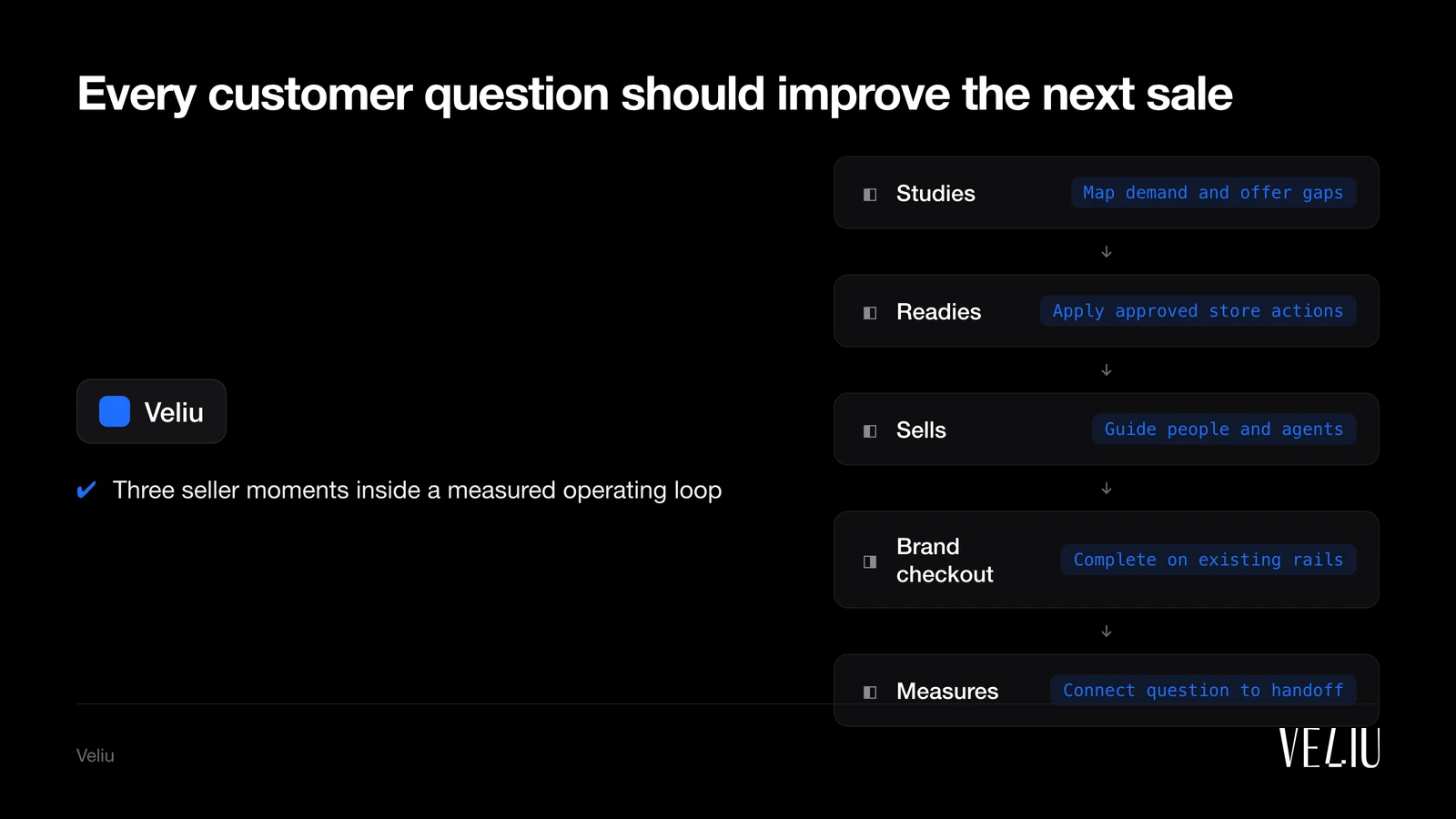
Three seller moments organize the work: studies, readies, and sells. Observation finds gaps. Store action resolves them, and selling generates questions that inform the next cycle.
The boundary matters.
The brand owns the customer relationship, order, payment flow, fulfillment promise, and return policy. Checkout uses the brand’s existing commerce rails. Other marketplace and merchant-of-record models can assign those responsibilities differently.
This gives the seller a clear principal when buyer-side systems act on a shopper’s behalf. A fuller explanation of the product role appears in What Is a Brand Agent?.
Evidence: commerce infrastructure is becoming actionable
Google said at NRF on January 11, 2026 that its Shopping Graph holds over 50 billion product listings, with more than 2 billion refreshed every hour. These figures describe Google’s graph. They indicate the scale and freshness of the product substrate behind Google shopping experiences, while offering no measure of total AI-shopping adoption. See Google’s NRF 2026 remarks.
Public protocols show movement from product answers toward authorized commerce actions. The Agentic Commerce Protocol repository, or ACP, documents product and checkout exchanges. Google launched the Universal Commerce Protocol, or UCP, on January 11, 2026, co-developed with Shopify, Etsy, Wayfair, Target, and Walmart, to cover the journey from discovery through checkout.
Google published the Agent Payments Protocol, or AP2, in September 2025 for signed purchasing mandates. Specific token controls and deployment maturity vary by payment provider.
The appeal is obvious: connect an agent and sales become automatic. The evidence does not support that shortcut. Current implementations still need coherent product records, valid variants, policy facts, authorization, checkout integration, and measurement across independently operated surfaces.
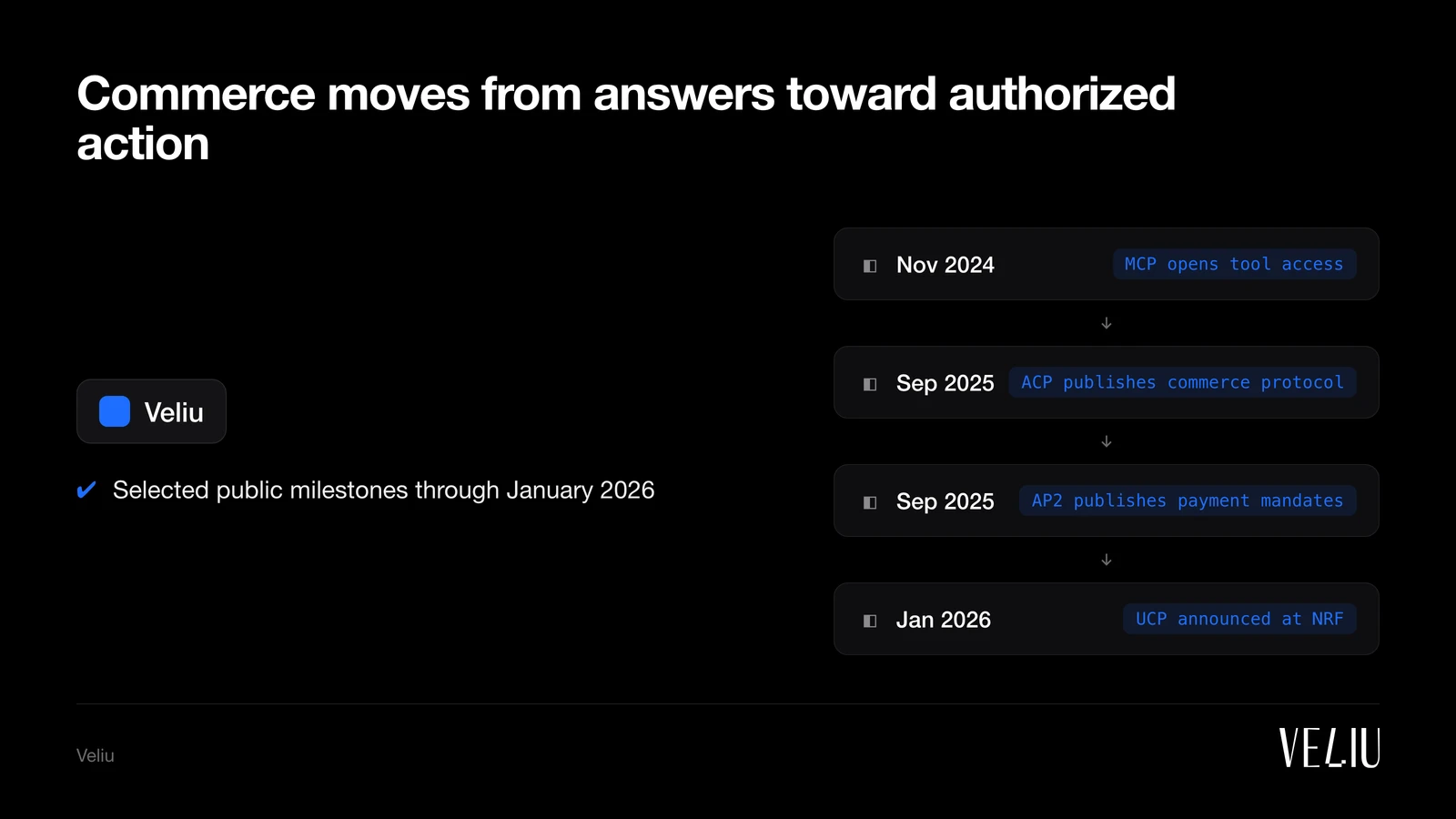
Methodology note: This timeline uses dated announcements and public repositories from MCP, ACP, AP2, and UCP. Protocol publication shows infrastructure activity. Adoption across merchants, consumers, markets, and payment providers remains uneven.
How is agentic selling different from agentic commerce?
Agentic commerce is the wider system in which software can interpret intent, find products, form carts, authorize payments, and complete orders. Agentic selling is the seller-side craft within that system. Every agentic transaction still has a seller, and the seller’s side is the half a brand can run.
| Responsibility | Buyer-side agent | Brand agent | Commerce infrastructure | Brand/operator |
|---|---|---|---|---|
| Mandate | Fulfill the shopper’s request | Sell within brand rules | Carry data and actions | Set objectives and boundaries |
| Principal | Shopper | Brand | Protocol participant | Brand and merchant entity |
| Inputs | Intent, budget, preferences | Catalog, policies, market signals | Feeds, APIs, mandates, tokens | Product and operational truth |
| Decisions | Compare and narrow options | Present, guide, and hand off | Validate and transport requests | Approve rules and exceptions |
| Selling surface | Shopping interface | Brand domain and machine interface | Connected endpoints | Owned store and channels |
| Checkout | Initiates or delegates | Guides the handoff | Maintains session state | Hosts checkout |
| Payment | Expresses user consent | Respects authorized scope | Carries mandate or token | Processes through its provider |
| Attribution | Records buyer journey | Connects question to handoff | Supplies event references | Defines reporting rules |
A buyer-side agent asks, “Which carry-on fits a 14-inch laptop and arrives in Austin by Thursday?” The brand agent answers for one brand with an eligible model, a valid black variant, the current price, and an approved delivery promise. Infrastructure carries those facts. The operator remains accountable for their accuracy.
Protocols are enabling layers, and the mandates belong to buyers and sellers. That gives a brand a simple decision rule. Invest in agentic-commerce infrastructure when the gap is connectivity: catalog exchange, checkout interoperability, identity, authorization, or payment. Invest in agentic selling when the gap is representation: who studies demand for the brand, prepares the store, answers at the counter, and turns each question into the next improvement. Most established brands need both: the infrastructure makes the brand reachable, and the seller decides what the brand says once a buyer arrives.
This ownership model also explains why a brand agent differs from a conventional conversational widget: its mandate spans market observation, store readiness, selling, and measurement.
Do Google’s and Microsoft’s brand agents already do agentic selling?
They validate the category and cover part of it. Microsoft launched Brand Agents on January 8, 2026: “AI-powered shopping assistants that speak in your brand’s voice,” installed on the merchant’s own site through Microsoft Clarity (Microsoft Advertising). Google launched Business Agent on January 11, 2026, “a virtual sales associate that can answer product questions in a brand’s voice” inside Search, which eligible U.S. retailers activate in Merchant Center (Google).
Both already speak in the brand’s voice, and Microsoft’s runs on the brand’s own site, so the difference sits in three other places. Independence: a platform’s agent works for the channel that runs it, and that channel also sells ads; the brand’s own agent works only for the brand. The whole craft: the brand’s agent studies the market, prepares the store at the source, sells, and measures from outside. Category education: it arrives already educated on how the category is shopped, and it sells to people and to AI shopping agents with the same competence. A brand can use the platform counters and still own the agent that decides what those counters receive.
Eight terms make the operating model usable
Brand agent: The seller-side agent representing one brand’s offer, voice, and commercial rules.
AI shopping agent: Software acting for a shopper to research, compare, select, or transact under given instructions.
Agentic commerce: The wider system in which agents participate in buying and selling tasks.
Agent view: The store as an external machine can retrieve, parse, and act on it.
Structured product feed: A machine-readable catalog file with fields such as item ID, title, price, currency, availability, image, and identifiers.
Schema.org product data: Page-level labels that identify a product, its offer, and supporting facts in a shared vocabulary.
Agentic storefront: An on-domain selling experience that composes approved components around a visitor’s current need.
GTIN: The Global Trade Item Number, the unique barcode number used to identify many commercial products.
How do the three seller moments feed each other?
The brand agent observes the market from outside the store, studies what buyers and engines encounter, readies approved store elements, sells through human and machine interactions, attributes the handoff, and learns from the questions customers asked.
Catalogs change every day.
Studies: inspect the market from outside
The agent checks how ChatGPT, Gemini, Perplexity, Copilot, and AI Overviews can encounter products across defined prompt patterns. A luggage brand might test “lightweight carry-on under $300,” “weekender with trolley sleeve,” and “carry-on delivered before Friday,” then record cited sources, competing offers, extracted prices, availability claims, and unanswered questions.
External observation exposes the agent view. Reading a private product API proves that an internal record exists. It cannot show whether a public engine retrieved the same price or connected the correct navy, 40-liter variant.
Model training can supply background familiarity. Current price, stock, delivery, and variant facts often depend on retrieval-time sources such as indexes, live fetches, or merchant feeds, and individual systems may cache or combine those sources.
Readies: freeze the baseline before changing data
Before any change, capture a day-zero baseline. Record what external systems extracted, what the feed contained, what the page exposed, and which variants worked. Later improvement needs a dated before state for credible attribution.
The agent then keeps identity, variants, price, availability, shipping, returns, policy constraints, approved components, feeds, schema.orgMachine-readable schema.org markup (Product, Offer, AggregateRating) embedded in a page as JSON-LD. It is the canonical way to hand engines unambiguous product facts.Read more data, and commerce endpoints coherent. Crawling, normalization, taxonomy mapping, feed updates, and endpoint checks support this work so “Size 8, walnut, $189” carries the same meaning across the selling path.
Consider one common failure. The page shows a shoe at $160, its feed says $145, and the size-9 offer leads to an out-of-stock page. An engine may reject the offer, repeat a stale price, or avoid using it, depending on the surface.
Sells: guide the request into brand checkout
On the brand’s domain, the agent can adapt the experience from permitted signals and approved components. A visitor with a gift query may see two eligible products, a material-care explanation, and a delivery option that fits the stated date.
It can also answer shopping agents machine to machine with current product, variant, availability, and policy facts. The checkout remains on the brand’s rails, and the brand remains merchant of record.
How the agent sells on the brand's own domain is explained in What Is an Agentic Storefront?. The practical boundary is clear: the agent composes an approved selling path, then hands the order into existing checkout.
What can a brand control when AI engines choose the products?
ChatGPT, Gemini, Perplexity, Copilot, and AI Overviews can draw on the open web, merchant feeds, partner catalogs, indexes, and live page fetches. Clean product data can make facts easier to retrieve and cite. Recommendation and ranking choices remain proprietary to each engine.
Identifiers help systems connect an offer to a product. A GTINThe GS1 Global Trade Item Number, the identifier that lets engines merge your offer with the same product sold elsewhere. A valid GTIN is numeric, 8 to 14 digits, with a GS1 check digit.Read more can join the same model across sellers. When a product has no GTIN, an MPN, or manufacturer part number, often works with the brand name. Accurate offers, working variants, strong images, crawler access, and fresh inventory give engines clearer evidence.
| Surface | Common substrate | Seller-side artifact | Common failure |
|---|---|---|---|
| ChatGPT Shopping/Search | Product feeds, search index, live fetch | Current feed and accessible product page | Feed price conflicts with page |
| Gemini and AI Overviews | Google Shopping Graph and web index | Merchant Center feed and product markup | Missing GTIN or stale stock |
| Perplexity | Merchant catalog and web retrieval | Complete merchant record and product page | Thin specifications |
| Copilot | Bing index and merchant data | Merchant feed and crawlable pages | Inventory update arrives late |
OpenAI documents OAI-SearchBot for search inclusion separately from GPTBot for model training in its bot documentation. Its evolving product feed specification covers identifiers, offers, media, variants, fulfillment, and eligibility controls. Merchants should validate the current specification during implementation because field groups can change.
Google’s Merchant Center specification requires core fields including ID, title, description, link, image, availability, and price. On the page, schema.org Product and Offer markup can expose corresponding facts. A missing currency code or stale stock value is a machine-level sales defect, even when the page looks polished to a person.
Public protocols establish reality, with uneven capability
Public protocols and live merchant programs show that agentic commerce has moved beyond slideware. End-to-end capability still varies by surface, platform, market, and payment provider.
As of September 2026, the checkout step itself differs by channel. For Shopify merchants, ChatGPT buyers complete the purchase on the merchant’s own checkout, opened in an in-app browser, while Microsoft Copilot, Google AI Mode, and Gemini can run a Shopify-powered direct checkout inside the AI channel when direct checkout is on for that channel, with Google’s version limited to select brands selling to U.S. buyers (Shopify Help Center, Shopify). The agentic checkout guide follows that sequence step by step.
ACP documents product-feed and checkout mechanics, and the agentic commerce protocol comparison sets the protocols side by side. UCP targets a wider journey spanning discovery, cart, checkout, and loyalty. MCP, the Model Context Protocol, gives agents tool access such as product search or inventory lookup; its scope does not define a complete commerce and payment system. AP2 uses signed mandates to bind user intent to cart and payment authorization.
Delegated or agent-scoped payment tokens can include controls such as merchant scope, cart scope, and spending limits. Available controls differ by token product, payment provider, market, and deployment. Merchants should verify the exact authorization boundary with their payment provider before enabling action.
Example: a $350 gift request crosses five boundaries
A shopper asks Gemini for a leather anniversary gift under $350, made without chrome tanning, available in cognac, and deliverable to Boston within four days.
Gemini retrieves candidates from the sources available to it. For one participating brand, the brand agent supplies the current cognac variant, material statement, price, inventory, shipping cutoff, and return policy. If the shopper arrives on the brand’s domain, the agent composes an approved path showing the eligible product, care information, gift packaging, and delivery choice.
The shopper confirms the selection. The agent hands the cart to existing checkout, where the brand processes payment and owns fulfillment.
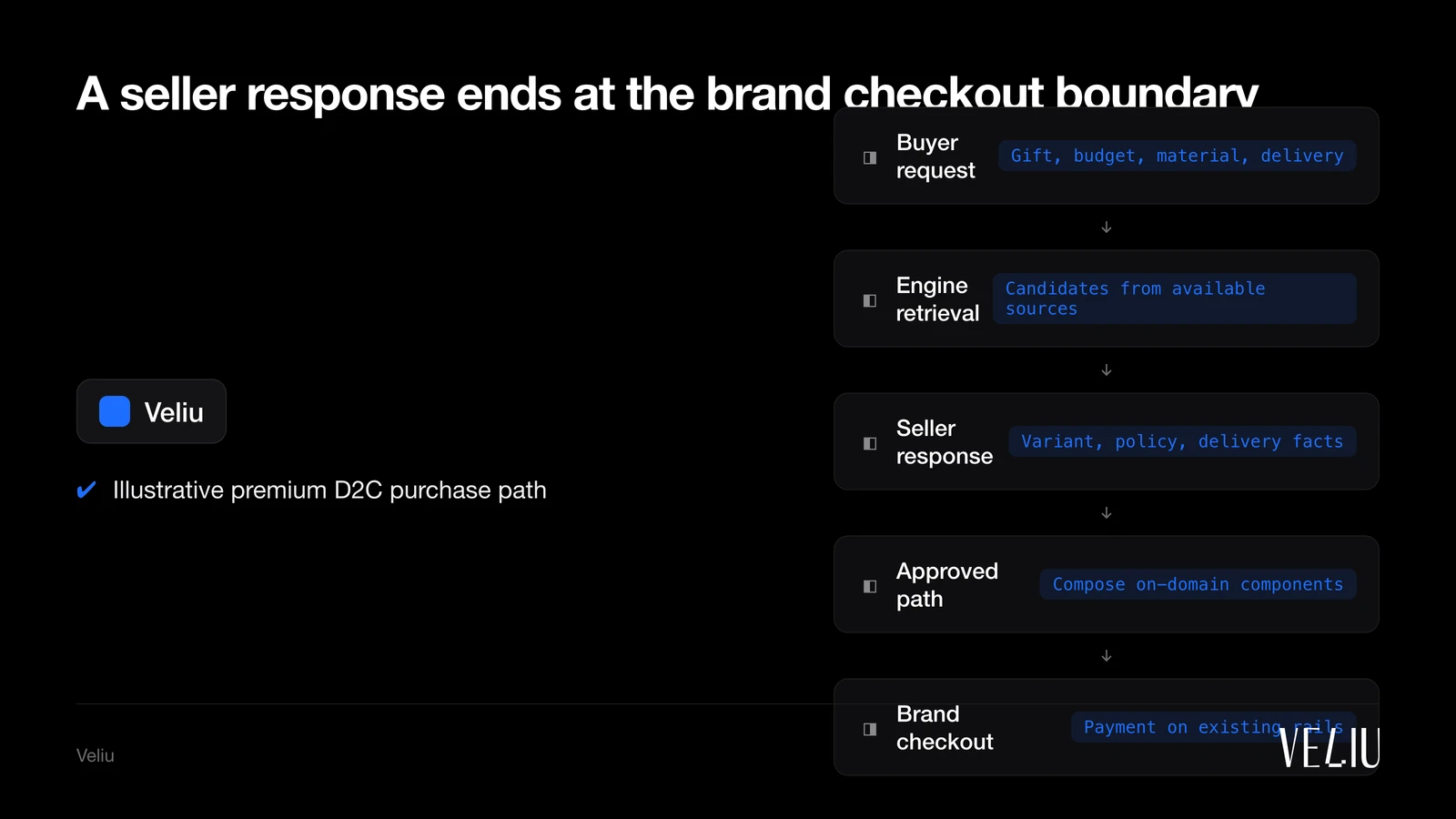
The buyer-side system interprets the shopper’s need. The brand agent presents and substantiates one brand’s eligible answer. Checkout completes the commercial record.
Readiness is visible in product-level evidence
Inspect evidence for each area. A single file or integration cannot establish that the complete selling path works.
| Area | Question | Evidence to inspect | Failure consequence |
|---|---|---|---|
| Product identity | Does each item have a valid identifier? | Feed, page markup, source catalog | Duplicate or mismatched product |
| Offer accuracy | Do price and currency agree? | Page, feed, checkout | Wrong quote or disapproval |
| Variant validity | Does each selectable variant resolve? | Variant URLs, stock, images | Dead choice or wrong item |
| Availability | How fast does stock propagate? | Change timestamps by surface | Sold-out item presented |
| Shipping and returns | Can a machine state the policy? | Policy pages and structured fields | Delivery query goes unanswered |
| Crawler access | Can retrieval bots reach key pages? | robots.txt, logs, edge rules | Missing web retrieval |
| Feed eligibility | Are eligible items accepted? | Program diagnostics | Product absent from catalog |
| Machine access | Can agents query current facts? | Feed or tool tests | Stale manual lookup |
| Checkout handoff | Does state survive transfer? | Cart and session tests | Purchase abandonment |
| Attribution | Can questions connect to handoff? | Event and session IDs | Unknown contribution |
| Frozen baseline | Was the before state captured? | Dated external snapshot | Improvement lacks proof |
Pick five high-revenue products and trace them from source record to public page, feed, external answer, cart, and checkout. One missing barcode, one price conflict, and one invalid size variant will reveal more operational risk than a catalog-wide presence score. For your own store, the free report reads your catalog from the outside, the way a buying agent does.
Measurement must connect facts to checkout
Outcome metrics show whether selling progressed. Causal inputs explain why it moved or stalled.
Outcome metrics: Track answer and citation share over a fixed prompt set, qualified on-site conversations, assisted checkout progression, and agent checkout completion on surfaces that support it. Segment results by category, market, intent, and engine.
Causal inputs: Measure extracted-fact accuracy, divergence among source systems, propagation latency, field completeness across the catalog, valid variant coverage, and checkout-handoff success.
Token count is an engineering cost measure. The presence of llms.txt, a proposed Markdown index for machine-readable content, is an implementation check. Neither measure establishes a commercial outcome.
| Metric | Method | Cadence | Decision enabled |
|---|---|---|---|
| Answer and citation share | Repeat a fixed prompt set by engine | Weekly | Choose categories needing evidence |
| Qualified conversations | Count sessions reaching product intent | Weekly | Improve selling components |
| Assisted checkout progression | Link conversation to cart and checkout | Daily | Repair journey breaks |
| Extracted-fact accuracy | Compare sampled claims with live truth | Weekly | Correct misleading records |
| Source divergence | Compare page, feed, endpoint, and checkout | Daily | Assign system fixes |
| Propagation latency | Time price and stock changes end to end | Daily | Adjust refresh schedules |
| Valid variant coverage | Test URL, stock, price, and image | Daily | Suppress or repair offers |
| Checkout handoff success | Run session-preservation tests | Per release | Block broken deployment |
Methodology changes the meaning of every number. A citation-share test should record prompts, engines, markets, dates, account state, and repetition count; its named limitation is that answers can vary by time, location, and user context. A factual-accuracy sample should preserve each answer and compare it with the source of truth at the same timestamp.
That closes the earlier price problem. A useful measure checks whether the engine read $160 when the store charged $160, whether size 9 was genuinely available, and whether that truthful answer survived the handoff.
Five actions create an auditable starting point
- Assign seller-side ownership. Give one operator authority across merchandising, feed health, storefront components, checkout boundaries, and measurement.
- Inspect the external agent view. Test real product questions on ChatGPT, Gemini, Perplexity, Copilot, and AI Overviews, then compare extracted facts with the live store.
- Freeze the baseline first. Preserve dated evidence before changing feeds, markup, policies, or components.
- Repair commercial coherence. Align identity, variant, price, availability, shipping, and returns across every surface a buyer-side system can reach.
- Measure question to handoff. Connect the original need, seller response, cart, and checkout progression with approved attribution events.
Veliu is the brand agent that does the selling: it studies the market, readies the store, and sells to people and to the AI shopping agents that arrive, in the brand’s voice and inside its rules, with checkout on the brand’s rails. We set out the thesis in our founding paper.
Author and methodology: Veliu Editorial Team. Veliu Research developed this article from public protocol specifications, merchant documentation, and vendor announcements reviewed through September 24, 2026. Counts are labeled by source and scope. Proprietary recommendation weights and unsupported adoption estimates are excluded.
Start tomorrow with one $160 shoe: compare its page, feed, public AI answer, size-9 cart, and checkout at the same timestamp.
The next paper, when it is written.
One email per paper, and nothing else.
Subscribe