In brief. Shopify agentic storefronts connect eligible Shopify products with supported AI shopping channels while keeping catalog, order, and checkout controls tied to the merchant’s Shopify setup. Success depends on coherent variant data, current price and stock, governed permissions, and an outside-in test that shows what AI buyers can actually read and act on.
- Shopify agentic storefronts create eligible routes into supported AI shopping channels, with availability and capabilities varying by merchant, market, and rollout.
- Coherent variant identity, price, stock, shipping, and return facts make products easier for AI systems to interpret.
- A frozen outside-in baseline shows what ChatGPT, Gemini, and other named surfaces can retrieve at a specific time.
- The merchant-authoritative cart should validate the final SKU, inventory, price, tax, shipping, and payment before an order completes.
- One variant-heavy product provides the fastest practical test of catalog quality, permissions, handoff, and checkout.
Shopify agentic storefronts connect eligible Shopify products to supported AI shopping channels such as ChatGPT and Gemini while keeping catalog, order, and checkout controls tied to Shopify. Their effectiveness depends on accurate variants, current price and stock, governed permissions, and outside-in testing of what each AI surface can retrieve and act on.
A wrong size can remove a product from consideration before a shopper ever reaches its page. For Shopify merchants, that risk can span ChatGPT, Google AI Mode, Gemini, Microsoft Copilot, and Meta, although integration, availability, eligibility, and transaction support vary by surface, account, market, and rollout.
A shopper might ask for a waterproof jacket under $250, a compatible replacement part, or help placing an order. Depending on the engine and query, the service can retrieve public pages or available commerce data, interpret product facts, and present eligible candidates under its own systems and policies.
This guide gives merchants a practical operating model for product interpretation, approved selling components, permissions, order handoff, and checkout.
Shopify connects the channel, and coherent facts make it usable
Shopify agentic storefronts are Shopify-managed commerce connections through which eligible products can appear in supported AI shopping experiences while catalog and order controls remain connected to the merchant’s Shopify setup. They extend a catalog into machine-mediated selling environments.
From the seller side, this is a sales-channel and catalog-distribution capability. The broader agentic storefront also covers how a brand presents, explains, and sells products to people and buying agents.
As of September 2026, Shopify’s Agentic Storefronts documentation lists four channels: ChatGPT, Google AI Mode and Gemini, Microsoft Copilot, and Meta. The channel is active by default for eligible stores and is managed under Sales channels > Agentic in the Shopify admin, where the merchant chooses which AI channels receive the catalog.
| Channel | Where the buyer pays | What the merchant controls |
|---|---|---|
| ChatGPT | On the merchant’s own online store checkout, opened in a ChatGPT in-app browser (a new tab on ChatGPT web) | Whether order data is shared with ChatGPT |
| Microsoft Copilot | Shopify-powered direct checkout inside Copilot, which Shopify describes as powered by UCP | Direct checkout on or off |
| Google AI Mode and Gemini | Native checkout powered by UCP, for select brands selling to U.S. buyers, with broader rollout underway | Direct checkout on or off |
| Meta | Shopify-powered direct checkout inside the channel when activated | Direct checkout on or off |
Shopify states that the channel needs no apps and adds no transaction fees beyond standard processing rates (Shopify). Brands on other commerce platforms can reach the same channels through Shopify’s Agentic Plan, which Shopify offers with no monthly subscription. The ChatGPT side has its own playbook in how to sell on ChatGPT.
The practical consequence is immediate.
An AI buyer may encounter a Shopify product record before the conventional storefront, depending on the retrieval path. “Trail Shell” supplies little context. “Women’s waterproof shell, size M, recycled nylon, $229 USD, in stock, ships to Oregon, returnable within 30 days” supplies facts a system can evaluate.
How does an AI channel read a Shopify catalog?
A useful operating model has five stages. Exact workflows differ by engine and query.
- Request: A shopper asks ChatGPT, Gemini, Perplexity, or Copilot for a product that meets specific constraints.
- Retrieval: The service can retrieve eligible catalog records, feeds, indexed pages, and other available sources.
- Interpretation: It can compare size, compatibility, price, availability, shipping, returns, reviews, and use cases.
- Selection: It presents candidates according to its own systems and policies.
- Handoff: It sends the shopper or an authorized order flow toward an enabled checkout path.
Feeds, schema.orgMachine-readable schema.org markup (Product, Offer, AggregateRating) embedded in a page as JSON-LD. It is the canonical way to hand engines unambiguous product facts.Read more markup, clean variants, and current policy facts can make products easier for these systems to read and cite, while each engine retains control of citation and selection. A feed is a structured catalog file sent to a commerce platform. Schema.org is a shared vocabulary that labels facts on a page so machines can recognize a product, offer, price, and stock state.
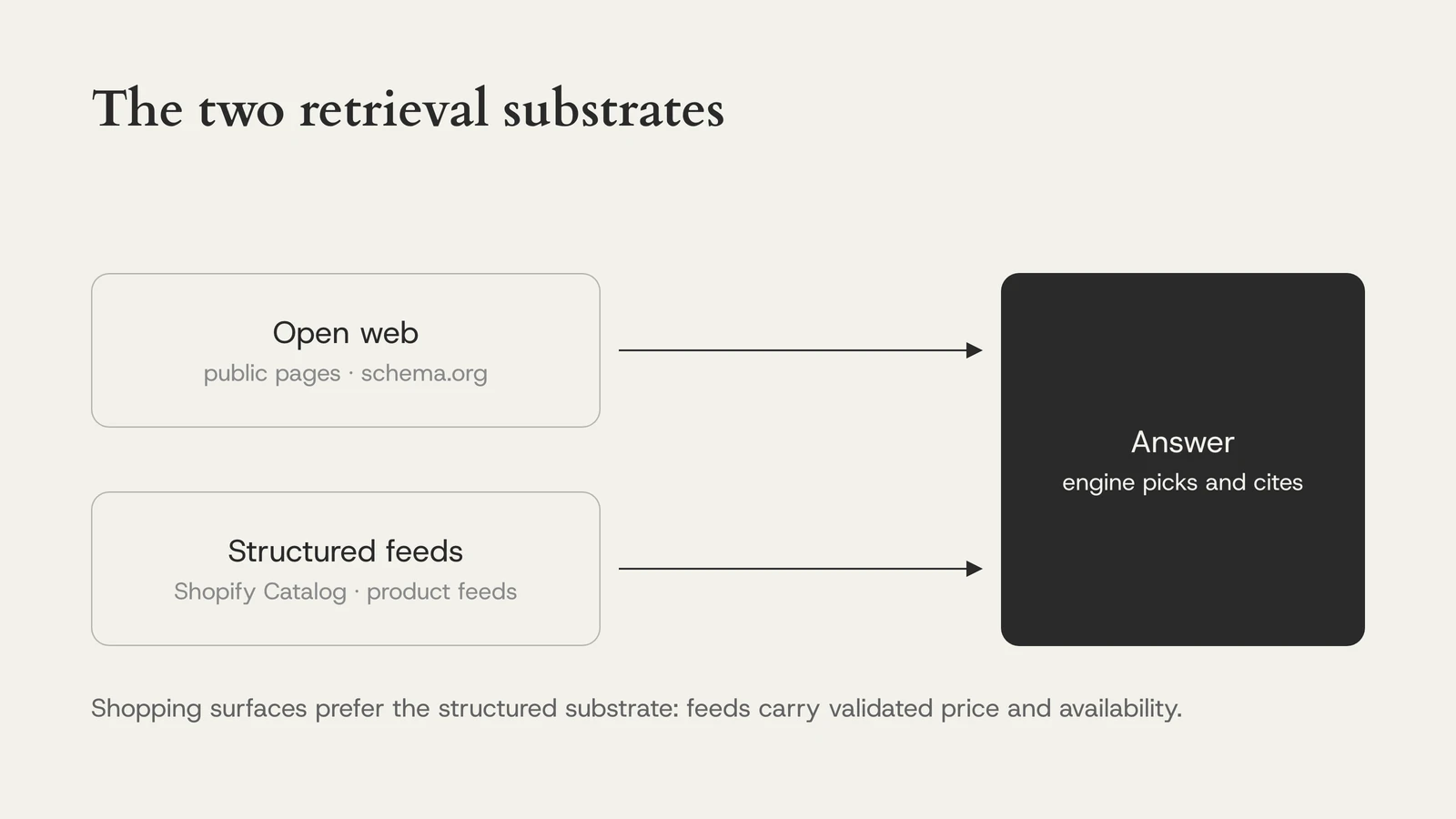
Connecting the channel creates another eligible route to a sale. Coherent product facts, permissions, and a working handoff determine whether that route can function.
The red size-8 shoe still has to remain distinct from the black size-10 version and from the same model sold by another retailer. Eligibility cannot repair a confused variant record.
A conventional store and an agentic storefront have different entry points
The conventional Shopify storefront remains a central destination for content, service, merchandising, and checkout. Shopify agentic storefronts add entry points where a machine can interpret the catalog before a person visits the site.
| Operating area | Conventional storefront | Shopify agentic storefronts | Merchant responsibility |
|---|---|---|---|
| Entry point | Search result, ad, email, direct visit | Prompt or task inside an AI shopping channel | Enable eligible markets and products |
| Interface | Merchant-designed pages and navigation | Channel-composed answers, cards, and actions where supported | Supply accurate facts and approved materials |
| Product interpretation | Shopper reads copy and controls | Machine can read catalog records, feeds, and pages | Keep identity, variants, and offers coherent |
| Selling components | Theme sections, filters, recommendations | Product cards, comparisons, policy answers, and actions where supported | Define approved content and behavior |
| Permissions | Store roles, apps, markets, inventory rules | Channel access and permitted commerce actions | Apply limited access and confirmation boundaries |
| Checkout | Shopify-connected cart and checkout | Channel handoff or supported agentic flow | Preserve authoritative totals, stock, tax, shipping, and payment controls |
| Measurement | Sessions, conversion, orders | Eligibility, fact accuracy, citations, handoff, and checkout events | Freeze a baseline and test from outside |
This is part of agentic commerce, where software can act for a buyer and a seller-side system must answer with usable commercial facts.
Seven terms make the system easier to manage
Agentic storefront: A selling surface that can interpret a shopper’s goal, compose approved product information, and support permitted actions.
AI shopping channel: A service such as ChatGPT or Gemini where a shopper can ask for comparisons, recommendations, or purchase help.
Shopify Catalog: Shopify’s system for mapping and distributing product information to supported discovery and commerce experiences.
Product feed: A structured export containing product identity, offer, availability, image, and policy data for another platform to ingest.
Structured data: Machine-readable labels embedded in a page, commonly schema.org in JSON-LD format, that identify product facts. JSON-LD is a standard way to place linked data in a web page.
Variant: A sellable version of a product, such as a blue shirt in size M, with its own stock and often its own identifier.
Agentic checkout: A governed flow in which software helps create or complete an order using authoritative cart and payment controls.
The Model Context Protocol, or MCP, supports access to tools and data. The Agentic Commerce Protocol, or ACP, and Universal Commerce Protocol, or UCP, cover commerce workflows in their respective ecosystems. Their availability does not give every Shopify merchant the same capabilities. The protocol map explains these boundaries.
Every sellable variant needs one coherent offer
Shopify can connect eligible catalog records to supported AI shopping surfaces through its sales-channel and catalog infrastructure. Products, markets, settings, and channel rules determine what can be available.
Start with eligibility. A UK-only bottle of wine with restricted shipping should remain unavailable to an ineligible US address. Product facts and market rules need to travel together.
A sellable variant needs a stable identity and current offer. Check its title, description, brand owner, Global Trade Item Number, or GTINThe GS1 Global Trade Item Number, the identifier that lets engines merge your offer with the same product sold elsewhere. A valid GTIN is numeric, 8 to 14 digits, with a GS1 check digit.Read more, manufacturer part number, or MPN, variant attributes, price, currency, availability, images, shipping, and returns. A GTIN is the unique barcode number assigned to many retail products. An MPN identifies a manufacturer’s item when applicable. Never invent either value.
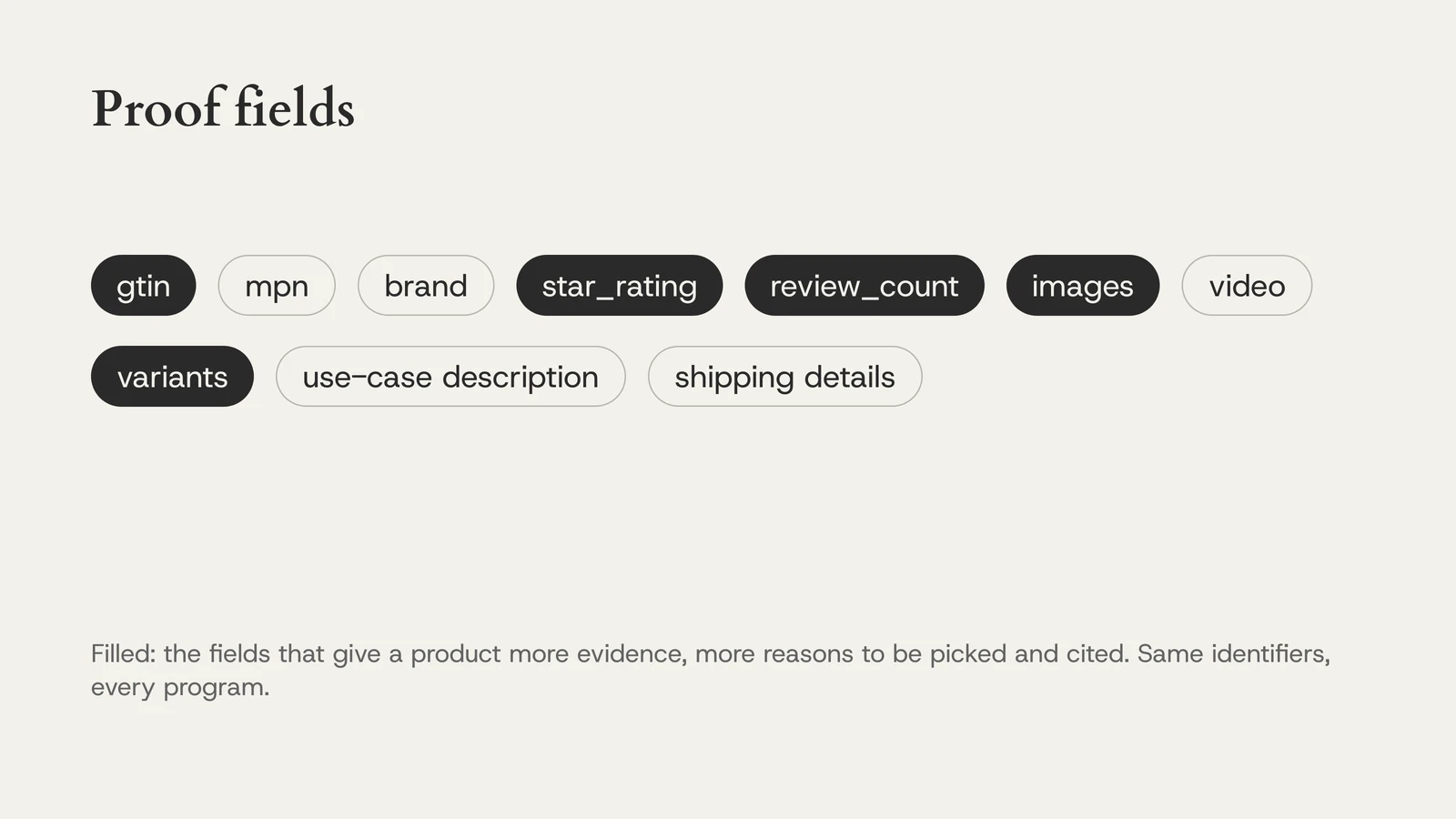
Consider a running shoe with three colors and nine sizes. If all 27 variants share generic copy while the feed says size 42 is available only in blue, the mapping must prevent an offer for size 42 in red. The same conflict appears when the page says $120, structured data says $110, and the feed says $125.
Schema.org’s `Product` and `Offer` definitions show how pages can label identifiers, prices, currencies, availability, and offer URLs. Google’s Merchant Center product data specification lists corresponding feed attributes.
Agreement matters because a channel can encounter a page, embedded structured data, and a feed at different times. Google Merchant Center warns in its price and availability guidance that mismatches between landing pages and product data can cause item issues. One source saying “in stock” while another says “out of stock” creates an operational conflict.
Approved components shape what the channel can say and do
Where a platform supports composition, an agentic storefront can form a response from merchant-approved parts such as product cards, comparisons, variant selectors, policy answers, and cart actions. Available components and enforceable controls vary by channel.
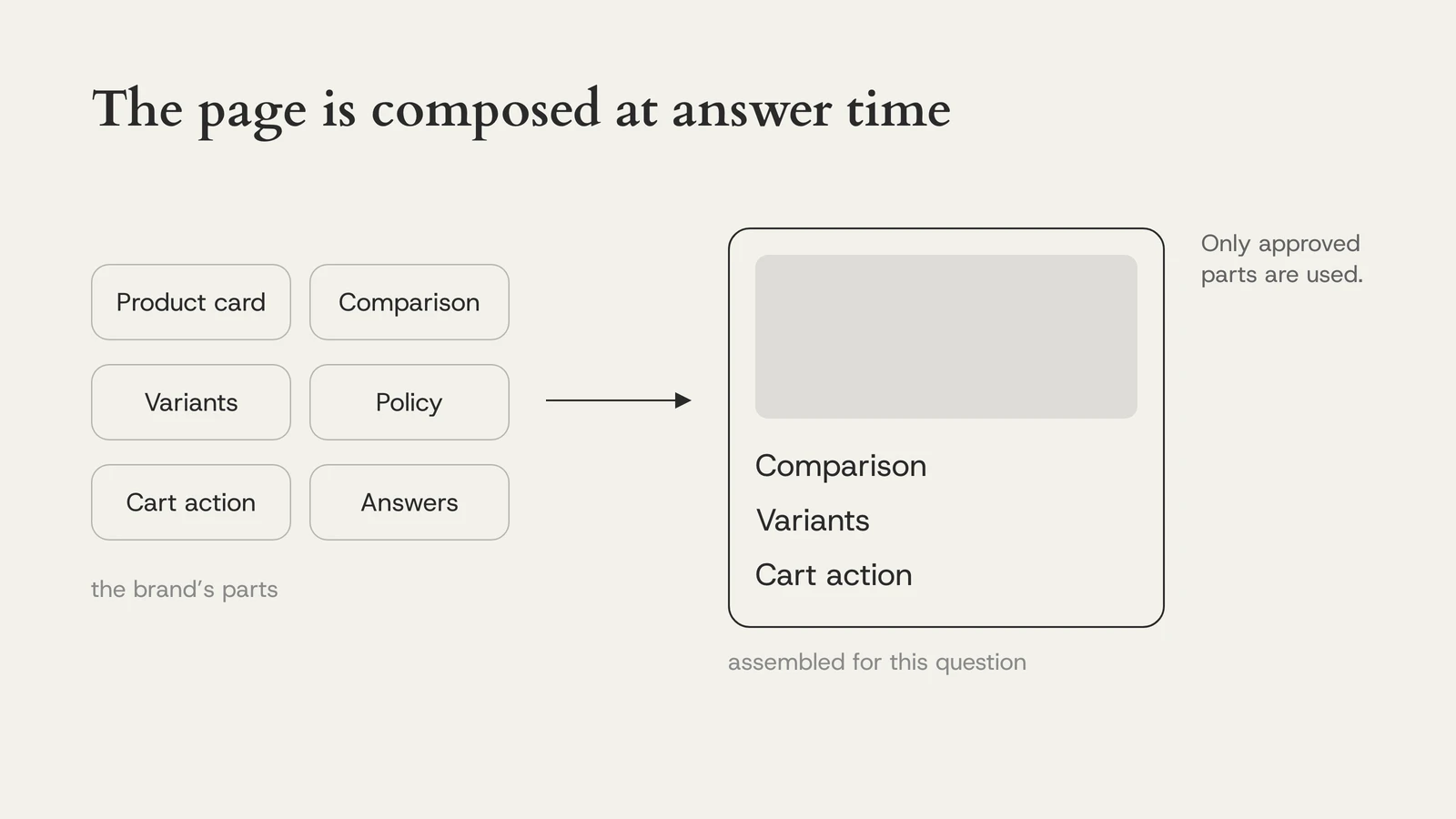
A shopper asking for “the lightest carry-on that fits a 55 cm limit” might receive a two-product comparison with dimensions, weight, price, and stock. If the shopper chooses navy, the variant selector must resolve the navy stock-keeping unit, or SKU, before an add-to-cart action becomes available.
Treat these components as an operating model until Shopify or the channel documents them as current capabilities. Define which facts may be shown, which components may be composed, and which actions require confirmation.
Permissions need the same precision. A product may be available for comparison while a discount stays restricted. A low-stock limited edition could permit an inventory check and require confirmation before cart creation. Wholesale prices can remain limited to authenticated buyers in eligible markets.
Record each gap as a gap.
The authoritative Shopify cart must decide the final order
Discovery can happen inside an AI surface while a merchant-authoritative checkout governs the order. For merchant-led Shopify transactions, merchant-of-record duties commonly follow the applicable payment, tax, fulfillment, returns, and market arrangements; each merchant should confirm the legal and payment structure for every enabled channel.
The checkout handoff should recalculate the cart. Validate the SKU, inventory, price, discount, tax, shipping method, and final total at purchase time. A recommendation generated five minutes earlier does not reserve stock.
Idempotency is a technical safeguard that prevents a retried network request from creating duplicate orders. Payment authorization records approval under the relevant payment method and protocol. The exact consent and authorization mechanics vary, so test the configured transaction path.
Where supported and configured, checkout remains on Shopify or another merchant-authoritative checkout path.
Twelve outside-in checks should precede activation
Use an outside-in check, meaning the public view a shopping system can encounter. Internal Shopify records help diagnosis. Public pages and channel outputs show what has propagated.
| Area | Outside-in check | Pass condition | Consequence of failure |
|---|---|---|---|
| Crawl access | Inspect robots.txt and request key URLs | Intended public pages are reachable | Pages may be absent from web retrieval |
| Product identity | Compare title, owner, GTIN, or MPN | One valid identity per sellable item | Duplicate or incorrect matching |
| Variant grouping | Test color, size, material, and URLs | Every choice resolves to the correct SKU | Wrong size, image, price, or stock |
| Price and currency | Compare page, JSON-LD, feed, and cart | Same current amount and ISO currency | Rejection, correction, or buyer confusion |
| Availability | Check page, structured data, feed, and cart | Current state agrees everywhere | An unavailable item may be offered |
| Shipping | Ask for cost, destination, and timing | Eligible methods and limits are clear | Failed handoff or unexpected cost |
| Returns | Ask a product-specific policy question | Current policy is retrievable and accurate | Weak comparison or customer dispute |
| Images | Inspect primary and variant images | Correct, reachable assets | Wrong product presentation |
| Source agreement | Compare core facts for a fixed sample | No unexplained contradictions | Reduced confidence and item issues |
| Market eligibility | Test supported and unsupported locations | Product appears only where sellable | Regulatory or fulfillment failure |
| Approved actions | Attempt each permitted action | Confirmation boundaries hold | Unauthorized discount or cart change |
| Checkout handoff | Run a controlled purchase scenario | Cart, tax, shipping, and payment resolve | Abandoned or duplicate orders |
OpenAI distinguishes `OAI-SearchBot`, which supports search visibility, from GPTBot, which is associated with model training. Shopping feeds can operate separately from crawling, so test feed eligibility and web access as distinct paths.
An llms.txt file is an optional map of machine-friendly links. Major shopping engines have not established it as a ranking lever. Give feeds, schema.org, variant accuracy, and checkout testing higher priority.
A frozen baseline makes the test credible
A day-zero baseline prevents improvement claims from drifting after edits begin. Use this reproducible method:
- Choose a fixed sample. Include hero, long-tail, and variant-heavy products. A 12-item sample could contain four from each group, with the same 12 used in every later test.
- Freeze the starting state. Save URLs, visible facts, JSON-LD, accessible feed exports, catalog mappings where available, channel eligibility, and checkout scenarios.
- Ask repeatable questions. Run the same prompts on named surfaces such as ChatGPT and Gemini. Include exact-product, category, compatibility, budget, and policy questions.
- Record each response. Capture retrieved facts, citations, variant handling, availability, policy answers, and handoff behavior with a timestamp and market.
- Make approved changes. Correct records, pages, structured data, feeds, permissions, or checkout configuration through the responsible owner.
- Retest the fixed sample. Preserve URLs, prompts, markets, and purchase scenarios so the comparison remains meaningful.
A Shopify record showing $89 is insufficient when the public page still exposes $99 and the channel returns the older amount. For your own store, the free report reads your catalog from the outside, the way a buying agent does.
Methodology note: Veliu Research compiled this framework from Shopify, schema.org, Google Merchant Center, and OpenAI primary documentation linked in this article. The method requires observed merchant data, fixed prompts, timestamps, and a frozen baseline. Its main limitation is channel variability by account, market, query, rollout, and test time.
Measure the route from readable product to valid checkout
Split hero and long-tail products because a polished top 20 can hide poor coverage across the remaining catalog.
| Metric | Calculation | Collection point | Operational use |
|---|---|---|---|
| Field completeness | Valid required fields divided by required fields | Page, JSON-LD, feed, catalog mapping | Find long-tail gaps |
| Source divergence | Conflicting facts divided by checked facts | Scheduled page and feed snapshots | Prioritize source fixes |
| Price accuracy | Correct returned prices divided by tested prices | Named AI surfaces versus live cart | Detect stale offers |
| Availability accuracy | Correct stock states divided by tested states | AI response, page, feed, inventory | Prevent failed carts |
| Propagation latency | Time from approved change to observed update | Change and retest logs | Set safe update windows |
| Answer and citation share | Appearances or citations divided by a fixed prompt set | Repeated tests by engine and market | Track relative presence |
| Eligible-product coverage | Eligible SKUs divided by intended sellable SKUs | Shopify and channel settings | Find exclusions |
| Checkout-session success | Valid sessions divided by attempts | Commerce and checkout logs | Diagnose cart failures |
| Checkout completion | Completed controlled orders divided by valid starts | Order and payment records | Validate the path |
Raw token counts do not show whether the right price appears or whether checkout works. The presence of llms.txt also provides little commercial evidence. Record both only after the selling path works.
The readiness scorecard needs product-level observations
Build four views from observed evidence.
Completeness matrix: Use one row per product and variant. Columns cover valid price, currency, availability, identifier, shipping, returns, and images. A green cell requires an observed and validated value.
Category-confidence ladder: Use merchant language such as “exact and useful,” “plausible but broad,” and “too broad to compare.” A merino hiking sock classified only as “Apparel” belongs in the final group because activity, material, and product type remain unclear.
Page-versus-feed table: Compare price, stock, variant, shipping, and policy facts. Include the source and observation time. A sale price that expired on the page but remains in a feed is a recorded conflict.
Component-permission checklist: Mark what may be shown, answered, changed, added to cart, or handed to checkout. Separate viewing from action. A channel may answer a return-window question while lacking permission to issue a return.
Missing observations stay marked as missing. An empty cell triggers investigation; an invented benchmark hides unfinished work.
This resolves the opening size problem. The product can enter consideration when the requested size maps to a valid variant, that variant maps to current stock and price, and the permitted handoff preserves the exact choice.
Channel activation leaves three decisions with the merchant
Transaction fees: Shopify states that Agentic Storefronts carries no transaction fees beyond standard processing rates. Confirm the processing rate for your plan and payment setup against a test order.
Site creation: An AI store builder addresses theme, page, or site creation. Agentic storefront enablement concerns catalog distribution, governed interactions, and transactions.
Revenue targets: A $10,000 monthly target depends on demand, margin, conversion, retention, fulfillment, and operating capacity. Channel activation adds an eligible selling route and supplies no fixed revenue outcome by itself.
Put one variant-heavy product through the full route
Veliu is the brand agent that does the selling: it studies the market, readies the store, and sells to people and to the AI shopping agentsSoftware agents that search, compare and complete purchases on a buyer's behalf. They read structured catalog data and transact through protocols like ACP and MCP.Read more that arrive, in the brand’s voice and inside its rules. Channels like these are counters it serves with the same product truth, and checkout stays on the brand’s rails.
Freeze one variant-heavy product today. Record its page, structured data, feed facts, market eligibility, and checkout result, then run the same purchase question in ChatGPT and Gemini.
The next paper, when it is written.
One email per paper, and nothing else.
Subscribe