
In brief. Google Shopping feed optimization is a field-level process that keeps each SKU complete, valid, current, consistently identified, and aligned across the feed, landing page, and schema. A canonical catalog can make product data easier for supported Google and AI shopping surfaces to read and match, subject to each operator’s ingestion, selection, citation, and ranking systems.
- Generate feed rows, product pages, and structured markup from one canonical product record.
- Validate assigned identifiers and current offer facts before improving promotional copy.
- Measure page-feed-schema divergence and propagation latency after every controlled price or stock test.
- Segment taxonomy and completeness results between hero SKUs and the long tail.
- Destination-specific feeds can improve readability, while each AI or shopping engine controls selection and ranking.
A $129.00 feed price paired with a $139.00 landing-page price can create an item-level inconsistency before a title rewrite matters. For ecommerce engineers and catalog owners, Google Shopping feed optimization starts with agreement across one product identity, one current offer, and one authoritative source for every exported field.
That agreement also affects whether product data is readable by Gemini, AI Overviews, ChatGPT, and other answer or shopping engines. These services may use structured feeds, schema.orgMachine-readable schema.org markup (Product, Offer, AggregateRating) embedded in a page as JSON-LD. It is the canonical way to hand engines unambiguous product facts.Read more markup, indexed pages, or program-specific merchant catalogs, with mechanisms that vary by operator and market.
This guide provides a reproducible audit of identifiers, taxonomy, variants, images, offer consistency, and update latency. Every product and price example is synthetic.
What should you access before feed editing?
Editing an export without access to its originating records produces a patch that the next scheduled build can overwrite. Collect these artifacts first.
| Requirement | Artifact | Failure signal |
|---|---|---|
| Merchant diagnostics | Google Merchant Center product access | The team can edit a CSV but cannot inspect item issues |
| Production payload | Current feed, Content API export, or Merchant API payload | The reviewed file differs from the scheduled source |
| Representative pages | Hero, long-tail, variant, sale, and unavailable SKUs | Rows point to generic pages or wrong variants |
| Rendered markup test | Rich Results Test or Schema.org Validator | Template JSON is absent from rendered HTML |
| Commerce source | ERP, PIM, inventory, or pricing service | Nobody can name which value wins a conflict |
| Identifier evidence | GS1 check-digit test and manufacturer records | A barcode passes length but fails its check digit |
| Current taxonomy | Google taxonomy and product-data specification | A broad or retired category is hard-coded |
Use Google’s current product data specification as the authority for required and conditionally required attributes. Platform requirements are date-sensitive, so the specification, destination names, and program availability must be rechecked against the live documentation before you rely on them.
Five terms define the audit
- Source of truth: the system whose value wins when records conflict, such as the inventory service for stock.
- Canonical product record: one normalized internal product record used to generate channel-specific outputs.
- GTIN: Global Trade Item Number, the GS1-managed barcode identifier assigned to a trade item.
- MPN: Manufacturer Part Number, the maker’s identifier, commonly submitted with
brandwhen no GTINThe GS1 Global Trade Item Number, the identifier that lets engines merge your offer with the same product sold elsewhere. A valid GTIN is numeric, 8 to 14 digits, with a GS1 check digit.Read more was assigned. - Google Product Taxonomy: Google’s controlled category tree for classifying products.
For a blue EU 42 hiking shoe, the canonical record may hold sku=SHOE-8842-BLU-42, availability=in_stock, and price=129.00 USD; the Google row and page markup then render those same facts in their required syntax.
1. Verdict: One canonical SKU limits channel drift
Map storefront inputs into a normalized record before generating the Google export. A practical internal model commonly includes id, title, description, link, image_link, availability, price, brand, identifier fields, and item_group_id where true variants exist; Google’s current rules determine which attributes are required for each product and market.
Keep id stable through routine copy, price, and availability changes. Replacing it can complicate reconciliation and continuity in item diagnostics.
| Field | Raw value | Canonical value | Rule |
|---|---|---|---|
id | Blue-Trainer-42 | SHOE-8842-BLU-42 | Stable commerce SKU |
brand | northstar shoes | Northstar | Approved alias |
availability | yes | in_stock | Feed enumeration |
price | 129 | 129.00 USD | Decimal and ISO 4217 currency |
gtin | 0012345678905 | 0012345678905 | Trim and validate |
A manual correction in the feed can leave the page and Offer JSON-LD, JavaScript Object Notation for Linked Data, emitting an old price. Generate downstream representations from canonical values, then validate each destination separately.
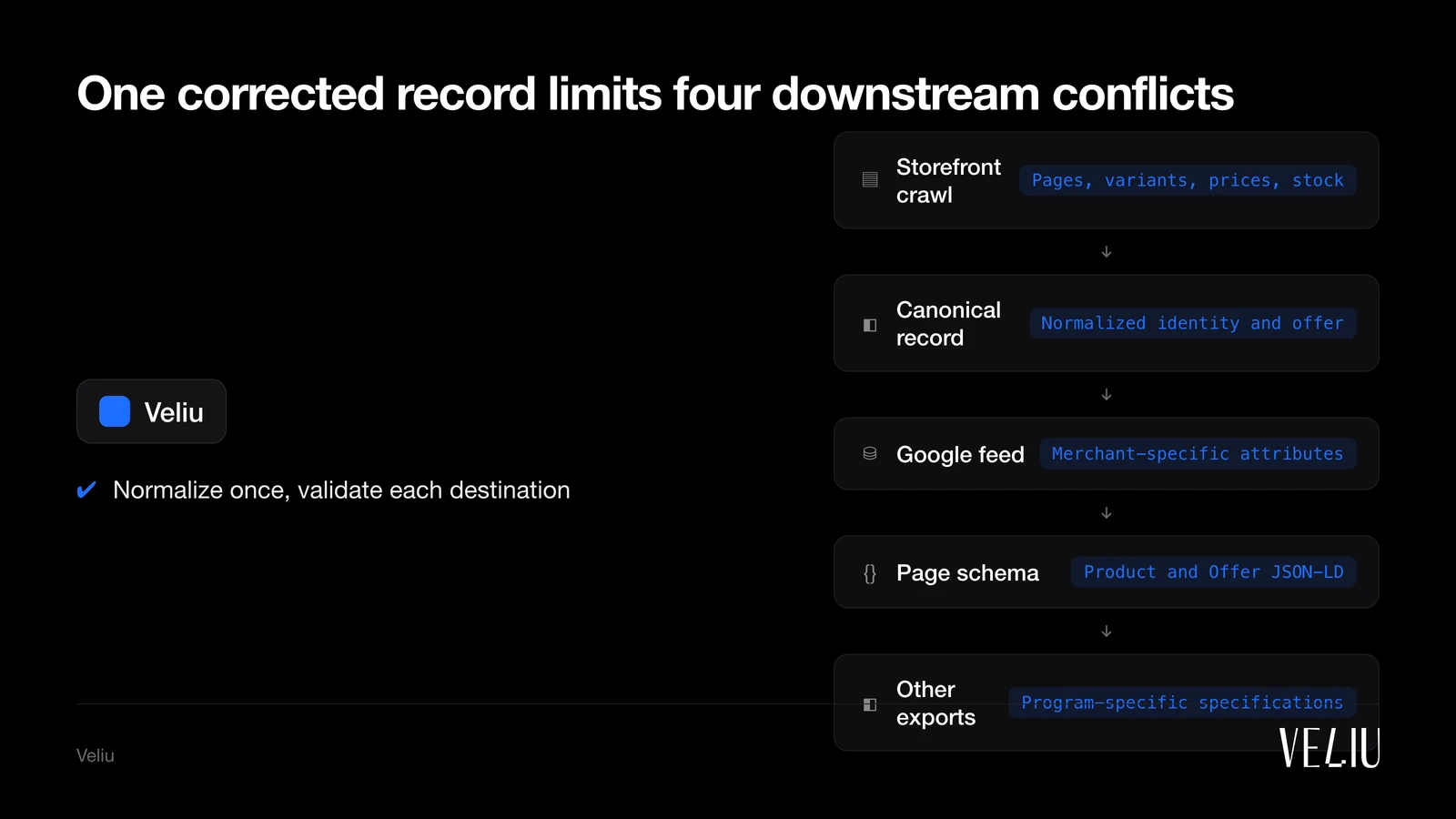
One record must win.
2. Verdict: Validate identifiers before rewriting copy
Validate gtin against the assigned manufacturer value and GS1 check digit. Schema.org documents supported forms under `gtin`, while Google’s specification remains the channel authority.
Never fabricate a barcode, pad a code solely to reach a preferred length, or reuse the identifier of another color or pack size.
For a handmade table with no assigned GTIN or MPN, identifier_exists=no may be appropriate; where an MPN exists, retain it with brand as applicable under Google’s rules.
| Result | Synthetic input | Action |
|---|---|---|
| Pass | 4006381333931 on the exact item | Preserve it |
| Warn | Blank GTIN with brand=Atelier North, mpn=AN-LAMP-04 | Confirm no GTIN was assigned |
| Fail | 4006381333932 | Reject because the check digit fails |
| Fail | A code padded without manufacturer evidence | Recover the assigned identifier |
The appeal is obvious: a numeric barcode makes the row look complete. The evidence does not support that shortcut because inaccurate identifiers can connect an offer with the wrong product identity.
3. Verdict: Titles should expose verifiable identity
Build title from normalized components such as brand, product type, model, and attributes that distinguish the SKU. Use description, product_type, product_highlight, and product_detail for supported materials, dimensions, compatibility, and intended use.
The second title identifies the model and exact child variant. A claim such as “waterproof” belongs only where the source record supports it, since an unsupported attribute can propagate to the page, feed, returns process, and systems that parse the description.
4. Verdict: SKU-level taxonomy reveals uncertainty
Assign the most specific supported google_product_category to each SKU and retain the merchant hierarchy in product_type. A “Travel” collection containing backpacks, luggage scales, and electrical adapters needs several taxonomy leaves because its collection label is too broad.
A useful internal quality model can record states such as exact_path, unique_leaf, fuzzy, tier1_only, and unresolved. Treat them as review controls in your own pipeline, and keep them separate from Google statuses.
| State | Engineering action |
|---|---|
exact_path | Spot-check and approve |
unique_leaf | Verify product context |
fuzzy | Queue ambiguous goods for review |
tier1_only | Enrich source attributes |
unresolved | Block automatic approval and repair |
A catalog dominated by broad classifications may be harder for downstream systems to classify or match against specific product requests. Report the distribution separately for hero SKUs and the long tail.
5. Verdict: Variant groups need visible differences
Use one item_group_id only for true variants of the same parent design. Each child should submit applicable differentiating attributes, such as color, size, material, or pattern; fields including condition and availability_date follow their own conditional rules and are not universal variant dimensions.
id | item_group_id | color | size | availability |
|---|---|---|---|---|
JKT-210-NV-S | JKT-210 | Navy | S | in_stock |
JKT-210-NV-M | JKT-210 | Navy | M | out_of_stock |
JKT-210-RD-M | JKT-210 | Red | M | preorder |
For a preorder child, provide availability_date when the current specification requires it. The URL should open or reliably preselect that child, and its image should represent the selected color where appearance differs.
6. Verdict: Price and stock should propagate together
Compare the commerce source with feed price and availability, the rendered page, and schema.org Offer. Currency uses an ISO 4217 code such as USD, GBP, or EUR.
Suppose a kettle changes from $129.00 to $139.00 at 10:02 UTC. The page updates at 10:03, JSON-LD remains at $129.00, and the feed updates at 14:00. The feed divergence lasts 3 hours and 58 minutes, while the schema has a separate stale interval.
Google documents that landing-page and submitted-data mismatches can lead to item issues or automatic updates in its price and availability guidance.
- Change the authoritative offer record.
- Invalidate page and structured-data caches.
- Generate or push the feed row.
- Fetch the rendered page and parse
Offer. - Record when Merchant Center reflects the value.
For a sale, preserve regular price and submit sale_price; use sale_price_effective_date when scheduling or current program rules call for it. Measure the interval at every surface.
Freshness is observable.
7. Verdict: Images must be accurate and retrievable
Use stable link and image_link values. The image must be crawlable and resolve to a valid product asset; supported redirects can work, so a direct HTTP 200 response is a monitoring target instead of a universal statement about every delivery path.
- [ ] Primary image shows the exact product and visible variant.
- [ ] No placeholder, price badge, or promotional watermark obscures it.
- [ ] The asset is available without authentication or browser-only challenges.
- [ ] HTTPS URLs remain stable after CDN changes.
- [ ] Alternate images add an angle, scale cue, or included accessory.
A high-resolution shoe image provides no usable evidence when a new CDN rule blocks retrieval.
8. Verdict: Shipping facts need market context
Supply shipping and return information through appropriate Merchant Center settings or attributes, then align visible policies and supported schema. Relevant values can include shipping, shipping_weight, shippingDetails, and hasMerchantReturnPolicy.
For a 12 kg floor lamp, shipping_weight can affect carrier-calculated or weight-based rules. Verify the final outcome for the US, UK, and Italy because carriers, thresholds, and return windows can differ.
9. Verdict: A three-way diff catches contradictions
Run a SKU-level diff across the feed, rendered page, and JSON-LD for identity, identifier, price, currency, availability, condition, and URL. Valid syntax can still carry stale facts.
| Fact | Feed | Page | JSON-LD | Pass rule |
|---|---|---|---|---|
| Price | price | Displayed amount | offers.price | Same current amount |
| Currency | Code | Market currency | priceCurrency | Same ISO code |
| Availability | Enumeration | Purchase state | Schema.org URL | Equivalent state |
| Identifier | gtin or mpn | Product details | gtin or mpn | Same assigned value |
| URL | link | Canonical URL | offers.url | Exact item or variant |
This synthetic timestamp illustrates the planned publication-date test record. It closes the opening $129.00 mismatch by identifying both stale outputs and assigning an owner.
Why does canonical data improve AI readability?
Google documents product data use across its shopping experiences, while Gemini, AI Overviews, ChatGPT, Copilot, and Perplexity have distinct retrieval and merchant-program mechanisms that can change by market and date. Structured feeds, indexed pages, schema.org markup, or program-specific catalogs may contribute where each destination supports them.
A canonical catalog can make identifiers, offers, variants, and taxonomy easier for supported systems to parse and match, including in agentic commerce, where AI performs product discovery, comparison, selection, or checkout, and when they support an agentic storefront that turns shopper questions into current product cards, comparisons, and explanations through a brand-approved component grammar and deterministic commerce rules. It still needs a valid destination-specific output, and each engine controls selection, citation, recommendation, and ranking.
For the broader mechanism, see Generative engine optimization: what AI can read in 2026 and Improve ChatGPT Brand Visibility: Fix Catalog Gaps.
Verdict: Measure distributions and propagation latency
There is no universal pass percentage for every assortment. Establish a baseline, set service levels by market and category, and segment hero products from the long tail.
| Metric | Calculation | Cadence |
|---|---|---|
| Required-field coverage | SKUs with every applicable field ÷ eligible SKUs | Every export |
| Valid GTIN rate | Valid assigned GTINs ÷ SKUs expected to have one | Every ingestion |
| Taxonomy distribution | Count by resolution state | Every build |
| Variant integrity | Valid groups ÷ tested groups | Every build |
| Divergence rate | Conflicting SKUs ÷ sampled SKUs | Daily and after releases |
| Propagation latency | Truth change to observation at each surface | Every controlled test |
Methodology: automate checks across the full export, then stratify rendered-page samples by market, category, SKU importance, sale state, and variant status. One limitation is Merchant Center processing time, which sits outside the merchant’s direct control.
Google’s operating priority is concise: “Provide the most accurate product data.”
Verdict: Repair identity and offer consistency first
A syntax-valid feed can still contain a malformed GTIN, several spellings of one brand, or a broad category copied across unrelated products. Repair the canonical identity, reject uncertain identifiers, classify at SKU level, and trigger feed generation plus cache invalidation from the same offer event.
Veliu gives a brand its own selling agent: it studies how the category gets bought, prepares the store so identity, offers, variants, and taxonomy stay consistent on every surface, and sells to people and to AI shopping agentsSoftware agents that search, compare and complete purchases on a buyer's behalf. They read structured catalog data and transact through protocols like ACP and MCP.Read more in the brand’s voice, with the feed and markup repairs in this guide handled as part of that preparation. Merchant traffic, prices, and reviews remain merchant inputs, while Google, Gemini, ChatGPT, Copilot, Perplexity, and other engines retain control of their results; the agent’s job is to make sure that whatever those engines read from your catalog is a fact you would stand behind.
Run one controlled price or stock change through the source record, feed, rendered page, and Offer JSON-LD, then assign an owner to every surface that misses its service-level target.
The next paper, when it is written.
One email per paper, and nothing else.
Subscribe