
In brief. ChatGPT brand visibility dashboards can show whether your brand appears in AI answers, but they do not prove that your products are readable, matchable, or buyable by AI engines. Ecommerce teams should audit the catalog inputs that ChatGPT, Gemini, Perplexity, Copilot, and AI Overviews can read: feeds, schema.org fields, identifiers, taxonomy, freshness, and checkout endpoints.
- ChatGPT brand visibility dashboards measure mentions and share of voice, but they do not prove that products are readable, matchable, or buyable by AI engines.
- Product feeds, schema.org fields, identifiers, taxonomy, freshness, and checkout endpoints are the catalog inputs ecommerce teams can audit and repair.
- Source-of-truth divergence across the page, feed, schema, and exports can create wrong machine-readable facts for price, stock, image, or offer eligibility.
- AI visibility work should separate measurement by prompt from fixability by SKU, market, and surface across ChatGPT, Gemini, Perplexity, Copilot, and AI Overviews.
To check brand visibility in ChatGPT, write a fixed set of buying prompts for your category, run them on a set cadence, and log how often ChatGPT names or cites your brand in the answers. That count is your baseline for seeing, measuring, and tracking visibility over time. What moves the number lives deeper: product feedsA structured export of the catalog (id, title, description, link, image, price, availability) in the Google Merchant Center spec, the format most shopping surfaces ingest.Read more, schema.orgMachine-readable schema.org markup (Product, Offer, AggregateRating) embedded in a page as JSON-LD. It is the canonical way to hand engines unambiguous product facts.Read more markup, identifiers, and price and stock freshness decide what ChatGPT can read about your products in the first place.
A $79 backpack can create three different machine facts when the page says $79, the feed says $89, and schema.org says sold out.
If you manage ecommerce growth, you may already track ChatGPT brand visibility, meaning how often your brand appears in ChatGPT-style answers for a defined set of prompts. The harder question is why a product is missing, mispriced, uncited, or impossible for a shopping agentSoftware agents that search, compare and complete purchases on a buyer's behalf. They read structured catalog data and transact through protocols like ACP and MCP.Read more to act on across ChatGPT, Gemini, Perplexity, Copilot, and AI Overviews.
This guide gives marketing and growth teams a practical audit path for making a product catalog easy for AI engines and shopping agents to read, match, and buy from. Each platform still controls selection, together with market factors such as traffic, pricing, reviews, and availability.
Answer block: ChatGPT brand visibility measures whether a brand appears in AI answers, but ecommerce teams improve AI findability by fixing catalog inputs: product feeds, schema.org markup, identifiers, taxonomy, price and availability freshness, and checkout endpoints across ChatGPT, Gemini, Perplexity, Copilot, and AI Overviews.
What does ChatGPT brand visibility measure?
ChatGPT brand visibility: how often your brand or products appear in ChatGPT answers for a defined set of prompts, markets, and dates.
GEO, or generative engine optimization: the work of making content and catalog data easier for AI answer engines to retrieve, understand, cite, and act on.
Structured catalog: a machine-readable product dataset where each SKU has consistent fields such as title, brand, price, availability, identifiers, images, shipping, and category.
Product feed: a file or API export, often CSV, XML, TSV, or JSON, that sends product records to a shopping platform such as Google Merchant Center, Microsoft Merchant Center, or an AI commerce program.
schema.org Product, Offer, and AggregateRating: on-page JSON-LD markup that labels a product, its commercial offer, and its visible review summary in a format engines can parse.
GTIN, MPN, and brand: GTINThe GS1 Global Trade Item Number, the identifier that lets engines merge your offer with the same product sold elsewhere. A valid GTIN is numeric, 8 to 14 digits, with a GS1 check digit.Read more is the global barcode identifier, MPN is the manufacturer part number, and brand is the maker or commercial brand used to match the same product across sellers.
Google Product Taxonomy: Google’s category tree for products, used to map free-text merchant categories into standard product categories.
Category confidence tier: a recorded rating of how well a product matched the standard taxonomy, from a full exact-path match down to unresolved.
Source-of-truth divergence: a mismatch between published product surfaces, for example the page says in stock while the feed says out of stock.
Agent-actionability: whether an AI shopping agent can move from reading a product record to a valid cart or checkout path through supported endpoints and payment flows.
How do you check brand visibility in ChatGPT?
You can see, measure, and track brand visibility in ChatGPT with a repeatable manual protocol before buying any tool.
- Write a fixed prompt set. Pick 20 to 50 buying questions a real customer would ask in your category, such as “best waterproof school backpack under $100,” and lock the wording, market, and language.
- Run every prompt in a clean session. Use a fresh chat without personalization carryover, so one answer cannot steer the next.
- Log what each answer contains. Record the date, whether your brand is named, where it appears in the answer, whether your domain is cited, and which competitors appear.
- Repeat each prompt across runs. Answers vary between sessions, so 3 to 5 runs per prompt give a more stable presence rate than any single response.
- Score share of voice. Divide the prompts where your brand appears by the total prompt set, and keep citation share and cited-fact accuracy as separate columns.
- Re-run on a fixed cadence. Track the same set weekly or monthly, and only compare runs that used identical prompts, because a changed prompt is a changed instrument.
This protocol gives you a dated baseline you can compare after every catalog fix. It cannot force an appearance, because each engine controls selection, so treat movement as evidence to investigate and pair every reading with the input audit below.
Catalog readiness comes before visibility interpretation
A tracker can tell you that your brand appears in 7 of 50 prompts. It cannot tell you, by itself, whether your long-tail SKUs are missing gtin, whether availability is malformed, or whether a stale feed kept a product from being eligible for a shopping surface.
Start with the inputs.
| Requirement | Why it matters |
|---|---|
| Prompt set and market | “Best trail running shoes under $120” in the US and “waterproof school backpack UK” are different demand tests, so track prompts by intent, category, and market. |
| Crawl access posture | ChatGPT Search, Perplexity, Bing, Google, and other engines may need allowed retrieval paths, while training access controls vary by vendor and use case. |
| Product feed source of truth | Shopping surfaces increasingly use structured feeds for fresh price, availability, and identifiers. |
| schema.org JSON-LD | Product plus Offer plus visible AggregateRating or Review helps web retrieval parse page facts. |
| Identifiers | Valid GTIN or MPN plus brand helps engines merge offers and compare the same product across sellers. |
| Taxonomy mapping | A standard category path helps attribute-rich queries match the right product family. |
| Price and availability freshness | A stale stock or price fact can create disapproval, bad buyer experience, or a wrong cited fact. |
| Images | Clean product images and additional images give shopping surfaces more evidence for cards and comparisons. |
| Shipping and returns | Shipping cost, delivery, and return policy fields can affect whether an offer is complete enough for commerce use. |
| Program exports or endpoints | Google Merchant Center, Microsoft Merchant Center, OpenAI ACP exports, and checkout endpoints each need their own validation. |
- Visible facts can be checked
- Schema.org fields are standard
- Useful for citations
- Can go stale
- Often incomplete on variants
- Carries price and stock
- Supports identifiers
- Feeds shopping graphs
- Disapprovals are field-specific
- Export drift is common
- Can expose eligibility
- Can support checkout sessions
- Useful for BOFU validation
- More implementation effort
- Engine support varies
Can a visibility dashboard prove your catalog is fixable?
The appeal is obvious: a ChatGPT brand visibility dashboard gives marketing a clean number for share of voice, mentions, positions, and competitors. The evidence does not support treating that number as a catalog-health score: OpenAI’s shopping documentation describes product result systems whose exact selection logic remains OpenAI-controlled, and Google’s Merchant Center documentation separates product-data quality from how products are eventually surfaced.
Measure visibility, then diagnose fixability.
For ecommerce, the useful metrics are practical: share of voice by prompt set, citation share, cited-fact accuracy, field completeness, freshness, and agent-actionability. A prompt report may show your running shoe brand absent from “best waterproof trail shoes for winter,” but the repair path may be a missing material, no valid GTIN, weak category mapping, or a feed that has not refreshed since yesterday.
A ranking dashboard is often a symptom report.
A BOFU team needs the repair report: which SKUs are readable, which facts disagree, which identifiers fail validation, and which surfaces have export gaps. If you want to measure visibility and fix SKU-level catalog gaps, start with a stable prompt set, then come back to this audit before you renew another visibility seat.
Methodology note: Veliu Editorial Team mapped this audit to primary platform documentation from OpenAI, Google Merchant Center, Microsoft Merchant Center, schema.org, and RFC 9309 robots.txt, checked against primary provider documentation on June 17, 2026. Limitation: AI answer and shopping engines keep ranking and selection weights proprietary, so the audit tests machine-readable inputs and field evidence.
How should ecommerce teams handle crawler access?
OpenAI documents separate user agents for different jobs: GPTBot for model training, OAI-SearchBot for ChatGPT Search indexing, and ChatGPT-User for user-triggered live fetches. That distinction matters because blocking a training bot is a different decision from blocking a retrieval bot.
A conceptual robots.txt posture might allow OAI-SearchBot so ChatGPT Search can index citation sources, while deciding separately whether GPTBot can train on your content. This is not a universal rule, because robots controls are vendor-specific and your legal, brand, and content strategy may require different choices.
The pitfall is common: a merchant blocks broad bot access to protect content, then expects ChatGPT citations from pages the retrieval crawler cannot index. RFC 9309 defines robots.txt as an advisory access convention, and OpenAI publishes bot documentation for its own user agents, so treat crawler policy as a named-vendor configuration.
Named sources to start with: OpenAI’s bot documentation and the RFC 9309 robots.txt standard.
What does a structured product record give an AI engine?
A product page written for humans says “waterproof weekender bag, olive, low stock.” A structured record says that the item has name, image, description, brand, sku, mpn, gtin, offers.price, priceCurrency, availability, priceValidUntil, shippingDetails, hasMerchantReturnPolicy, and visible review evidence such as aggregateRating.ratingValue and reviewCount.
Google recommends JSON-LD for structured data, and schema.org defines the `Product` and `Offer` properties. For ecommerce visibility work, the reliable pattern is Product plus Offer plus AggregateRating or Review when the rating or reviews are visible to shoppers on the page.
The mechanism is straightforward, but small field errors can matter. If availability is not a schema.org enum URL such as https://schema.org/InStock, a parser may not treat it as a valid availability fact. If priceCurrency is missing, “79” is not enough to know whether the product costs 79 USD, GBP, or EUR.
Pitfall: markup that disagrees with visible page content. If the page shows 4.6 stars from 128 reviews, but JSON-LD says 4.9 from 2,104 reviews, the issue is a trust problem in a machine-readable field.
How do identifiers decide whether products can be matched?
A valid GTIN helps an engine understand that your “Nike Pegasus 41 Men’s Road Running Shoes” is the same manufacturer product sold by other merchants. If no GTIN was assigned, use mpn plus brand; do not fabricate a barcode.
Consider one SKU:
| Field | Bad record | Better record |
|---|---|---|
| Title | Pegasus men shoe blue | Nike Pegasus 41 Men’s Road Running Shoes, Blue |
| Brand | NIKE Inc. / nike / Nkie | Nike |
| GTIN | 0001234567890 | Valid manufacturer-assigned GTIN, if assigned |
| MPN | blank | FQ6852-400, if this is the manufacturer part number |
| Category | Running | Sporting Goods > Athletics > Running |
The bad record forces the engine to guess whether “Nkie” is a typo, whether the zero-padded GTIN is real, and whether the shoe is a running shoe, casual sneaker, or replacement part. The better record gives the matching layer named fields it can compare across sellers and feeds.
Pitfall: zero-padding or inventing GTINs. Google’s product data specification states that GTIN is required when manufacturer-assigned, and identifiers must be valid; see Google Merchant Center product data specification.
Why are merchant categories weaker than machine taxonomy?
“New arrivals,” “Founder picks,” and “Rainy day edits” are useful merchandising collections. They are too ambiguous for AI shopping queries that need to match attributes, use cases, and product families across many merchants.
Map the catalog to Google Product Taxonomy and record a confidence tier for every mapping: exact_path when the full category path is confidently matched, unique_leaf when the leaf category is clear, fuzzy when the system has a plausible but imperfect match, tier1_only when only the top category is reliable, and unresolved when the product should not be trusted for category matching yet.
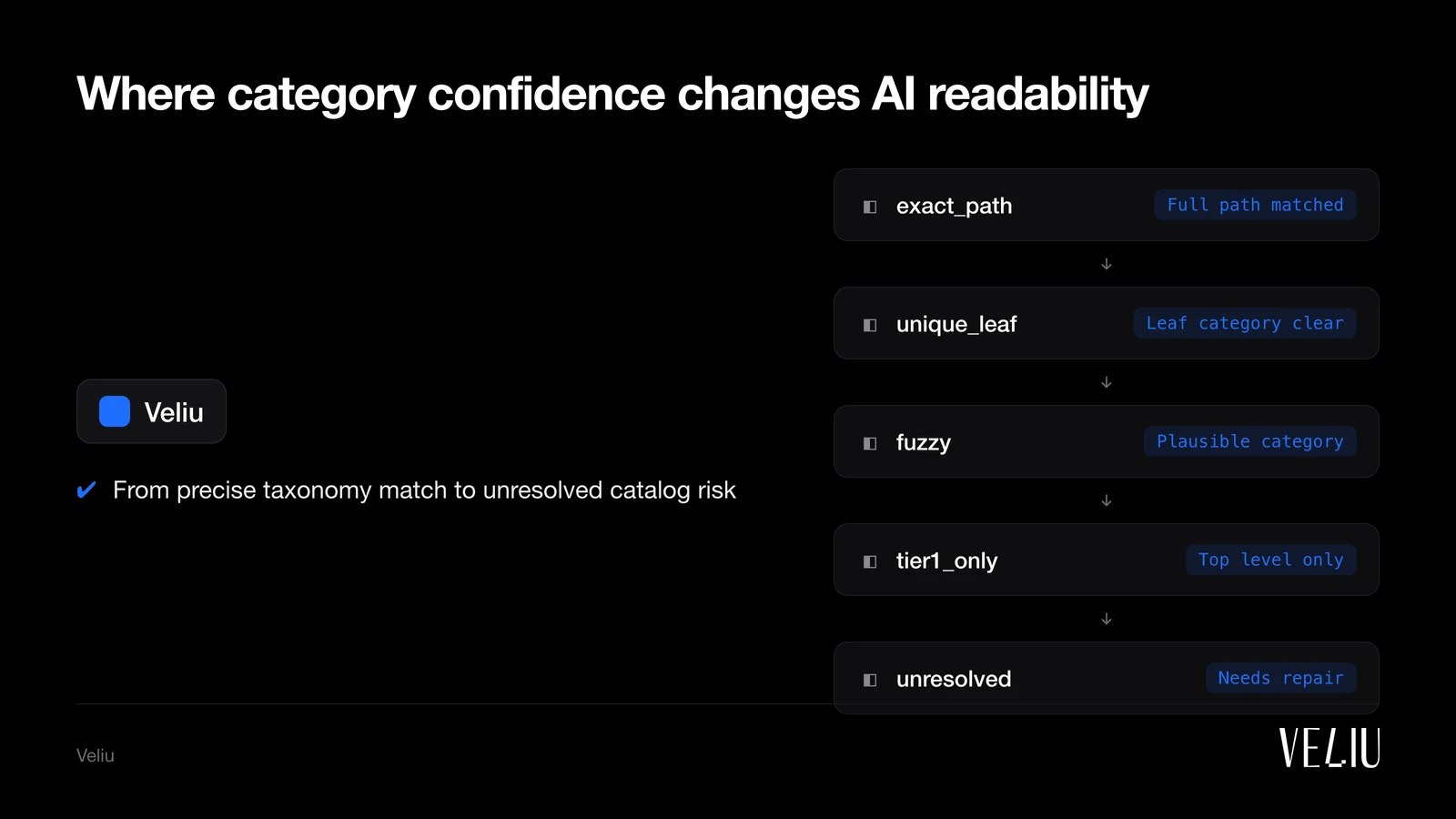
For a query like “carry-on backpack for a 3-day business trip,” taxonomy confidence changes what the engine can safely compare. A bag mapped to Luggage & Bags > Backpacks with material, capacity, and dimensions has more matchable structure than a product left in a merchant collection called “Work travel.”
Pitfall: relying on collection names as if they were machine taxonomy. Human merchandising can remain, but the structured catalog needs a standard path.
How does source divergence break the answer before the shopper arrives?
Google tells merchants to keep product data consistent between landing pages and product data, and documents item issues when price or availability differs; see Google Merchant Center item issue guidance. The same consistency risk applies beyond Google because AI engines increasingly read a mix of pages, feeds, and program exports, although exact ingestion behavior varies by engine.
Audit these surfaces side by side: product page, JSON-LD, Google Merchant Center feed, Microsoft Merchant Center feed, and OpenAI ACP or other program export where used.
| Field to audit | Page | JSON-LD | Google feed | Microsoft feed | ACP or program export |
|---|---|---|---|---|---|
| title | visible H1 | name | [title] | title | title |
| URL | canonical page | offers.url | [link] | link | url |
| image | visible image | image | [image_link] | image link | image_url |
| price | visible price | offers.price | [price] | price | price |
| currency | visible or locale | priceCurrency | price currency | price currency | currency |
| availability | visible stock | enum URL | [availability] | availability | availability |
| identifiers | visible or hidden | gtin, mpn, sku | [gtin], [mpn], [id] | identifiers | id, identifiers |
| shipping and returns | policy text | shippingDetails, hasMerchantReturnPolicy | shipping fields | shipping fields | fulfillment fields |
A didactic mismatch: the page says the backpack is $79, the Google feed says $89, and JSON-LD says https://schema.org/InStock while the page shows “sold out.” One backend value may be correct, but every published surface is a separate promise to a crawler, feed validator, or shopping agent, and Google Shopping feed optimization helps prevent mismatches that can affect whether a platform trusts or uses that offer.
Pitfall: assuming your ecommerce platform has one correct product value, so every export must be correct. Exports transform data, schedules delay updates, and plugins can rewrite fields.
Why this decides what ChatGPT, Gemini, Perplexity, Copilot, and AI Overviews can sell for you
ChatGPT brand visibility matters, but ecommerce demand can now appear across ChatGPT, Gemini, AI Overviews, Perplexity, Copilot, and platform-native shopping surfaces depending on the market, query, and device. An agentic storefront can use structured product data to make products easier for these systems to read and cite, while each engine controls selection and presentation.
ChatGPT can use product feeds and web or schema sources according to OpenAI’s published commerce materials; OpenAI’s shopping results documentation describes current shopping-result inputs. Google says Merchant Center lets merchants manage how products appear across Google surfaces, and Google’s Shopping Graph has been described by Google as a product dataset used for shopping experiences. Microsoft Merchant Center powers product feeds for Microsoft Advertising and shopping placements, while exact Copilot answer composition should be treated as Microsoft-controlled.
This is why a catalog audit should not be scoped to one prompt tracker. The same SKU may be readable in Google Merchant Center, absent from Microsoft Merchant Center, present on the page, and missing from an ACP export. Your growth report should separate AI visibility measurement from catalog readiness by surface.
For a broader channel framing, see Generative engine optimization for ecommerce and How GEO works.
What evidence shows a catalog repair worked?
Do not close a catalog project with “schema added” or “feed submitted.” Close it with field-level evidence by SKU group, market, and surface.
| Check | Pass evidence | Fail evidence |
|---|---|---|
| Structured-data validation | Product and Offer parse with required fields | Missing priceCurrency, malformed JSON-LD, or unsupported availability value |
| Feed disapproval rate | Merchant Center item issues reviewed and resolved by field | Price, image, identifier, or landing-page mismatch issues remain |
| Identifier validity | GTIN check digit valid, or MPN plus brand present when no GTIN exists | Zero-padded GTIN, invented GTIN, or blank brand |
| Source-of-truth divergence rate | Page, JSON-LD, feeds, and exports agree on named fields | Price, availability, title, image, or URL differs across surfaces |
| Propagation latency | Price or stock change reaches page, schema, feed, and export within the operating target | Sale price or stock status lags after a merchandising change |
| Crawler access logs | Retrieval bots such as OAI-SearchBot are allowed and observed when intended | Search/indexing bots blocked by robots.txt or edge rules |
| Field-completeness distribution | Hero SKUs and long tail both have required fields | Top sellers complete, long tail missing identifiers or shipping |
| Category-confidence distribution | Most commercial SKUs are exact_path or unique_leaf after review | Large unresolved or tier1_only pockets in revenue categories |
| ACP eligibility | Search and checkout eligibility fields populated according to the current program spec | Search eligibility missing or checkout readiness claimed without required endpoints |
| Checkout availability | Implemented endpoints respond and return authoritative carts | Checkout session fails, stale cart returned, or endpoint unavailable |
| Catalog area | Hero SKUs | Long tail | Evidence to inspect |
|---|---|---|---|
| Core offer fields | Complete or incomplete | Complete or incomplete | price, currency, availability, URL |
| Identifiers | Valid or missing | Valid or missing | GTIN, MPN, brand |
| Taxonomy | exact_path to unresolved | exact_path to unresolved | Google Product Taxonomy path, confidence tier |
| Proof fields | Present or absent | Present or absent | reviewCount, star_rating, images |
| Agent-actionability | Ready or blocked | Ready or blocked | eligibility flags, checkout endpoint status |
This no-invented-numbers matrix is deliberately binary at first. Once the audit is trustworthy, you can add rates by SKU count, revenue band, market, and category.
Common failure modes that mislead marketing reports
Visible in a tracker, unreadable as a catalog
A brand can appear in a ChatGPT answer because of press, Reddit mentions, or category awareness, although the exact causes behind any one answer are usually not public. That does not mean the SKU catalog is readable. If the product feed is missing identifiers and the page lacks valid Offer markup, the visibility number is weak evidence for product-level readiness.
Crawled page, missing feed truth
A crawler can read a landing page, but shopping surfaces often need feed-grade facts for price, availability, image, and identifiers. If a coffee machine page is indexed but the feed omits [availability], the engine may have a page citation without a reliable offer record.
Good descriptions, weak identifiers
A 220-word description of a moisturizer helps humans. A valid GTIN, MPN plus brand, and consistent variant grouping help machines match that moisturizer to the same product across sellers, reviews, and price comparisons.
Correct category for humans, unresolved taxonomy for machines
“Summer essentials” can work in navigation and email. In a structured catalog, the same sunscreen needs a standard taxonomy path and attributes such as SPF, size, and skin type if you want it to be matchable for specific shopping prompts.
Fresh price in the store, stale price in the feed
A merchandising manager changes a jacket from $149 to $119 at 09:00. If the feed still says $149 at 15:00, AI shopping surfaces and Merchant Center validators can read the stale price, even though the storefront looks correct.
llms.txt present, core product data still broken
llms.txt can be a useful Markdown map for content discovery, but it is not access control and no major AI vendor has publicly committed to relying on it for shopping ingestion. Google’s John Mueller compared llms.txt to the old keywords meta tag in public discussion, a blunt warning against treating it as a ranking lever.
What this means for your BOFU plan
- Keep AI visibility tracking, but add a fix layer that audits feeds, schema.org fields, identifiers, taxonomy, freshness, and endpoints by SKU group.
- Prioritize source-of-truth consistency before another dashboard renewal, because a $79 page, $89 feed, and sold-out schema record create a measurement problem and a buyer-trust problem.
- Treat taxonomy confidence as a merchandising input:
exact_pathandunique_leafproducts are easier to route into attribute-rich shopping queries thantier1_onlyorunresolvedproducts.
- Measure latency to truth after price and stock changes, especially during promotions, clearance, and high-volume launches.
- Put a brand agent on the job. Veliu gives your brand an agent whose mandate is to sell: it studies how buying conversations in your category actually run, prepares the store so every product fact holds up, and sells to people and to AI shopping agents in your voice, repairing feeds, markup, identifiers, and taxonomy as part of that work.
The operational implication is specific: before the next visibility review, pick 25 revenue-critical SKUs and compare page, JSON-LD, Google feed, Microsoft feed, and AI commerce export field by field.
The next paper, when it is written.
One email per paper, and nothing else.
Subscribe