
In brief. Define credible buying situations, align live pages with structured product data and feeds, provide verifiable evidence, and test a frozen prompt set before and after each change.
- ChatGPT can evaluate products more accurately when public pages, structured data, merchant feeds, and policies show the same current facts.
- Crawler access, valid identity, complete variants, and visible evidence create the foundation for product consideration.
- Merchant-feed eligibility opens a path into a shopping system but does not determine which product an engine selects.
- A frozen day-zero baseline and fixed prompt set make catalog improvements measurable across citations, accuracy, appearance, and handoff.
- The final buying path should preserve the correct product, price, variant, and checkout on the brand’s rails.
ChatGPT may describe or omit a $495 carry-on inaccurately when its public page says $495, its machine-readable offer says $450, and its merchant feed says “out of stock.” For US brands asking how to get recommended by ChatGPT, the practical route is to make product identity, price, availability, policies, and proof accessible and consistent across live pages and merchant data.
This guide is for ecommerce founders and operators who want products to enter credible buying comparisons. ChatGPT is the focus, while Gemini, Perplexity, Copilot, and AI Overviews reflect the same commercial shift: shoppers increasingly ask an engine before reaching a store, and each engine may use a different mix of indexed pages, structured product facts, merchant programs, and other sources.
The goal is operational. Choose buying situations your product can satisfy, inspect the store from outside, reconcile every important fact, and run a repeatable test. Recommendations remain controlled by each engine and can vary by request, location, availability, and retrieval context.
Five terms make the workflow understandable
- Retrieval at answer time: an engine fetches current records or pages while answering a request.
- Shopping result: a product card or recommendation supported by catalog or web evidence.
- Product feed: a structured file that a merchant sends to a shopping platform.
- Structured data: machine-readable facts embedded in a page, commonly schema.orgMachine-readable schema.org markup (Product, Offer, AggregateRating) embedded in a page as JSON-LD. It is the canonical way to hand engines unambiguous product facts.Read more markup written as JSON-LD.
- Agent view: what an external shopping agentSoftware agents that search, compare and complete purchases on a buyer's behalf. They read structured catalog data and transact through protocols like ACP and MCP.Read more can read from the public store without private system access.
Training data can create background familiarity with a company or product. Current price, stock, variants, and citations often require retrieval from live sources or ingested catalogs because those facts change between model-training cycles.
The minimum evidence surface comes first
The checklist below is the starting point for a recommendation-readiness review. The linked specifications were reviewed on August 30, 2026. Merchant enrollment, fields, and eligibility rules can change, so verify the current OpenAI commerce documentation before implementation.
| Requirement | Exact artifact or value | Why it matters | Quick check |
|---|---|---|---|
| Public product URLs | One stable canonical URL per product or meaningful variant | Retrieval needs an accessible source | Open it in a private browser session |
| Crawler access | Policy for OpenAI’s documented search crawler; separate training controls | Search retrieval and model training have distinct controls | Compare /robots.txt with OpenAI’s bot documentation |
| Product structured data | schema.org Product plus Offer; ratings only with visible support | Gives machines explicit product and offer facts | Validate rendered HTML and source HTML |
| Identifiers | Valid GTIN, or brand owner plus MPN where appropriate | Helps identify the same trade item across sources | Verify the check digit and source record |
| Current price | Amount plus ISO 4217 currency, such as USD | A number without currency is ambiguous | Compare page, JSON-LD, and feed |
| Availability | A schema.org value such as https://schema.org/InStock | Standard values reduce interpretation errors | Check every sellable variant |
| Variant grouping | Stable family grouping and distinct variant identifiers | Keeps sizes and colors separate | Test two neighboring variants |
| Shipping | Machine-readable details plus a visible policy | Delivery constraints affect suitability | Test a US ZIP code |
| Returns | Machine-readable terms plus an accessible policy | Buyers need the applicable conditions | Follow the policy link |
| Merchant feed | Current required offer facts and applicable eligibility settings | Gives commerce systems structured merchant data | Check the current feed specification |
| Visible reviews | On-page reviews aligned with marked-up totals | Markup needs visible supporting evidence | Recount a sample manually |
| Dated source of truth | Named system, owner, and update time for each fact | Reconciliation requires accountability | Trace one controlled offer change |
A checklist creates discipline.
It does not create evidence by itself.
Step 1: Choose buying situations you can credibly satisfy
Start with situations where the product has a provable fit. A useful query map covers the need, use case, constraints, comparisons, and follow-up questions a careful buyer asks before paying.
For a premium carry-on, test: “Which premium carry-on under $600 fits a 22 by 14 by 9 inch airline limit, uses an aluminum shell, and can arrive in Boston by Friday?” A comparison prompt could ask for warranty, empty weight, return window, and wheel-replacement policy.
That request creates six evidence obligations: price, dimensions, material, delivery deadline, warranty, and returns. Map each desired claim to a product page, feed value, visible policy, review, or credible independent source.
| Query constraint | Required product fact | Supporting source |
|---|---|---|
| Under $600 | Current price and currency | Product page, structured offer, merchant feed |
| Airline dimensions | Exterior dimensions | Specification table and description |
| Aluminum shell | Material | Product page and feed description |
| Boston by Friday | Inventory and delivery estimate | Shipping system and visible delivery message |
| Long warranty | Duration and exclusions | Public warranty policy |
| Easy comparison | Weight, returns, and repair terms | Product page, policies, and relevant independent review |
Build a practical set of 20 to 40 prompts if that range covers your key situations, then mark the evidence source for every factual claim you want ChatGPT to make. This range defines the working test design; it carries no statistical threshold.
The appeal is obvious: winning “best carry-on” appears to offer the greatest demand. The evidence does not support using that broad prompt as the main diagnostic because it hides which identity, constraint, policy, or offer fact caused the product to appear or disappear.
Step 2: Crawler access determines whether evidence can be retrieved
A polished page has limited retrieval value when crawler rules, firewall challenges, blocked rendering, or redirects prevent access. OpenAI documents OAI-SearchBot for search, GPTBot for training, and ChatGPT-User for some user-initiated visits; inspect the current definitions in its bot controls and apply the general rules in RFC 9309.
Inspect the rendered page, source HTML, /robots.txt, canonical URL, structured data, images, policies, and any region selector that changes price or availability. Do this without the company’s private commerce API. The private API shows internal truth; the agent view shows what an external system can retrieve.
This example separates search access from training policy. Adapt it to the complete crawler policy, then test the effective response because wildcard rules, content-delivery networks, security challenges, and regional redirects can alter the result.
Request five representative URLs through a verified test process. Record the HTTP status, rendered content, canonical destination, and machine-readable offer.
Step 3: Verdict: Source agreement is the priority check
For this workflow, source agreement is the first technical check because a mismatch can create item issues, stale descriptions, or uncertain offers. Google documents landing-page and product-data consistency problems in its Merchant Center guidance; apply the same reconciliation discipline to every merchant destination while treating each platform’s rules separately.
Use this matrix for hero products and a sample from the long tail, meaning the many lower-volume products beyond the best sellers. OpenAI feed labels are version-sensitive, so the table describes required concepts and sends implementers to the current specification instead of freezing field names in this guide.
| Fact | Public page | JSON-LD | Merchant feed |
|---|---|---|---|
| Identity | Visible title and canonical URL | Name, URL, and SKU properties | Current identity fields |
| Company and maker | Visible brand owner or maker | Brand property | Current brand field |
| Identifier | Visible where appropriate | GTIN or MPN property | Supported identifier field |
| Variant | Size, color, material | Variant-specific SKU and offer | Distinct item and grouping data |
| Price | Visible amount | Price property | Current price field |
| Currency | Visible market currency | Currency property | Supported currency value |
| Stock | Visible status | Availability property | Current availability field |
| Images | Primary and additional views | Image property | Supported image fields |
| Shipping | Visible delivery terms | Shipping details | Supported shipping facts |
| Returns | Visible return terms | Return-policy property | Supported policy facts |
| Rating | Visible aggregate | Rating value | Supported rating field, if available |
| Review volume | Visible count | Review count | Supported review-count field, if available |
| Search eligibility | Not applicable | Not applicable | Current search-eligibility setting |
| Checkout eligibility | Not applicable | Not applicable | Current checkout setting, where offered |
Follow the current OpenAI product-feed specification for exact names, required values, delivery method, and eligibility dependencies. Those implementation details can change after this article’s August 30, 2026 review date.
For schema.org, use the public definitions for `Product` and `Offer`. A red carry-on advertised at $495 should show that variant, 495.00, USD, and its current stock state across all relevant sources. A stale $450 value raises the risk of exclusion, stale presentation, or an inaccurate description, depending on the system and retrieval event.
Assign one authoritative source and one update owner for every fact. Record how the value reaches the page, JSON-LD, feed, and any commerce interface.
Step 4: Product identity needs valid identifiers and variants
A Global Trade Item Number, or GTINThe GS1 Global Trade Item Number, the identifier that lets engines merge your offer with the same product sold elsewhere. A valid GTIN is numeric, 8 to 14 digits, with a GS1 check digit.Read more, is a globally unique trade-item identifier generally licensed to a brand owner through GS1 and commonly encoded in a barcode. Validate its length and check digit. Never pad, guess, or fabricate one.
When no GTIN has been assigned, provide the brand owner and Manufacturer Part Number, or MPN, together where appropriate. A handmade limited-run bag may legitimately lack a GTIN. A mass-produced suitcase commonly carries one when the brand owner’s market and product setup require assignment.
Variants need equal care. A black 20-inch carry-on and a silver 22-inch version need distinct identifiers, prices, stock states, images, and attributes while remaining members of one product family. Collapsing them can send a shopper to the wrong size or an unavailable offer.
Descriptions should provide comparison facts. “Fits the published 22 by 14 by 9 inch limit” is testable. “The ultimate travel companion” has no defined test.
| Category confidence | Plain-language meaning | Merchant action |
|---|---|---|
| Exact match | The product clearly fits the specific category | Keep the mapping and verify attributes |
| Plausible match | The category is close with one meaningful mismatch | Review neighboring categories and buyer language |
| Broad match | The parent category supplies weak comparison detail | Choose a specific category when evidence supports it |
| Ambiguous match | Several categories fit or none fits clearly | Resolve identity and attributes before publishing |
Sample identifiers, grouping, images, category fit, and attributes across best sellers and low-volume products.
Step 5: Verifiable evidence beats unsupported superlatives
Visible evidence should support every structured claim. If an aggregate rating says 4.8 from 327 reviews, shoppers should be able to see the rating and supporting review evidence on the page. Review markup should align with visible authors, text, and ratings.
OpenAI’s shopping guidance states: “Product results are selected independently and are not ads.” Its shopping documentation also names relevance, availability, price, quality, and merchant context as considerations, while exact selection weights remain proprietary.
Independent evidence can strengthen a checkable claim. A specification sheet can establish dimensions, while a named travel publication can report measured weight after testing. Scope every statement to what the source measured and when it measured it.
Inventory each superlative, rating, certification, warranty statement, and performance claim. Attach visible first-party evidence or a named independent source.
Step 6: Verdict: Feed eligibility does not secure selection
An eligible merchant feed gives a product a structured path into a commerce system. Selection still depends on the request, location, available inventory, supporting evidence, and the engine’s current process, so confirm eligibility rules against the OpenAI feed specification as of the implementation date.
Document feed generation, delivery results, validation errors, and the time required for an approved offer change to appear downstream. If inventory reaches zero at 10:04 a.m., record when the page, JSON-LD, feed, and observed shopping answer reflect that event.
Run one controlled price or inventory change on a test product. Measure propagation at every observable layer.
Why does verifiable product evidence shape AI findability?
ChatGPT, Gemini, Perplexity, Copilot, and AI Overviews can use differing combinations of indexed pages, structured data, merchant feeds, and commerce integrations to answer product questions; this map of what commerce protocols handle, and what they leave to merchants distinguishes feeds and checkout from buyer authorization, agent trust, payment credentials, and tool access. Consistent identity, offers, policies, and proof make a product easier to read and describe, while recommendation decisions remain with each engine.
The commercial journey continues after the answer. On the brand’s domain, the store can answer permitted follow-up questions, present approved components suited to the request, preserve the correct price and variant, and keep checkout on the brand’s rails. See Agentic Commerce: Who Sells When AI Buys? and What Is Generative UI, and Who Composes Your Storefront?.
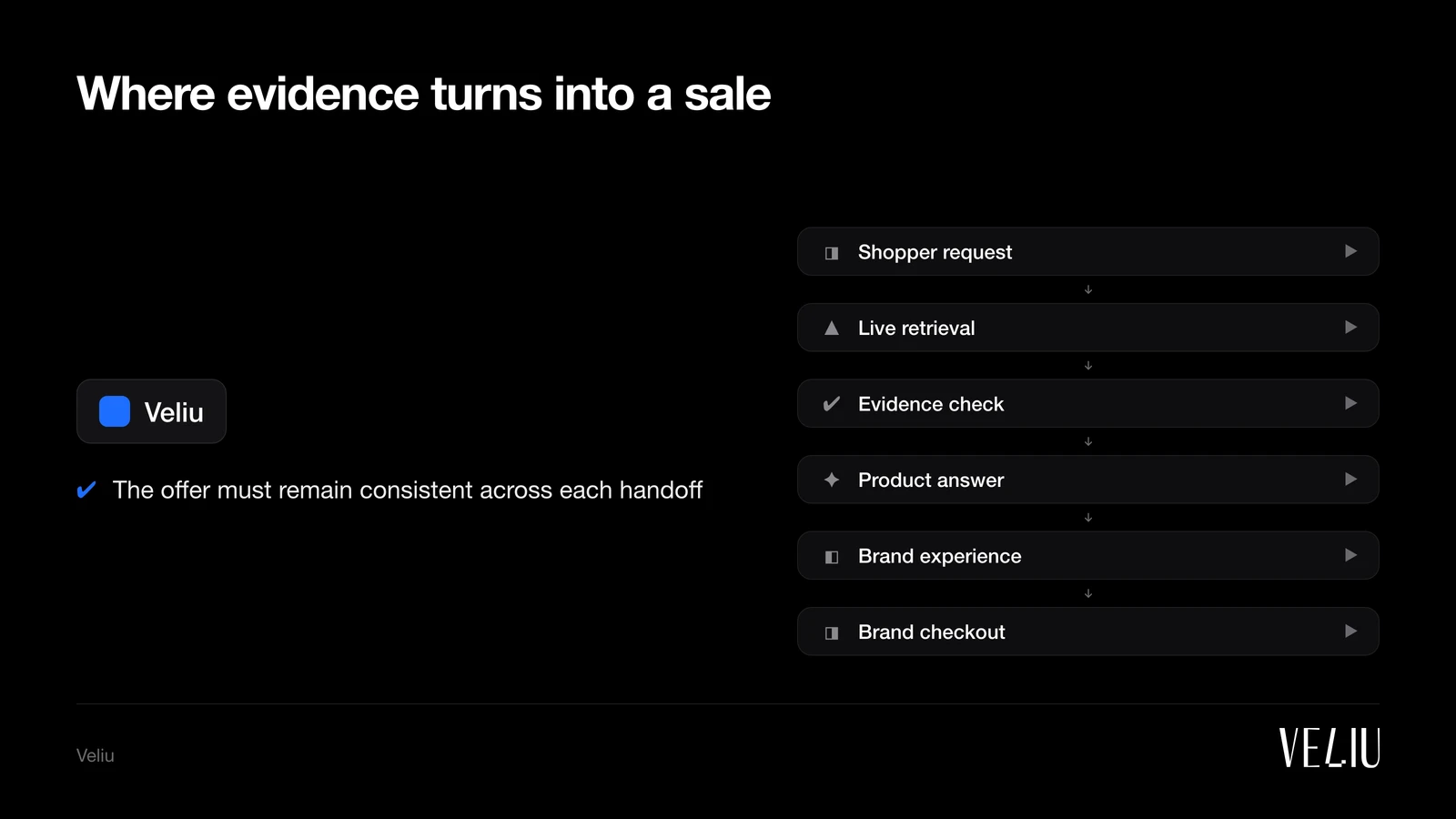
A missing identifier can confuse identity.
A wrong price can break the handoff.
Step 7: A frozen baseline makes the test reproducible
Freeze a dated day-zero baseline before changing pages, feeds, or policies. Record the market, date, model or product name shown in the interface, session state, exact prompt, source data, answer, and cited URLs.
Use the same balanced prompt set across needs, constraints, comparisons, and follow-up depth. Run repeated clean-session tests under documented conditions. Record product appearance, citations, factual accuracy, price, availability, follow-up quality, and whether the final link reaches the intended variant.
Methodology matters more than a favorable screenshot.
After each documented change, repeat the same prompt set. Treat the results as observations within that sample because model behavior, retrieval, location, and inventory can change.
Measurement must expose missing signals
Use actual observations. Display baseline unavailable when no day-zero measurement exists and signal missing when a source or value cannot be observed. Invented thresholds hide the gaps the test should expose.
| Metric | Formula or method | Pass condition | Diagnostic value |
|---|---|---|---|
| Structured-data validity | Validate sampled pages and count errors | No blocking errors in tested records | Finds unusable markup |
| Field completeness | Valid required facts divided by expected facts | Improves from the baseline | Exposes neglected catalog depth |
| Source divergence | Disagreeing facts divided by checked facts | Declines from the baseline | Locates conflicting systems |
| Propagation latency | Time from approved change to observed update | Meets the documented operating target | Reveals stale offer paths |
| Prompt-set appearance | Prompts showing the product divided by tested prompts | Improves under the same design | Measures consideration within the sample |
| Citation share | Eligible answers citing the brand domain divided by checked answers | Improves within the same scope | Separates appearance from attribution |
| Cited-fact accuracy | Correct cited claims divided by checked cited claims | Improves from the baseline | Tests faithful representation |
| Price accuracy | Correct observed prices divided by checked prices | Improves from the baseline | Detects damaging errors |
| Availability accuracy | Correct stock states divided by checked states | Improves from the baseline | Detects dead ends |
| Follow-up quality | Fixed rubric for dimensions, policy, variant, and delivery | Improves on the same rubric | Tests depth after first appearance |
| Correct handoff | Intended destinations divided by attempts | Improves from the baseline | Connects the answer to buying |
This resolves the $495 carry-on problem raised at the start. The work is complete only when the live page, machine-readable offer, merchant feed, observed answer, and destination show the same current truth.
Common failures reveal where to work next
An inaccessible source wastes a clean page
Crawler blocks, firewall challenges, broken redirects, and rendering failures can prevent retrieval. Test the effective response from outside the company network.
Feed eligibility only creates an entry path
Eligibility supports ingestion or consideration under the applicable program. It does not determine the final result.
One screenshot is weak evidence
A single answer has no control for session state, model changes, location, or wording. Preserve a dated prompt set and repeatable conditions.
Schema presence can hide an incomplete offer
A page may include Product markup while omitting currency, variant-specific availability, shipping, or returns. Measure validity and completeness across the catalog.
llms.txt remains a lower-priority experiment
llms.txt is a proposed Markdown index for machine-oriented content. As of August 30, 2026, public vendor documentation reviewed for this guide did not establish broad production use across the named shopping engines. It grants no crawler access and should follow accessible pages, valid structured data, reliable feeds, and tested freshness.
Brand mentions and product recommendations require different tests
A company mention can appear in an informational answer even when no product enters a shopping comparison. Test buyer-focused questions with clear identity, accessible sources, consistent facts, and credible corroboration. How to Get Found on ChatGPT: What AI Can Verify covers the broader workflow.
Product testing adds offer details: current price, inventory, variants, shipping, returns, and a valid handoff. Apply the same dated prompt set and accuracy rubric across relevant engines. For the wider read-and-skip mechanics, see Generative engine optimization for ecommerce.
Safe testing rarely requires private data
Do not paste customer personal data, payment details, confidential contracts, unreleased products, credentials, or private API keys into consumer sessions. Use approved test accounts, public catalog facts, redacted evidence, synthetic customer details, and the company’s data-governance policy.
Veliu’s brand agent studies the market, readies the store, and sells to people and to the AI shopping agents that arrive. Catalog reading, normalization, feeds, and commerce endpoints help it answer with the correct price and valid variant. On the brand’s site, it can compose approved components from permitted signals, answer human and machine buyers, return the questions customers asked, and keep checkout on the brand’s rails.
Give one owner responsibility for reconciling the page, structured data, feed, and commerce facts. Then freeze the baseline before the next price, inventory, policy, or variant change.
Your next operational move is specific: choose one high-value product today, capture every public offer source, and record the day-zero result before anyone edits it.
Author: Elyas Tirit, Founding Designer & Builder at Veliu
Methodology note: Veliu Editorial Team reviewed the linked OpenAI, schema.org, Google, GS1, and IETF primary documentation on August 30, 2026. The proposed test protocol measures public agent-view observations across a fixed, dated prompt set, with raw answers, citations, source snapshots, and controlled catalog changes retained for comparison. Merchant availability and engine behavior can vary by market and date.
The next paper, when it is written.
One email per paper, and nothing else.
Subscribe