
In brief. Current Perplexity onboarding terms determine merchant eligibility and submission requirements. Product identity and offer facts should agree across the feed and landing page, especially GTIN, variant, price, currency, and availability. Catalog inclusion can support discovery, while Instant Buy or Buy with Pro has separate conditions that require independent verification.
- Current Perplexity onboarding terms, account screens, and Help Center pages determine operational requirements at submission time.
- Stable product IDs, valid assigned GTINs, explicit currency, current availability, and variant-specific URLs create a testable offer record.
- Feed and landing-page facts should be compared at the same timestamp, with screenshots, payloads, and hashes retained as evidence.
- Catalog discovery and Instant Buy or Buy with Pro require separate status checks and transaction tests.
- A controlled price or stock update reveals real propagation latency and provides the basis for monitoring frequency.
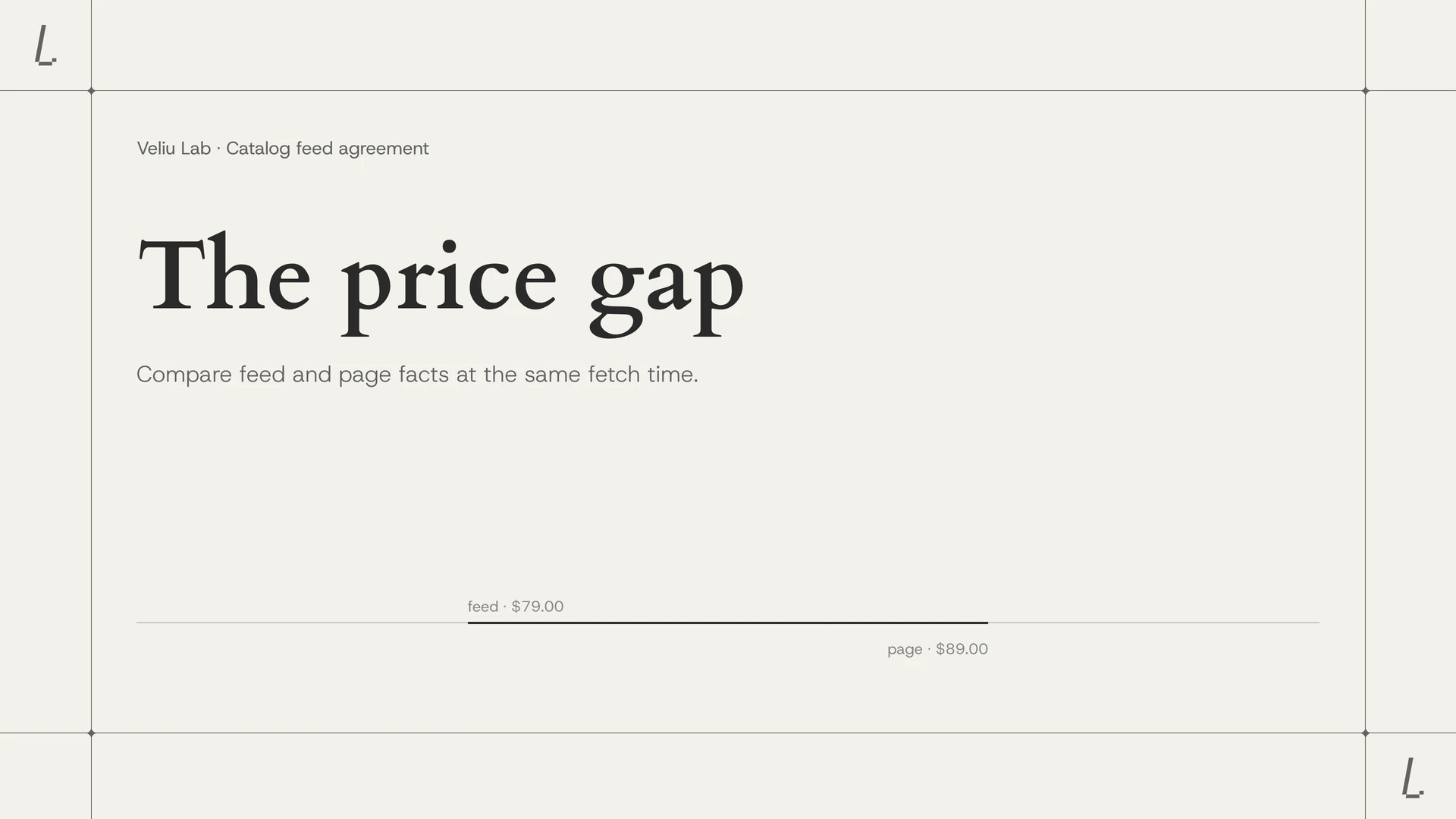
A $79.00 feed price paired with an $89.00 product page can make an otherwise complete Perplexity Merchant Program submission unreliable. The conflict gives Perplexity two offer facts for one product, which can weaken product understanding, produce a stale card, or send a shopper to an unexpected price.
This guide is for developers and ecommerce operators responsible for catalog exports, validation, and submission evidence. Shoppers increasingly ask Perplexity, ChatGPT, Gemini, Copilot, and AI Overviews to compare products. Those systems can read feeds, structured page data, and open-web evidence, so clean product facts make an offer easier to understand and cite; each engine still controls selection.
You will build a source-linked preflight, test feed-to-page agreement, separate catalog discovery from checkout readiness, and retain evidence that identifies the exact export an engine received.
Author: Giulia Margreth, Member of Technical Staff at Veliu
Methodology and source scope: This implementation guide compares Perplexity’s public Merchant Program and Instant Buy materials with GS1 identifier rules and schema.orgMachine-readable schema.org markup (Product, Offer, AggregateRating) embedded in a page as JSON-LD. It is the canonical way to hand engines unambiguous product facts.Read more product vocabulary. Perplexity requirements are volatile, so the current onboarding terms, page states, screenshots, and file hashes must be retrieved and verified on publication day. Recommendations labeled as interoperability checks are conservative engineering practices where current Perplexity documentation does not define a public requirement.
Which five terms prevent false passes?
A feed can pass syntax validation while still describing the wrong price, variant, or destination. These five terms separate a technically readable file from an offer that a shopping engine can interpret and a shopper can complete.
- Merchant catalog or feed: a structured export with one record per sellable product or variant.
- GTIN: the Global Trade Item Number, a GS1-issued barcode identifier containing 8, 12, 13, or 14 digits.
- Landing-page consistency: agreement between exported facts and the visible product page at fetch time.
- Discovery eligibility: whether a product can be ingested and considered for a product result.
- Checkout readiness: whether an offer has a working transaction path under current merchant, market, payment, and fulfillment conditions.
Eligibility depends on current Perplexity terms
Merchant eligibility should be confirmed against Perplexity’s current onboarding terms on submission day. Public launch materials establish historical program scope, while current terms and account screens determine accepted merchants, markets, shipping coverage, prohibited goods, transport methods, and any separate checkout conditions.
Perplexity’s Shop like a Pro announcement described a free Merchant Program for large retailers. Its Instant Buy Help Center page has described a US-based user context. Neither source should be treated as a permanent 2026 eligibility specification without checking the live onboarding flow.
That distinction is operational.
A November 2024 announcement can show what launched. The terms visible when you apply control the current submission.
Record the authority set before implementation:
Save a PDF or screenshot and calculate a SHA-256 hash when a page exposes no revision number. Never replace a missing version with an assumed date.
Step 1: Freeze merchant and market eligibility
Use three Perplexity-controlled surfaces: the current Merchant Program page, the legal or onboarding terms reached from that page, and the relevant Help Center article. Confirm merchant entity, destination coverage, prohibited products, account conditions, and the status of Instant Buy or Buy with Pro.
Store the URL, retrieval timestamp, screenshot, and hash together. If any requirement is unclear, mark it Needs confirmation and stop the submission from receiving a production approval.
Step 2: Treat the submission route as a dependency
The accepted route may involve an application, partner connection, upload, feed URL, or another onboarding mechanism. Record the transport, authentication method, format, refresh process, size limits, and rejection reporting shown in the current interface.
Based on the public materials cited here, Perplexity has not consistently exposed a stable field specification comparable in scope to the public Google Merchant Center product-data specification. Recheck that documentation state at publication and implementation time.
A Google field such as item_group_id may be useful in your internal model. Call it “variant group” in working documentation until Perplexity’s current specification confirms an accepted native field.
| Plain concept | Accepted field or column | Primary-source evidence |
|---|---|---|
| Product ID | Needs confirmation | Current onboarding specification |
| Price | Needs confirmation | Current onboarding specification |
| Availability | Needs confirmation | Current onboarding specification |
| Variant group | Needs confirmation | Current onboarding specification |
Step 3: Product identity must survive every export
A valid GTINThe GS1 Global Trade Item Number, the identifier that lets engines merge your offer with the same product sold elsewhere. A valid GTIN is numeric, 8 to 14 digits, with a GS1 check digit.Read more has 8, 12, 13, or 14 digits and ends with a check digit. GS1’s GTIN guidance controls identifier allocation and validation; a feed platform does not authorize merchants to invent missing codes.
Use a maintained GS1-compatible library in production. This compact JavaScript check catches length and checksum failures:
| Record | Value | Verdict | Reason |
|---|---|---|---|
| Valid example | 4006381333931 | Pass | 13 digits and valid checksum |
| Failed checksum | 4006381333932 | Fail | Final digit is invalid |
| Handmade product | No assigned GTIN | Conditional | Use supported identifier-absence handling and retain provenance |
Run four build-time tests: IDs are unique, unchanged products retain IDs across two exports, assigned GTINs pass validation, and every variant URL resolves to the represented color, size, pack, or configuration. Preserve an MPN, meaning manufacturer part number, with the brand name when appropriate and accepted.
Step 4: Complete the offer before polishing prose
A persuasive description cannot compensate for a missing price, currency, availability value, destination, or variant identity. Complete those offer facts first, then add factual copy that matches the represented product.
The appeal is obvious: better prose appears likely to improve a product card. The evidence does not support using prose as a substitute for offer data. A 28 L black backpack still needs a current 79.00 USD price, stock state, stable URL, and black 28 L variant identity.
Schema.org’s public `Product` and `Offer` vocabularies provide a useful page cross-check. They do not define Perplexity’s feed requirements.
| Fact | Example | Pass test | Common failure |
|---|---|---|---|
| Title | Acme Trail Pack 28L, Black | Product and variant are named | Parent title omits color |
| URL | https://shop.example.com/trail-pack?color=black | HTTPS, HTTP 200, correct selection | Redirect lands on blue 35 L |
| Price | 79.00 | Matches visible offer | Sale has ended on page |
| Currency | USD | ISO 4217 code is explicit | Bare $ is ambiguous |
| Availability | In stock | Maps to accepted value | “Ships soon” is free text |
| Image | Stable HTTPS URL | Anonymous fetch succeeds | Signature expires in 15 minutes |
Why does page-feed agreement require a timed comparison?
Price, currency, availability, selected variant, and destination should match between the feed and rendered page at the same observation time. A timestamped comparison identifies whether the feed is stale, the page changed first, or a variant URL resolved incorrectly.
Step 5: Test agreement at fetch time
Store both observations and the clock used for them.
| Feed observation | Page observation | Verdict | Repair |
|---|---|---|---|
79.00 USD | 79.00 USD | Pass | None |
79.00 USD | 89.00 USD | Fail | Correct source, regenerate, refetch |
In stock | Out of stock | Fail | Synchronize inventory |
| Black, 28 L | Blue, 35 L default | Fail | Publish a stable variant destination |
Feed and page divergence can contribute to rejection, stale cards, or an inaccurate destination, though Perplexity does not publicly document every enforcement mechanism. Capture the initial HTML, rendered document object model, final URL, response headers, and screenshot because a price hidden behind a location modal or login may be absent from an anonymous fetch.
The original $79.00 problem now has a diagnosis: it is actionable only when the team knows which export Perplexity retrieved and when the page changed to $89.00.
Step 6: A valid URL can still be unreadable
An HTTP 200 response from a developer laptop does not prove that an external retrieval path can read the same page. Test anonymous access, redirects, robots rules, geographic controls, web application firewall behavior, rendered offer facts, and image longevity.
For each sampled product and image URL, inspect:
- TLS certificate validity.
- Status code and redirect chain, with an internal threshold such as three redirects.
- Final URL and represented variant.
- Anonymous access without cookies.
- Initial HTML and rendered price, currency, availability, and selected option.
- Edge logs for challenges, rate limits, and blocked network ranges.
Perplexity documents PerplexityBot for index retrieval and Perplexity-User for user-triggered fetching. Cloudflare challenged Perplexity’s crawler behavior in an August 2025 investigation. Cloudflare wrote that Perplexity was “using stealth, undeclared crawlers,” a disputed finding that makes current crawler documentation and your own timestamped edge logs the relevant operational evidence.
Checkout readiness is a separate gate
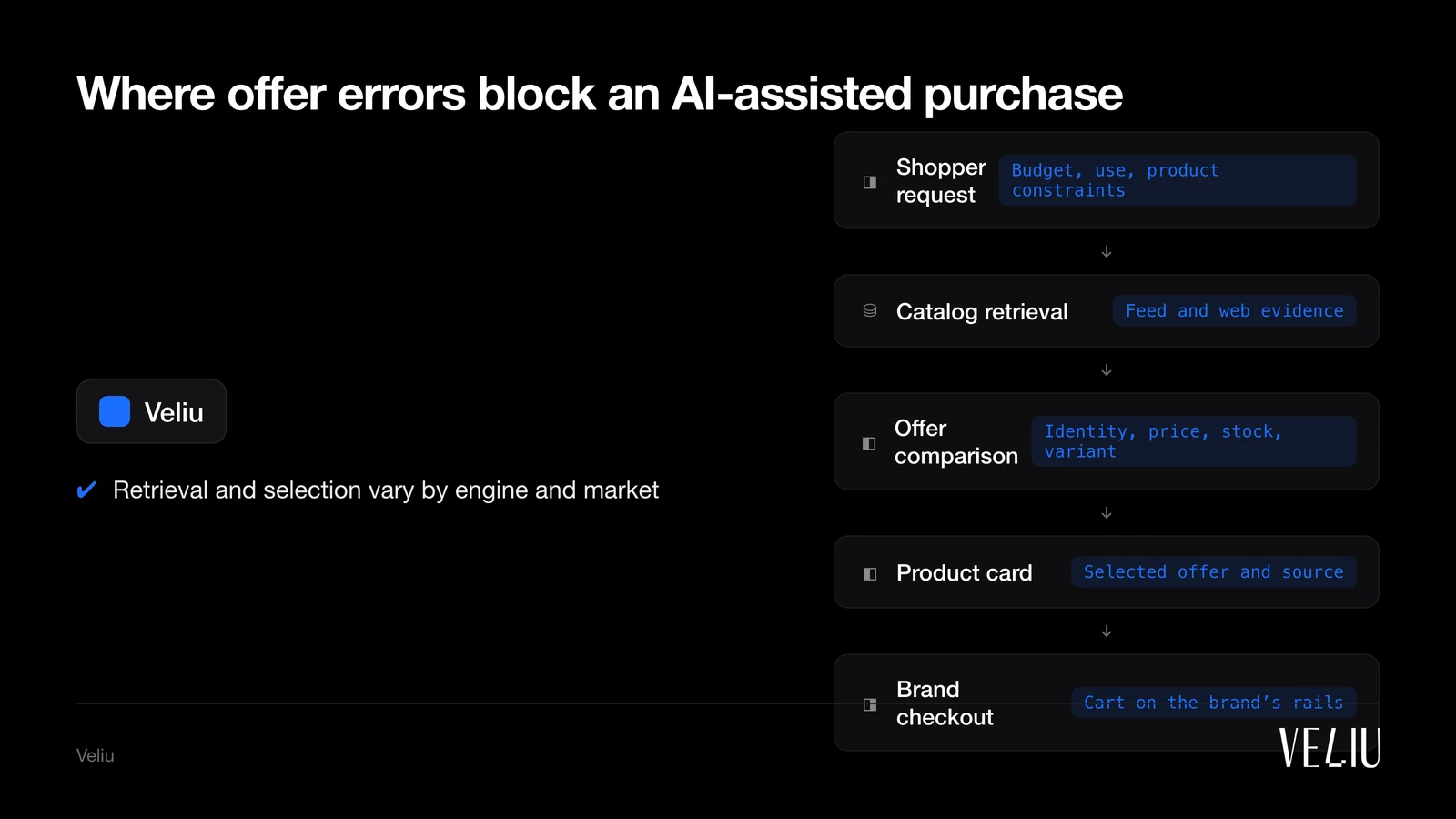
Catalog ingestion can support product discovery, while Instant Buy or Buy with Pro may have separate merchant, geography, payment, fulfillment, and item conditions. The protocol boundaries between catalog access, buyer intent, agent trust, and checkout help explain why these remain separate gates. Verify program status independently and test the permitted transaction path through order confirmation.
Step 7: Separate discovery from checkout
Record catalog status and checkout status in different fields. An accepted product record does not establish that the SKU can be purchased inside Perplexity.
Test cart creation, shipping methods, taxes, inventory reservation, payment handoff, cancellation, and order confirmation. Keep checkout on the brand’s rails unless current Perplexity documentation identifies another approved route for that merchant. The agentic checkout guide details the boundary between product discovery and transaction orchestration.
Step 8: Submit one immutable evidence packet
A versioned packet ties terms, catalog bytes, validation results, samples, and submission receipts to one review. Create a new packet after any feed change; overwriting the submitted version destroys the evidence needed to diagnose stale prices or rejected variants.
The README should state export timestamp, row count, checksum, validation tool version, sample rule, submission date, terms retrieval date, and owner.
Verification needs counts, samples, and timestamps
A single observed answer is evidence for one prompt, market, account state, and timestamp. Verify feed retrieval and catalog-wide validation first, then use a frozen prompt set and before-and-after evidence to inspect rendered cards, variants, freshness, destinations, and any permitted checkout flow.
| Check | Method | Pass condition | Evidence |
|---|---|---|---|
| Account status | Current console or response | Explicit status shown | Screenshot and timestamp |
| Feed retrieval | Receipt, logs, or console | Intended hash fetched | Hash and fetch time |
| Row outcomes | Exposed report, if available | Counts reconcile | Exported report |
| Card accuracy | Stratified SKU sample | Identity and variant match | Prompt and response |
| Price accuracy | Machine comparison | Amount and currency match | Diff output |
| URL resolution | Anonymous fetch | HTTP 200 on correct variant | Redirect trace |
| Freshness | Controlled price or stock change | New fact appears; latency recorded | Before and after evidence |
| Checkout path | Permitted test flow | Valid cart and handoff | Test-order record |
A 30-SKU sample can reveal defects in a 50,000-SKU catalog. It cannot establish catalog-wide completeness, so run full-file checks for required facts and disclose the sample selection rule for rendered tests.
Verdict: Clean merchant data improves AI findability
Perplexity, ChatGPT, Gemini, Copilot, and AI Overviews can use combinations of merchant data, indexed pages, structured markup, and web retrieval that vary by query, market, and current product implementation. Stable identifiers, current offers, explicit currency, resolved variants, and reachable destinations make products easier to interpret across those surfaces.
A shopper might ask Perplexity for a rain-ready 28 L backpack under $100. Perplexity can retrieve available catalog and web evidence, compare sufficiently clear offers, render a product card, and direct the shopper toward an eligible destination; exact behavior and selection remain controlled by Perplexity.
Google surfaces such as Gemini and AI Overviews can draw on Google’s index and Shopping Graph, while Copilot can combine Bing retrieval with available merchant information. The implementation varies, yet the interoperability requirement stays concrete: 79.00 USD, In stock, and Black, 28 L should identify the same offer everywhere they appear.
See how buy-side and seller-side agents divide the work for the wider commercial model.
The preflight checklist needs evidence owners
Every check should have a Pass, Fail, or Needs confirmation status plus a named owner and retained artifact. “Recommended” identifies an interoperability practice; it does not convert that practice into a Perplexity-native requirement.
| Group | Check | Source class | Evidence | Owner |
|---|---|---|---|---|
| Eligibility | Current market, account, shipping, and product terms checked | Confirmed from live terms | Snapshot and hash | Legal/Ops |
| Transport | Current route and authentication tested | Confirm live | Retrieval log | Engineering |
| Identity | IDs stable; assigned GTINs valid | GS1 and engineering | Diff and validator | Data |
| Offer | Price, currency, and availability complete | Interoperability | Coverage report | Commerce Ops |
| URLs | Product and image URLs resolve anonymously | Interoperability | HTTP report | Engineering |
| Agreement | Price, stock, URL, and variant match | Interoperability | Reconciliation report | QA |
| Freshness | Controlled update latency measured | Interoperability | Event timeline | Engineering |
| Checkout | Program and transaction status checked separately | Conditional | Account evidence | Payments/Ops |
Common failures have observable signatures
Reused identifiers: two colors collapse into one result. Group records by GTIN, compare variant attributes, restore the manufacturer-assigned code, and retain the duplicate report.
Parent URLs: a black medium product opens as blue large. Follow redirects in a clean session, inspect selected options after rendering, and publish a stable server-readable variant state.
Stale availability: an in-stock card reaches an unavailable page. Change one controlled SKU, record export and observation timestamps, then set update frequency from measured propagation delay.
Undocumented fields: an internal column is populated but ignored. Map every claimed Perplexity requirement to a current primary source and keep unconfirmed concepts in plain language.
Blocked retrieval: internal requests return 200 while edge logs show 403 responses externally. Correlate user agent, verified network data, firewall action, timestamp, and response body before changing a security rule.
Run one controlled update before production
Freeze the current source set, validate every row, reconcile feed and page facts, then change one approved test SKU’s price or stock state. Record export, retrieval, card observation, and checkout timestamps so monitoring reflects measured propagation instead of an assumed refresh interval.
Veliu’s brand agent studies the market, readies the store, and sells to people and to the AI shopping agentsSoftware agents that search, compare and complete purchases on a buyer's behalf. They read structured catalog data and transact through protocols like ACP and MCP.Read more that arrive. Feeds, catalog normalization, and endpoints help it answer with the correct price and valid variant. On the brand’s site, it can assemble a selling experience from permitted signals and approved components, answer shopping agents machine to machine, and return the questions customers asked. Checkout stays on the brand’s rails.
The next paper, when it is written.
One email per paper, and nothing else.
Subscribe