
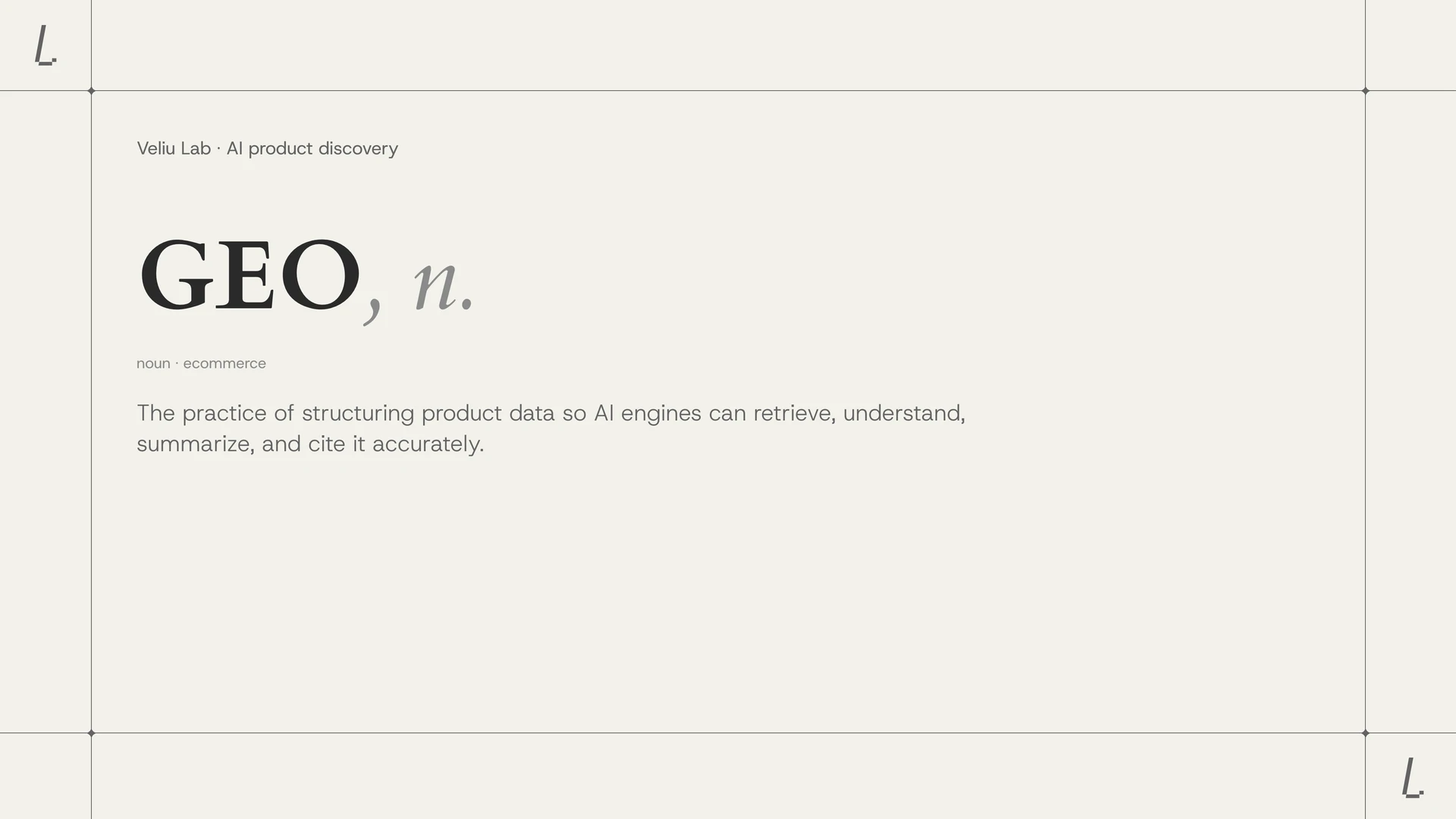
In brief. Generative engine optimization is the practice of structuring content and product data so AI answer engines can retrieve, understand, summarize, and cite it accurately. For ecommerce, the key unit is the canonical product record: price, availability, identifiers, taxonomy, images, shipping, and checkout facts that stay consistent across pages and feeds.
- Generative engine optimization makes product and content facts easier for AI answer and shopping systems to retrieve, understand, and cite accurately.
- For ecommerce, the core GEO asset is the canonical product record behind the page, including price, stock, identifiers, taxonomy, images, shipping, and checkout facts.
- Structured data, merchant feeds, valid identifiers, and page-feed consistency matter more than content polish alone for product findability.
- Merchants should measure catalog readiness with field completeness, mismatch rates, freshness latency, crawler access, and fixed prompt tests.
- Veliu’s role is to fix catalog readability and matchability, while AI engines remain responsible for citation, selection, and ranking decisions.
A missing barcode can make a jacket harder for ChatGPT, Gemini, Perplexity, Copilot, or AI Overviews to compare confidently. Generative engine optimizationGEO is the practice of making your content and catalog data easy for generative engines like ChatGPT, Perplexity and Google AI Mode to retrieve, cite and reuse in their answers.Read more is the practice of structuring content and product data so AI systems can retrieve, understand, summarize, and cite it accurately.
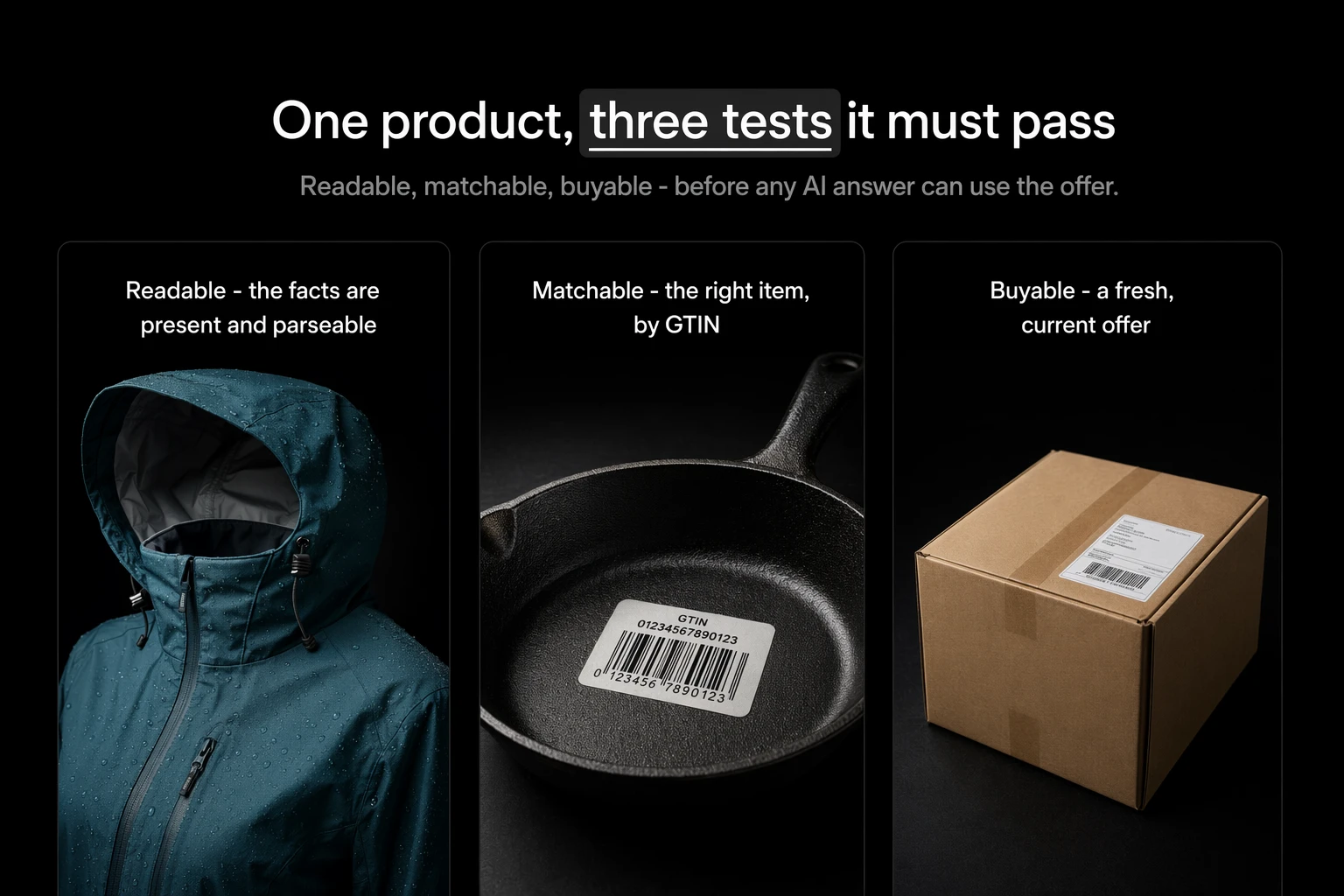
In ecommerce, what is generative engine optimization in practice? It is catalog truth made machine-readable. AI answer and shopping surfaces increasingly read live web pages, schema markup, merchant feeds, and commerce indexes when answering shopping questions.
By the end of this guide, you will know how your catalog facts can become easier for AI answer and shopping engines to read, match, and use in eligible commerce flows. You control whether your catalog is readable, consistent, and matchable.
Tiny catalog errors become retrieval errors.
Methodology note: this article is based on public documentation from Google, OpenAI, schema.orgMachine-readable schema.org markup (Product, Offer, AggregateRating) embedded in a page as JSON-LD. It is the canonical way to hand engines unambiguous product facts.Read more, robots.txt RFC 9309, Perplexity, Microsoft/Bing resources where cited, and Veliu’s agent-view methodology.
GEO means the product record must survive machine reading
Generative engine optimization, or GEO, is the practice of structuring web content and product data so generative answer engines can retrieve, understand, summarize, and cite it accurately. For ecommerce, the practical unit is the canonical product record behind the page.
A canonical product record is the clean version of one sellable item: the same title, brand, GTINThe GS1 Global Trade Item Number, the identifier that lets engines merge your offer with the same product sold elsewhere. A valid GTIN is numeric, 8 to 14 digits, with a GS1 check digit.Read more, price, stock status, image, size, color, shipping, return policy, and category wherever that product appears. GTIN means Global Trade Item Number, the unique barcode assigned by GS1, such as a UPC in the US or an EAN in Europe.
If your page says a shoe is “navy,” your feed says “blue,” and your variant table hides size 42, an engine has more work to do before it can trust the item. That is the practical shift from page-first thinking to catalog-first work.
SEOSearch Engine Optimization: earning visibility in classic search results through content, links and technical site health. In 2026 it remains the base layer that AI search builds on.Read more helps search engines crawl and understand pages. GEO helps answer engines and shopping systems retrieve and reuse product facts with less guessing.
What is generative engine optimization in ecommerce?
GEO in ecommerce is the operational work of making product facts consistent across pages, structured data, feeds, and checkout paths. A product record should preserve the same price, availability, identifiers, taxonomy, images, shipping facts, and variant relationships wherever a machine reads it.
That sounds basic.
It is also where many catalogs fail, because a product page can look polished while the feed shows stale stock, JSON-LD misses priceCurrency, or a private-label product uses a fabricated GTIN that points engines toward the wrong item.
The terms you need before the catalog work starts
| Term | Plain-language definition |
|---|---|
| GEO | Generative engine optimization, the work of making content and product facts easier for generative answer engines to retrieve, understand, and cite. |
| AEO | Answer engine optimization, the broader practice of making information usable in direct answers, including AI answers and classic featured answers. |
| AI Overviews | Google’s AI-generated answer blocks in Search, grounded in Google’s indexes and systems. |
| RAG | Retrieval-Augmented Generation, a method where an AI pulls live sources at answer time before writing its response. |
| Structured data | Machine-readable labels on a page, often JSON-LD, that state facts like product price, availability, and rating. |
| Product feed | A structured catalog file or API export sent to a merchant program such as Google Merchant Center or OpenAI’s product feed. |
| Canonical catalog | The cleaned, consistent version of your products that resolves duplicate names, variant confusion, and category drift. |
| MPN | Manufacturer Part Number, the maker’s product code used when no GTIN exists. |
| Google Product Taxonomy | Google’s standard category tree used to classify products in Merchant Center feeds. |
| Source-of-truth divergence | A mismatch between your page, schema, feed, or export endpoint, such as one price on-page and another in the feed. |
Product GEO works only when retrieval has clean facts
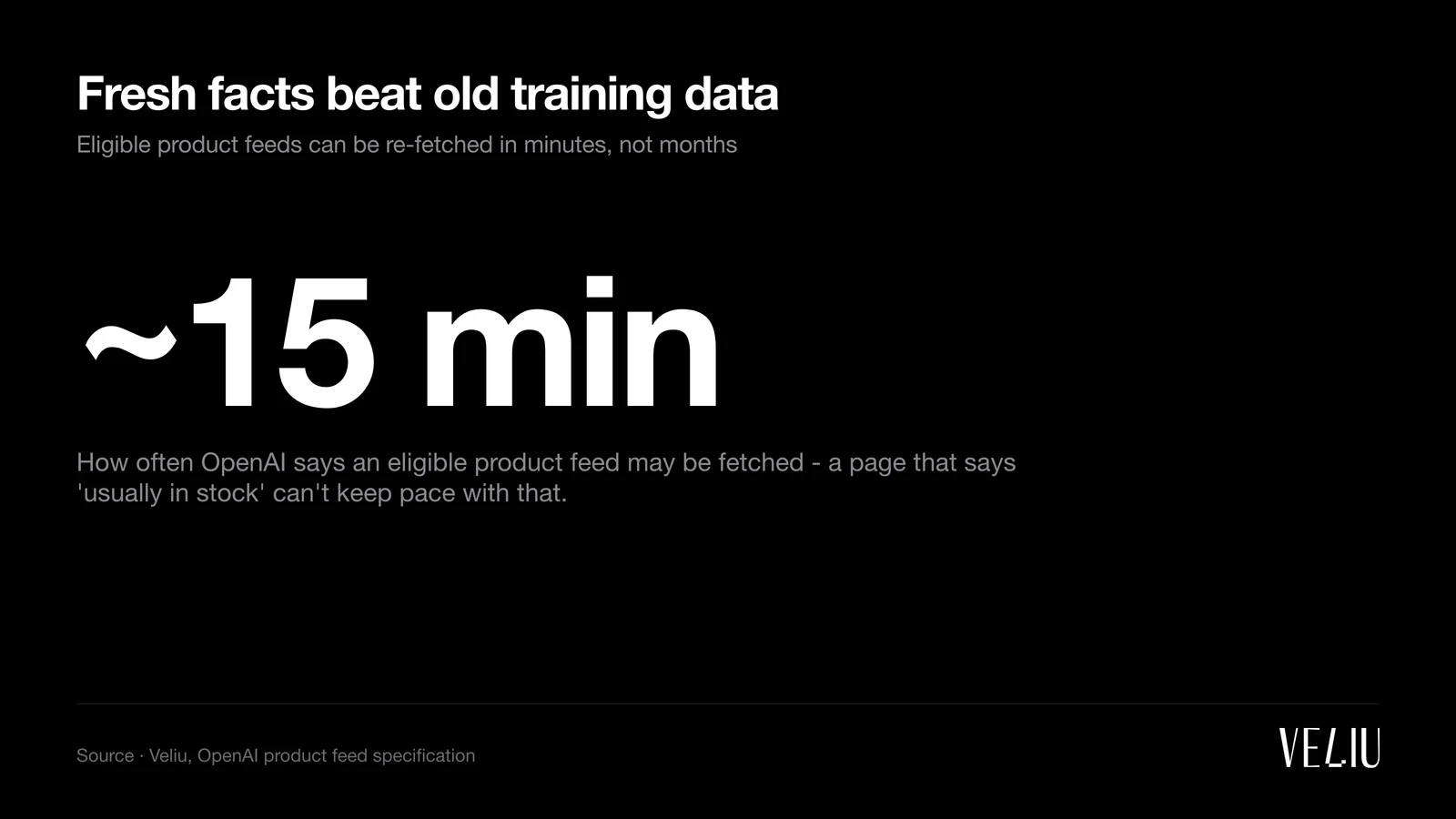
Live facts beat old training data. Prices, stock, variants, ratings, shipping cutoffs, and promotions change too quickly to rely on a model’s training data. A size M linen shirt that sold out at 10:13 can still appear in old page text, but a shopping answer needs the current availability field.
Google’s Shopping Graph documentation says Google uses a constantly refreshed dataset of products, sellers, brands, reviews, and inventory from across Google and the web, and Google’s product structured data documentation asks merchants to provide explicit Product and Offer properties. OpenAI’s product feed specification says eligible feeds may be fetched as often as about every 15 minutes.
Perplexity has described merchant-program participation publicly, with coverage and eligibility varying by market.
The direction is clear for a store owner: generative engine optimization works for catalogs by helping shopping engines use structured, fresh product records in ways prose alone may not support. A paragraph saying “our boots are usually in stock” cannot replace a current availability field for the black size 8 variant.
The appeal is obvious: many guides treat GEO as a content-writing problem, where better summaries win mentions. The evidence does not support that as a full ecommerce answer: Google’s product structured data documentation asks for explicit Product and Offer properties, while Google Merchant Center separately enforces feed attributes and feed-to-page consistency.
John Mueller of Google gave a blunt warning about another popular shortcut, llms.txt, comparing it to the old keywords meta tag in public comments. The lesson for merchants is simple: do not mistake a low-priority map for the catalog facts shopping systems actually consume.
Primary references worth reading include Google’s product structured data documentation, the Google Merchant Center product data specification, schema.org Product, schema.org Offer, and OpenAI’s product feed spec.
SEO still matters, and catalog truth carries commerce
SEO still matters because AI systems can retrieve from the open web, including product pages, reviews, guides, and support pages. Ecommerce GEO adds another layer: the same product must be understandable across the page, JSON-LD schema, merchant feed, identifiers, taxonomy, and checkout path.
- Indexable pages
- Clear internal links
- Useful product and guide content
- Does not prove feed accuracy
- Cannot guarantee AI citations
- Structured Product and Offer facts
- Feed-page consistency
- Identifiers and taxonomy alignment
- Needs operational upkeep
- Engine selection remains external
| Discipline | Main surface | What it optimizes | Ecommerce proof artifact | What it cannot guarantee |
|---|---|---|---|---|
| SEO | Search results pages and crawled web pages | Crawlability, relevance, links, page quality, technical health | Indexable product page, clean internal links, useful content | A specific AI citation, ranking, or sale |
| AEO | Direct answer surfaces | Clear answers, entities, citations, concise evidence | FAQ content, help pages, product explainers, citations | That a shopping engine can price or buy a SKU |
| GEO | Generative answer and shopping engines | Retrievable, structured, consistent facts | Product feed, schema.org Product and Offer, canonical catalog, valid identifiers | Recommendation, ranking, or demand |
| Product feed optimization | Merchant programs and commerce graphs | Attribute completeness, policy compliance, freshness | Google Merchant Center feed, Microsoft Merchant Center feed, OpenAI ACP feed | Organic selection by any engine |
The stance is simple: for merchants, GEO becomes real when a product record can survive machine reading. A red dress with five sizes, one sale price, and two images should still be the same red dress across every surface.
How does GEO work before an AI cites a source?
Retrieval-Augmented Generation, or RAG, means an AI answer engine pulls relevant records or pages at answer time, then writes an answer grounded in those sources. If your SKU is absent from one retrieval substrate, the engine may still have other sources, but that missing path makes the SKU harder to cite from your preferred facts.
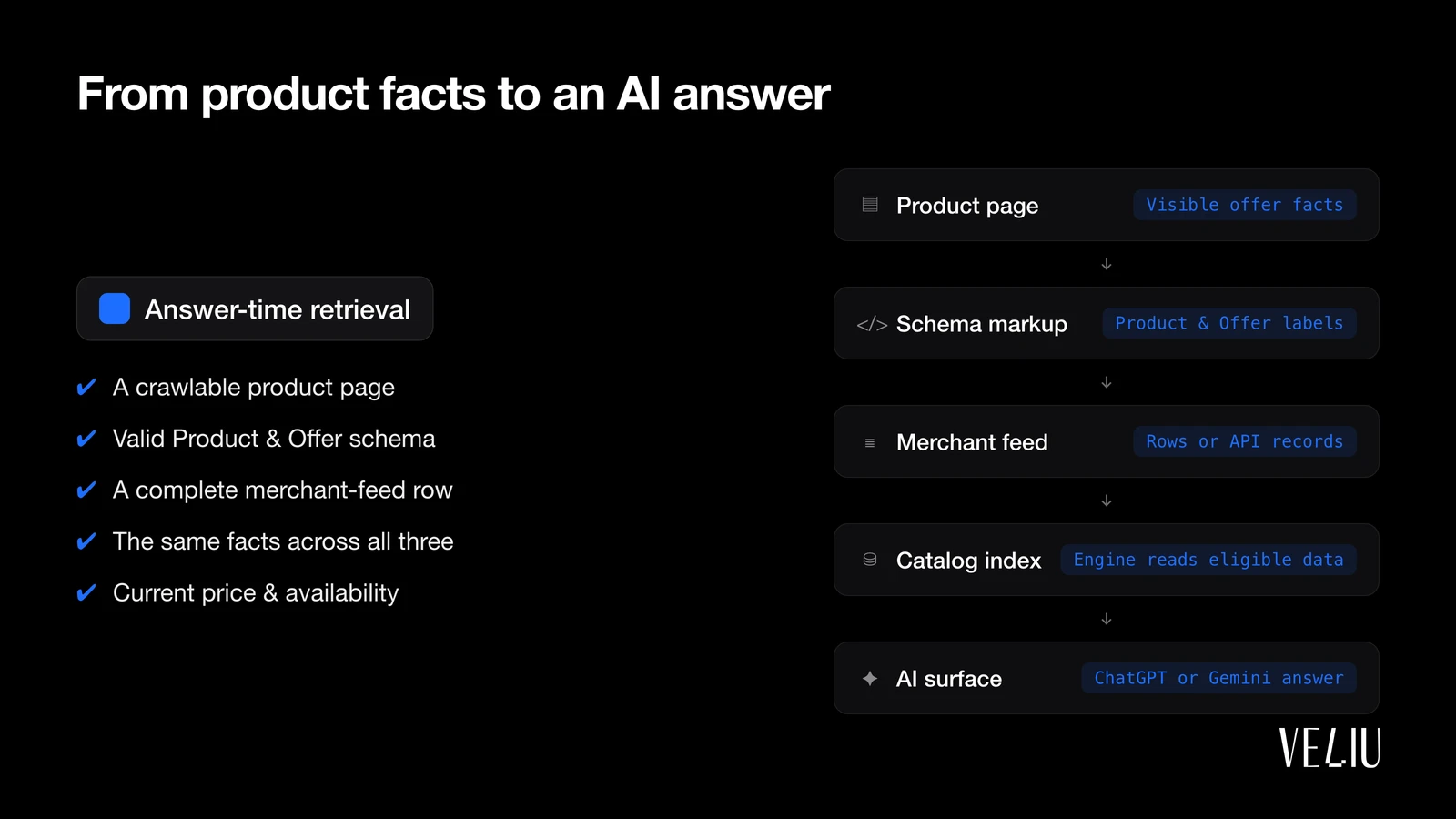
There are two main substrates. The first is the general web: pages crawled into indexes or fetched live when a user asks a question. The second is structured merchant data: feeds and commerce graphs built from seller-submitted catalogs, reviews, and product crawls.
A kitchenware shop example makes this concrete. If your “24cm cast iron pan” has a rich product page but no valid price in schema and no feed entry, an answer engine may see a page about the pan, yet lack the current offer facts needed for a shopping comparison.
Feeds carry the facts shopping engines need
Product feedsA structured export of the catalog (id, title, description, link, image, price, availability) in the Google Merchant Center spec, the format most shopping surfaces ingest.Read more carry rows or objects with fields such as id, title, description, link, image link, price, availability, brand, GTIN, MPN, shipping, and category. These are easier for a shopping system to validate than a decorative product page.
The manifest matters.
Google Merchant Center and Microsoft Merchant Center use feed attributes to understand offers at scale. OpenAI’s Agentic Commerce Protocol, or ACP, includes a product feed with item fields such as title, brand, price, availability, image URL, seller URL, and eligibility flags. Perplexity’s Merchant Program can give participating merchants a catalog path alongside open-web citations where the program is available and the merchant is eligible.
For a non-technical merchant, think of the feed as the stockroom manifest. The product page is the shop window. A window can persuade a buyer, but the manifest tells a machine which sizes exist, which price is current, and which barcode belongs to the item.
Schema helps the open-web path
Schema.org Product, Offer, and AggregateRating in JSON-LD, a machine-readable script format, tells crawlers the facts visible on the page. Google’s documentation requires or recommends fields such as name, image, description, brand, offers, price, priceCurrency, availability, shippingDetails, and return policy details depending on the rich result type.
Consistency matters. If the visible product page says “In stock,” JSON-LD says https://schema.org/OutOfStock, and the feed says “preorder,” the machine sees three different shop assistants giving three different answers.
Common failures are ordinary store problems: priceCurrency missing for a bag, priceValidUntil left in 2024 for a sale price, ratings marked up without visible reviews, or a product rating placed on the whole website instead of the product.
Identifiers make matching possible
GTINs let engines merge the same product sold by many merchants. When a manufacturer assigned a GTIN, use it and validate the check digit. If no GTIN exists, use MPN plus brand.
Do not fabricate identifiers. A fake GTIN for a private-label candle can be worse than no GTIN because it may match the wrong item. For handmade, vintage, or one-off products, make the brand, model, condition, material, and variant fields as explicit as possible.
This is where Veliu’s brand agent starts working: it studies how engines read the storefront, readies each product record, and sells to the people and to the AI shopping agents that ask about the item. The crawl, the normalization, and the taxonomy mapping run underneath that job, and they are why the agent can answer with the current price and a valid variant.
Why this matters for AI catalog readability
Complete, consistent structured product data can make a merchant’s catalog easier for ChatGPT, Gemini, AI Overviews, Copilot, and Perplexity to read and match. Citations, selections, and rankings remain controlled by each engine.
| AI surface | Possible catalog inputs | Merchant-controlled readiness work |
|---|---|---|
| ChatGPT Shopping | OpenAI ACP product feed, web pages, schema.org Product and Offer where available | Feed completeness, allowed retrieval bots, accurate price and availability, product identifiers |
| Gemini and AI Overviews | Google Search index, Google Merchant Center, Shopping Graph | Product structured data, Merchant Center feed quality, taxonomy, GTINs, page-feed consistency |
| Copilot Shopping | Bing index, Microsoft Merchant Center, IndexNow signals | Microsoft feed attributes, Bing crawl access, schema, freshness notifications |
| Perplexity Shopping | Merchant Program catalog where eligible, real-time web sources, visible citations | Catalog enrollment where eligible, citable product pages, third-party proof, clean schema |
A practical example: a UK outdoor store sells “Women’s StormShell Jacket, teal, size 12.” If ChatGPT reads one price, Google Merchant Center reads another, and Bing cannot crawl the page after a robots.txt change, the catalog is not presenting one coherent product fact set.
The goal is to remove machine confusion before an AI answer or shopping engine tries to interpret the catalog record for a waterproof women’s jacket available this week.
The ecommerce GEO checklist should start with messy products
Use this checklist on a sample of products across best sellers, long-tail SKUs, sale items, variants, and out-of-stock products. Those are where catalog systems usually leak.
| Audit dimension | What to check | Why it matters | Failure example |
|---|---|---|---|
| Structured-data completeness | Product, Offer, AggregateRating or Review where valid | Enables open-web extraction | Product schema exists, but no Offer |
| Valid Offer price and priceCurrency | Numeric price and ISO currency such as GBP, USD, EUR | Prevents ambiguous pricing | price present with no priceCurrency |
| Availability enum | Valid schema.org URL such as https://schema.org/InStock | Makes stock machine-readable | “Available soon” as free text only |
| priceValidUntil | Future date for temporary prices | Avoids stale sale snippets | Sale date left in 2025 |
| shippingDetails and return policy | Shipping cost, region, delivery, returns where applicable | Supports commerce comparison | Free returns shown on page, absent in markup |
| GTIN or MPN + brand | Valid GTIN when assigned, otherwise MPN and brand | Enables product matching | Zero-padded fake EAN |
| Google Product Taxonomy alignment | Specific category path and confidence tier | Helps systems understand product type | “Accessories” for a phone charger |
| Image quality and additional images | Clean primary image plus extra angles where useful | Gives visual proof fields | One watermarked marketplace image |
| Feed-page consistency | Price, stock, URL, image, title, variants | Reduces disapprovals and distrust | Feed and page show different prices |
| Crawler posture | Allow retrieval bots you want indexed by | Keeps citation paths open | Blocking OAI-SearchBot while expecting ChatGPT citations |
| Freshness latency | Time from stock or price change to page, schema, feed | Prevents wrong answers | Sold-out size remains in feed for 2 days |
| Checkout actionability | Cart and checkout path available where supported | Lets commerce flows use the offer | Variant can be viewed but not added to cart |
- Product and Offer schema
- Valid price and currency
- Crawl access allowed
- May still have weak identifiers
- GTIN or MPN plus brand
- Specific taxonomy
- Clean variants
- Bad source data can still mismatch
- Fresh feed
- Accurate availability
- Checkout path works
- Engine selection remains external
Good-looking pages still break when offer facts are hidden
A beautiful page without machine-readable offer facts is like a shelf label written in invisible ink. The buyer sees the jacket, but a crawler may miss the current price, size variants, or stock state if those facts only appear after a script runs.
Check the rendered HTML and JSON-LD, alongside the design preview. A product page for “Classic Oxford Shirt” should expose color, size, price, currency, availability, image, brand, and canonical URL in places machines can parse.
Feed acceptance is the floor
A row can pass basic validation while missing GTIN, product type, material, additional images, sale price dates, or variant grouping. Feed acceptance is useful, but it is not a full catalog-quality score.
For apparel, weak variants are common. If five sizes of the same trouser do not share an item_group_id, the system may treat them as separate products instead of one variant family.
Vague categories hide the real product
“Accessories” can mean phone cases, handbag straps, bike lights, or necklace extenders. Vague categories make products harder to match to intent.
Map categories to a known taxonomy. When Veliu’s agent readies a catalog, it grades how confidently each product maps to a category and flags the records that need human attention, such as a charger labeled only as “Accessories.”
Price and availability mismatches create distrust
A mismatch is not a minor formatting issue when a shopping engine has to state a price. Google’s Merchant Center documentation specifically covers automatic item updates and feed-to-landing-page consistency because mismatches affect item validity and user trust.
A simple example: your page, JSON-LD, and feed disagree on the coffee grinder’s price or stock status. Before writing more GEO content, fix that product fact chain.
Blocking retrieval bots removes citation paths
Robots.txt, standardized in RFC 9309, can block crawlers that build retrieval indexes. Blocking training bots is a different decision from blocking search or retrieval bots.
OpenAI documents separate user agents including GPTBot for training and OAI-SearchBot for search indexing. A merchant can decide its crawler posture deliberately, but the tradeoff is real: if a retrieval crawler cannot access a page, that engine loses one path to cite it.
The jacket from the opening comes back here. A missing barcode is one failure. A blocked retrieval bot is another. Both make a real product harder for machines to read.
Measure GEO with catalog evidence
Measure GEO like catalog operations. ChatGPT brand visibility dashboards can capture outcomes you observe, but the best measurement also includes causal inputs that make your product facts easier to retrieve, trust, and use.
| Metric type | Metric | Use it? | Why |
|---|---|---|---|
| Outcome | AI answer and citation share by prompt set, engine, market, and category | Yes | Shows whether your domain or products appear in defined test answers |
| Outcome | Agent checkout completion where supported | Yes | Measures whether a commerce flow can finish after product selection |
| Causal input | Structured-data field completeness | Yes | Missing fields block extraction before quality can matter |
| Causal input | Source-of-truth divergence rate | Yes | Mismatches across page, schema, feed, and exports create distrust |
| Causal input | Factual accuracy of extracted price, stock, and specs | Yes | Tests what engines say against your live source of truth |
| Causal input | Freshness latency | Yes | Measures delay from store change to machine-readable truth |
| Weak signal | “Has llms.txt” | No, as a standalone KPI | It is a low-priority content-surfacing aid, without confirmed status as a ranking lever |
| Weak signal | Raw token-count reduction claims | No | Compactness does not prove citation, accurate price, or buyability |
| Weak signal | Context-window size | No | A larger window does not fix missing identifiers or stale stock |
The KDD 2024 GEO paper that helped popularize the term found visibility changes from specific content modifications, but its findings were position-dependent, based on 2023-era GPT-3.5-style systems, and have no clean 2026 ecommerce replication. Treat it as useful history, separate from a catalog playbook.
Bing and Seer-style AI surface studies can be useful for directional prompt tracking, but they also depend on sampled prompts, markets, engines, and dates. If you test 120 prompts in June 2026, write down the prompt set, country, language, engine version when available, and the limitation that answer surfaces change quickly.
A catalog-first workflow is the practical path to AI-readable product records
A working GEO process starts with the catalog because the catalog carries the facts answer and shopping engines need.
Step 1: crawl the storefront. Pull product pages, variant data, images, prices, and stock states from the live shop. Include awkward products, such as bundles, sale items, preorder items, and one-off resale listings.
Step 2: normalize product records. Turn “Nike Air Force 1,” “NIKE AF1,” and “Air Force One” into one canonical identity where appropriate. Keep variant facts such as size, color, and condition separate from the base product name.
Step 3: validate identifiers. Check GTIN format and check digits when a manufacturer barcode exists. For products without a GTIN, pair MPN and brand, and mark genuinely identifier-less goods honestly.
Step 4: map to Google Product Taxonomy. A specific path beats a vague label. “Apparel & Accessories > Clothing > Outerwear > Coats & Jackets” gives a machine more context than “Fashion.”
Step 5: align page, schema, feed, and export endpoints. The same product should tell the same story everywhere. If the page changes stock at 14:05, the feed and structured data should follow quickly.
Step 6: publish to relevant merchant programs. This may include Google Merchant Center, Microsoft Merchant Center, OpenAI ACP feeds where applicable, and Perplexity’s Merchant Program where eligible. The right mix depends on market, platform, and business model.
Step 7: monitor divergence and freshness. Run recurring checks for price mismatches, stale availability, missing images, taxonomy drift, and crawler access changes. Catalog quality decays unless someone owns it.
What to do next in your store
- Audit the long tail alongside hero SKUs. Your top products may be clean while older variants lack GTINs, current images, or valid availability.
- Fix feed-page mismatches before writing more GEO content. A new buying guide will not repair a product whose page, JSON-LD, and feed disagree on price or stock.
- Validate identifiers before scaling feeds. Bad GTINs can connect your offer to the wrong product; missing MPN plus brand can leave legitimate products harder to match.
- Map categories to a known taxonomy. A specific category path makes a size variant, spare part, or refurbished item easier for machines to compare with the right peers.
- Track whether target AI answer and shopping surfaces return facts that match your live catalog, using a fixed prompt set and documented caveats. Record the date, market, prompt, engine, product URL, returned price, returned availability, and whether the answer cites your page.
Veliu’s brand agent takes this work off the merchant’s desk: it studies the market, readies the store, and sells to people and to the AI shopping agents that arrive, in the brand’s voice. Untangling messy storefronts into canonical, taxonomy-aligned records is part of how it prepares, and it is why the agent’s answers hold up when an engine checks them.
Run the first check on 20 awkward products: one sale item, one out-of-stock variant, one product without a barcode, one bundle, and one best seller whose page and feed changed this week.
The next paper, when it is written.
One email per paper, and nothing else.
Subscribe