

In brief. GEO tools usually measure brand visibility in AI answers, including mentions, citations, prompts, competitors, and sentiment. Ecommerce teams also need a second layer: product data that is structured, consistent, taxonomy-aligned, and available through feeds or endpoints that AI answer engines and shopping agents can read.
- GEO tools split into visibility measurement and catalog-data repair, and ecommerce teams usually need both capabilities named separately.
- AI visibility trackers can show mentions, citations, sentiment, and competitors, but they generally do not fix SKU-level feed, schema, identifier, or taxonomy defects.
- Catalog normalization makes product records more structured, consistent, taxonomy-aligned, and available through AI-accessible shopping paths.
- Product schema, merchant feeds, GTIN or MPN coverage, price, availability, and variant handling are practical ecommerce GEO foundations.
- A 50-SKU audit across page, schema, feed, identifiers, taxonomy, price, availability, and endpoint readiness is the fastest way to identify the real gap.
ChatGPT, Gemini, Perplexity, Copilot, and AI Overviews have turned one search question into a multi-surface measurement problem for ecommerce teams. Most GEOGEO is the practice of making your content and catalog data easy for generative engines like ChatGPT, Perplexity and Google AI Mode to retrieve, cite and reuse in their answers.Read more tools monitor brand mentions, citations, prompts, and sentiment, while ecommerce teams also need to audit and fix the structured catalog that those AI surfaces increasingly read.
That distinction matters when a $79 running vest appears as $89 in a feed, has no GTINThe GS1 Global Trade Item Number, the identifier that lets engines merge your offer with the same product sold elsewhere. A valid GTIN is numeric, 8 to 14 digits, with a GS1 check digit.Read more, the Global Trade Item Number barcode used to identify a product, and is marked OutOfStock in Product schema while the page says it ships today. A dashboard can show that the product is absent from an answer. It cannot, by itself, make the catalog readable, matchable, and ready for AI-accessible shopping paths.
The useful question is whether you need to measure the gap or fix the substrate.
By the end, you will know which type of GEO tool fits measurement, content optimization, technical SEOSearch Engine Optimization: earning visibility in classic search results through content, links and technical site health. In 2026 it remains the base layer that AI search builds on.Read more, product-feed readiness, and catalog normalization. For a marketing manager, the trade-off is budget and ownership: do you need to see what is happening across AI surfaces, or do you need to fix the catalog machines read?
What are GEO tools for ecommerce actually measuring?
A GEO tool helps teams understand or improve how their brand, content, or products appear in generative search and answer engines. GEO means Generative Engine Optimization, the practice of making content and product data easier for AI answer engines to retrieve, understand, cite, and use in shopping workflows.
This article covers ecommerce GEO software: tools for generative search visibility, answer tracking, product-data readiness, and catalog normalization. If you came from the People Also Ask query “What are the examples of geographic tools?”, examples include maps, compasses, GPS devices, and GIS software, which serve a separate classroom or GIS intent.
For ecommerce, one acronym covers two jobs. The first job is visibility measurement: tracking whether ChatGPT, Gemini, Perplexity, Copilot, Claude, or AI Overviews mention your brand, cite your pages, or include competitors for a prompt set. The second job is catalog readiness: checking whether product facts such as price, availability, identifiers, taxonomy, variants, and feed eligibility are clean enough for shopping systems to read.
These categories serve different jobs: visibility reporting and catalog-data repair.
John Mueller of Google warned against overinvesting in shortcuts in 2025, when public coverage reported him comparing llms.txt to the old “keywords meta tag,” a signal SEO teams once overestimated. Source: Search Engine Roundtable, “Google's John Mueller: LLMs.txt Is Like The Keywords Meta Tag,” June 18, 2025. The appeal is obvious: 1 simple file feels easier than fixing 8,000 SKUs. The evidence does not support it: the public llms.txt specification is a community proposal, while major shopping surfaces document feeds, Product schema, Merchant Center data, crawlers, and commerce protocols as operational inputs.
Primary sources reviewed for this article include OpenAI’s shopping and commerce documentation, Google Merchant Center product data specifications, schema.orgMachine-readable schema.org markup (Product, Offer, AggregateRating) embedded in a page as JSON-LD. It is the canonical way to hand engines unambiguous product facts.Read more vocabulary pages, OpenAI bot documentation, RFC 9309 for robots.txt, Microsoft merchant documentation, Perplexity’s Merchant Program announcement, and the llms.txt proposal.
The ecommerce GEO stack has 6 practical categories
Some categories measure AI visibility, some audit technical readiness, and a smaller set helps fix SKU-level catalog data. SKU means stock keeping unit, the merchant’s internal product or variant identifier, such as ALV-12L-BLK-M for a black medium running vest.
| Tool category | Key differentiator | Best for | What it generally does not solve |
|---|---|---|---|
| AI visibility trackers | Prompt, mention, citation, sentiment, and competitor monitoring across answer engines | Board reporting, share-of-voice tracking, PR and brand monitoring | SKU normalization, feed repair, identifier validation, endpoint readiness |
| SEO/AEO suites | Existing SEO workflows extended into AI Overviews and answer monitoring | Search teams that need keyword, content, technical SEO, and AI visibility in one process | Product-feed correctness, taxonomy decisions, page-versus-feed conflicts |
| Content optimization tools | Page rewriting, entity coverage, FAQ structure, topical depth, answerability | Editorial teams improving category pages, guides, and product copy | Commerce fields such as priceCurrency, GTIN, availability enums, variants |
| Crawler and log analytics | Bot access, crawl behavior, robots.txt checks, server logs | Technical SEO teams managing AI crawler access | Catalog normalization or merchant-feed export |
| Structured-data and feed validators | Product JSON-LD, Offer fields, Merchant Center diagnostics, disapprovals | Merchants with clean source data that need compliance checks | Fixing inconsistent source data at scale |
| Catalog normalization tools | Crawl storefronts, normalize products, align taxonomy, surface divergence, prepare structured records | Ecommerce teams with messy SKU data, weak taxonomy, missing identifiers, and AI shopping readiness gaps | Brand sentiment reporting or full PR-style AI visibility dashboards |
- Prompt tracking
- Citation monitoring
- Competitor views
- Sentiment trends
- Does not repair SKU data
- Limited feed-level fixes
- Field completeness checks
- Taxonomy alignment
- Feed and page reconciliation
- Export-ready records
- Needs catalog access
- Less focused on PR reporting
- Keyword workflows
- AI Overview monitoring
- Content briefs
- Technical SEO checks
- May miss SKU-level commerce defects
Methodology note: this comparison uses public primary documentation from OpenAI, Google, schema.org, Perplexity, the robots.txt RFC, Microsoft merchant documentation where relevant, and the llms.txt proposal, reviewed on 2026-06-17 and updated on 2026-07-06. It also reflects Veliu’s agent-view methodology, which is vendor-specific and should be evaluated during a product demo. The limitation is clear: each AI engine controls its own retrieval and selection systems, so public documentation can identify readable inputs and access paths, but not private ranking weights.
Which GEO terms matter before a vendor call?
GEO: Generative Engine Optimization, the work of making brand, content, and product data easier for answer engines to retrieve, understand, and cite. For ecommerce, the foundation is product data that machines can read consistently across pages, schema, feeds, and endpoints.
AEO: Answer Engine Optimization, the practice of structuring content so answer systems can extract a direct, supported response.
AI visibility: How often and how accurately a brand, product, or domain appears across AI answer surfaces for a defined prompt set.
Citation share: The percentage of tracked AI answers that cite or attribute to your domain, measured across prompts, engines, markets, and dates.
Structured product data: Machine-readable product facts such as title, description, brand, price, currency, availability, identifiers, images, shipping, returns, and variants.
Product schema: schema.org Product markup, usually JSON-LD, that describes a product page with fields such as name, brand, offers, aggregateRating, sku, mpn, and gtin.
Merchant feed: A structured catalog file or API submitted to a shopping system, such as Google Merchant Center or an OpenAI Agentic Commerce Protocol product feed.
Google Product Taxonomy: Google’s category system for classifying products, for example Apparel & Accessories > Clothing > Outerwear.
GTIN/MPN: GTIN is the Global Trade Item Number, the barcode-style product identifier assigned by GS1; MPN is the Manufacturer Part Number used when a product has no GTIN.
Source-of-truth divergence: A mismatch between product facts on the page, in schema, in a feed, or in an endpoint, such as page price $79 and feed price $89.
Agent-actionability: Whether an AI shopping agentSoftware agents that search, compare and complete purchases on a buyer's behalf. They read structured catalog data and transact through protocols like ACP and MCP.Read more can move from product search to an available checkout path with current cart, shipping, tax, and payment authorization data.
AI visibility trackers measure the gap, but do not repair SKU data
AI visibility trackers monitor prompts, mentions, sentiment, citations, source attribution, competitors, and trends across engines such as ChatGPT, Gemini, Perplexity, Claude, and Copilot. For a marketing manager, that maps neatly to share of voice, brand lift proxies, competitive displacement, and executive reporting.
These tools generally diagnose visibility and content gaps, while improving ChatGPT brand visibility by fixing catalog gaps usually requires a different workflow. As a hypothetical June 2026 test, a tracker might show that a competitor’s hiking backpack appears in 18 of 60 prompts. It may still miss the reason your own backpack is hard to parse: a failed GTIN check digit, a missing priceCurrency, and a feed category mapped only to tier 1.
Measurement remains valuable because it shows where products and pages appear or are absent, while ChatGPT brand visibility requires auditing what AI can read to address the underlying catalog data. If your team cannot see whether Perplexity cites a retailer review page, whether Copilot pulls a Bing-indexed product URL, or whether Gemini surfaces a competitor category page, you are flying blind.
Those blind spots can push budget toward reporting instead of repair.
Veliu approaches the problem from outside the tool stack: it gives the brand an agent whose mandate is to sell. The agent studies how engines and shopping agents read the storefront, prepares every product record, and sells to the people and to the AI shopping agents that arrive, in the brand’s voice. Crawling, normalization, and taxonomy mapping happen inside that job, and the agent grades how confidently each product maps to a category, which is why a messy product list turns into records it can answer from with the right price and a valid variant.
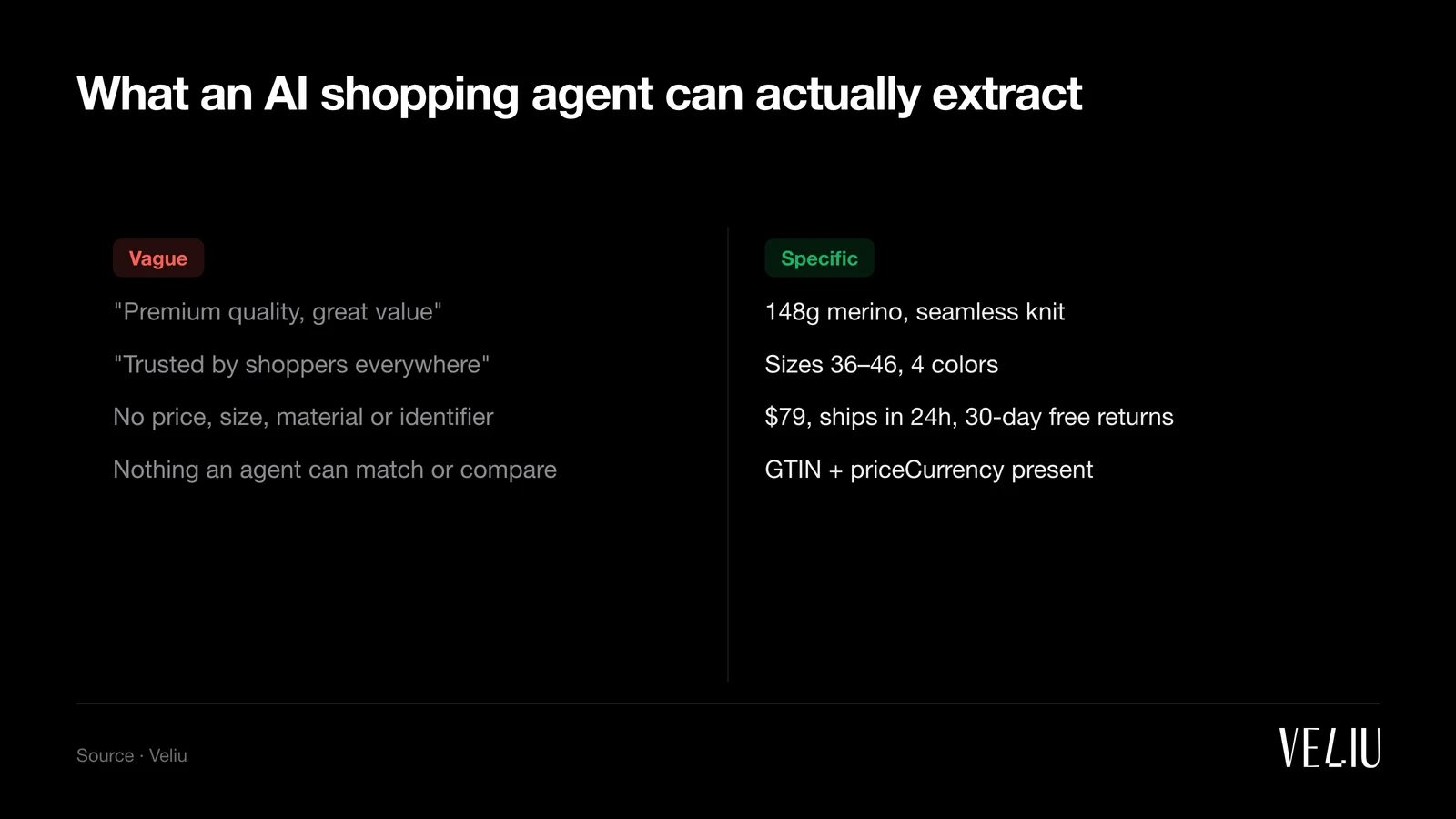
A concrete example shows the gap. A fashion shop may list “Nike Air Max 90,” “NIKE airmax90,” and “Air Max 90 by Nike” across variants and reseller entries. Humans understand the product family; machines need a canonical brand, model, variant grouping, identifiers, images, condition, and category path before they can reliably match those rows to the same commercial object.
As it readies a store, Veliu’s agent checks product-field completeness and surfaces divergence between page, feed, and endpoint. That matters because the same SKU can be readable on the page and broken in the feed, or valid in Merchant Center and stale in a commerce endpoint.
Engines still decide what they retrieve, cite, and show, and merchants still control traffic quality, prices, reviews, inventory, and offer competitiveness. The agent’s mandate covers the rest: when a question arrives, the answer it gives is current, consistent, and buyable.
Content improves answerability, but commerce facts carry the offer
SEO and AEO suites are good for keyword research, technical SEO, content briefs, AI Overview monitoring, internal linking, and connecting GEO work to existing search workflows. They help teams move from classic search visibility to answer visibility without abandoning the dashboards, tasks, and governance they already use.
Product interpretation can still fail if the SKU has missing GTINs, stale availability, invalid Offer markup, weak variant attributes, or a broken feed. A category page can be well rewritten for “best lightweight trail shoes for wet weather” while the products underneath are missing material, waterproofing, gender, size, and variant data.
Content improves answerability, while commerce facts provide the structured evidence shopping systems need.
AI shopping systems increasingly read structured substrates. OpenAI says improved shopping results in ChatGPT Search use factors such as relevance, price, availability, quality, and whether the merchant is the primary seller, and its commerce documentation defines product feeds for the Agentic Commerce Protocol with fields including item ID, title, description, URL, brand, price, availability, image URL, seller data, and eligibility flags. Sources reviewed July 6, 2026: OpenAI shopping results help article and OpenAI product feeds specification.
Google’s ecommerce path is older and heavily documented. The Google Merchant Center product data specification requires core attributes such as id, title, description, link, image_link, availability, and price, with identifiers such as brand, gtin, and mpn required when applicable. Google also documents feed-versus-landing-page consistency issues because mismatched price or availability can trigger item-level problems. Sources reviewed July 6, 2026: Google Merchant Center product data specification and Google landing page requirements.
Microsoft Copilot Shopping is connected to Bing-indexed pages and Microsoft merchant-feed infrastructure, though Microsoft’s surfaces and eligibility rules change by market and program. Perplexity’s Merchant Program, announced with shopping features in 2024, gives merchants another catalog path for product cards and buying flows. Sources reviewed July 6, 2026: Microsoft Merchant Center API documentation and Perplexity Merchant Program announcement.
Veliu’s agent is built around that reality. As it readies the store, it produces normalized product records that can be checked against schema.org Product and Offer, feed requirements, taxonomy paths, identifiers, and endpoint availability before downstream systems consume them.
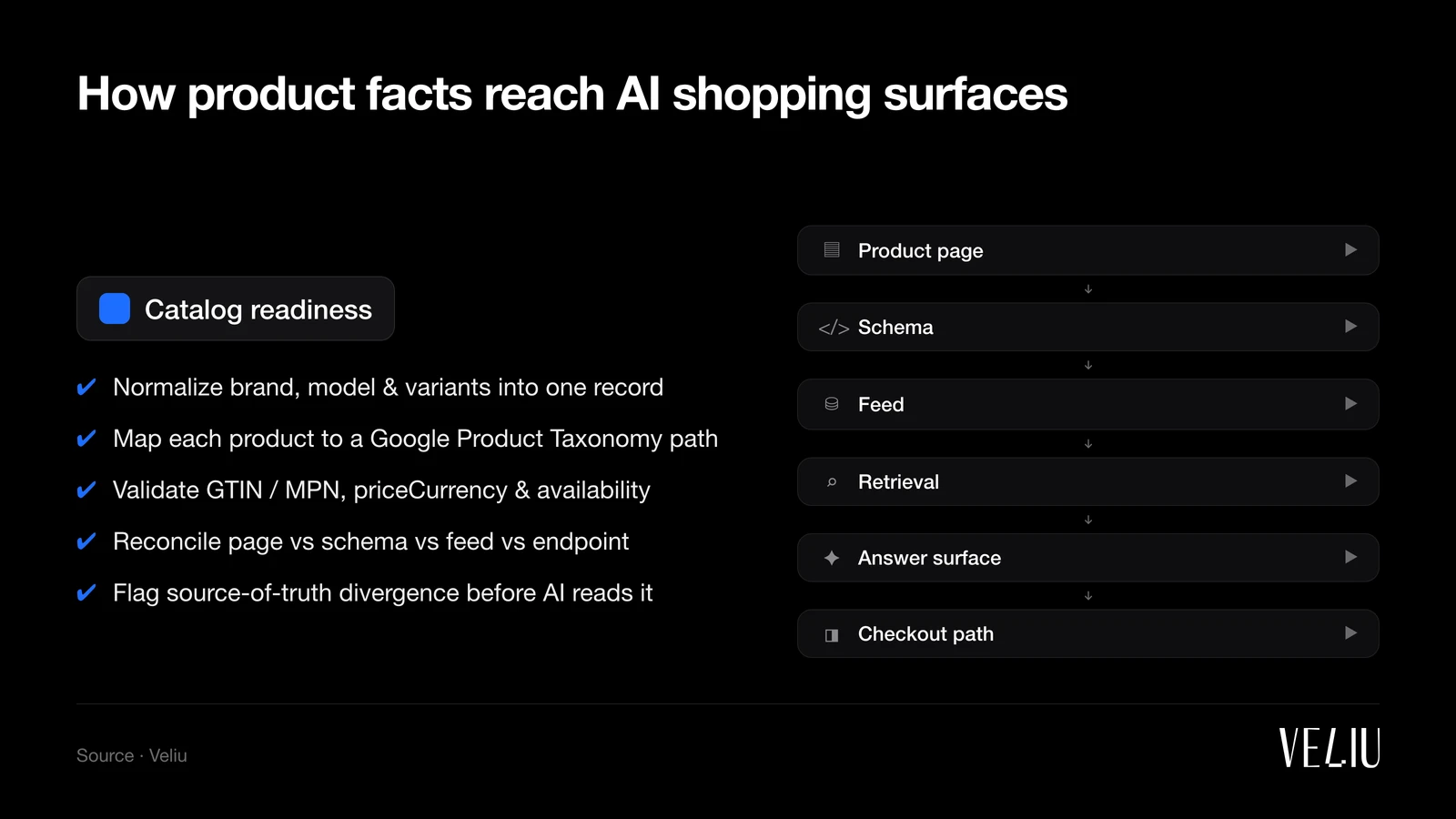
The caveat belongs here once: each engine controls retrieval and selection, but complete structured data gives these systems clearer product facts to parse than inconsistent page copy alone.
Product-data readiness needs records, with prose polish secondary
Content optimization tools are useful for rewriting pages, improving entity coverage, FAQ structure, topical depth, answerability, and comparison copy. A merchandising team can use them to turn a thin product description into a clearer answer to “Is this stroller cabin-approved for United Airlines?”
Optimized prose cannot repair a mismatched price, missing priceCurrency, invalid availability enum, fabricated GTIN, or absent item_group_id. The schema.org Offer type expects machine-readable offer facts such as price, priceCurrency, availability, and url; the Product type supports identifiers such as gtin, mpn, sku, and, as of the current schema.org vocabulary, asin. Sources reviewed July 6, 2026: schema.org Product, schema.org Offer, and schema.org asin.
A page can be clear to a human reader while still missing the structured fields shopping systems need.
A canonical product record is the machine version of the product your merchandising team already thinks it has. When Veliu’s agent builds one, it normalizes brand, model, category, and subcategory, maps the product to a standard category path, and grades how confidently that mapping resolved, so a human can review the records the agent is least sure about.
Then come the commerce fields: id, title, description, canonical URL, image URL, price, price currency, availability, GTIN or MPN plus brand, condition, variants, shipping, returns, ratings where valid, and multiple images where available. Without those fields, natural-language copy has to carry facts it was never meant to carry.
Consider a concrete SKU: “AeroLite 12L Running Vest, Black, Medium.” The product page says $79 and “ships today.” The feed says $89 and in_stock. The JSON-LD says https://schema.org/OutOfStock and omits priceCurrency. A content optimizer might improve the description, but a catalog-readiness workflow must flag source-of-truth divergence across page, feed, and schema before an AI shopping system can confidently read the offer.
The loose thread from the opening $79 running vest closes here: the problem was never the sentence quality. The problem was that 3 machine-readable surfaces disagreed about the same SKU.
Validation works better after product identity is stable
Validators and Merchant Center diagnostics validate Product, Offer, AggregateRating, Merchant Center feed requirements, crawlability, image issues, and disapprovals. They are essential for compliance because malformed JSON-LD can be ignored or partially ignored depending on parser behavior and error severity.
They show errors item by item and often assume the merchant already has clean source data and taxonomy decisions. In a hypothetical catalog of 4,300 SKUs with free-text categories such as “Accessories,” “Other,” “New arrivals,” and “Top picks,” a validator can flag weak fields. It cannot reliably decide the correct Google Product Taxonomy path for each item without normalization.
Validation works better after normalization.
Veliu’s agent runs the same order as it readies a store: crawl, normalize, classify, enrich, and validate against the fields that matter for commerce. The order is deliberate because a validator works best after the catalog has a coherent source of truth.
A complete record should cover at least id, title, description, url or link, image_url or image_link, brand, price, priceCurrency, availability, GTIN or MPN, itemCondition, variant attributes, shipping, return policy, multiple images, and use-case-rich attributes. For a waterproof hiking boot, use-case-rich attributes might include material, waterproof membrane, sole type, gender, size, color, season, and terrain.
The mechanism-level difference is field repair plus identity repair. “Patagonia Torrentshell 3L Jacket,” “Torrentshell rain shell,” and “M’s Torrentshell 3L” may need to resolve into one brand and model family, with gender and size handled as variants. Validation starts to work once the product identity is stable.
Why does this matter for ChatGPT, Gemini, Perplexity, Copilot, and AI Overviews?
ChatGPT, Gemini, Perplexity, Copilot, and AI Overviews increasingly ground some answers and shopping experiences with retrieval, indexed pages, Product schema, Merchant Center data, merchant feeds, and partner catalog programs. Mechanisms differ by platform and market, but the ecommerce pattern is clear enough for growth teams: visibility is partly a marketing reporting problem and partly a product-data operations problem.
OpenAI documents separate bots for training and retrieval, including GPTBot and OAI-SearchBot, and states that site owners can manage access with robots.txt. Source reviewed July 6, 2026: OpenAI bots documentation. Robots.txt itself is an advisory web standard, formalized in RFC 9309.
For a growth team, the operational point is sharper than the protocol names. A GEO tool stack that only measures mentions can tell you where you are absent. A catalog-readiness layer can help remove the data defects that make products hard to read, match, and make available through AI-accessible shopping paths.
Here is a shop-level example. A kitchenware retailer wants visibility for “best induction-safe stainless steel sauté pan under $120.” The answer engine may need product title, material, compatible cooktop, size, price, currency, stock status, brand, reviews, images, and a canonical URL. If the page says “induction ready” but the feed lacks material and cooktop attributes, the product has less structured evidence for that query.
Visibility outcomes still depend on each engine plus merchant-controlled factors such as traffic, price, reviews, inventory, content quality, and availability. The work you control is the readability, consistency, taxonomy alignment, and endpoint availability of the catalog.
Vendor calls should separate monitoring, auditing, fixing, and exporting
Use this matrix in vendor calls. It separates monitoring, auditing, fixing, and exporting because those are different capabilities with different budgets and owners.
| Requirement | Why it matters | Ask the vendor | Evidence to request |
|---|---|---|---|
| Multi-engine prompt and citation tracking | Shows AI visibility across ChatGPT, Gemini, Perplexity, Copilot, Claude, and AI Overviews | Which engines, markets, and dates are tracked? | Prompt set, sample answers, citation exports |
| Citation source attribution | Identifies which pages, reviews, or third-party sources support answers | Can you show source URLs and answer spans? | CSV export with URLs, timestamps, and prompts |
| Crawler and bot access checks | Blocked retrieval bots can reduce citation opportunities | Do you inspect robots.txt and named AI user agents? | Bot access report for OAI-SearchBot, Googlebot, PerplexityBot, and others |
| Product JSON-LD validation | Product and Offer markup helps machines extract SKU facts | Do you validate Product, Offer, and AggregateRating at field level? | Error report for Offer.price, priceCurrency, availability, gtin, mpn |
| Google Merchant Center or feed checks | Feeds are core shopping inputs for Google and other catalog systems | Do you check required and applicable attributes? | Feed audit against Google product data spec |
| Page-versus-feed divergence | Mismatched price or stock can create item-level issues | Do you compare page, schema, feed, and endpoint values? | Divergence report with SKU, field, source, and timestamp |
| GTIN/MPN/brand validation | Identifiers let systems match identical products across sellers | Do you check GTIN length and check digit, plus MPN and brand coverage? | Coverage distribution, invalid identifier list |
| Taxonomy mapping quality | Weak categories reduce product matchability for attribute-rich queries | Do you map to Google Product Taxonomy and expose confidence? | googleCategoryId, googleCategoryPath, tier fields, resolution value |
| Freshness and propagation latency | Price and inventory change faster than model training data | How do you measure time from source change to feed and endpoint update? | Latency report by field and channel |
| Variant handling | Apparel, size, color, and configuration errors break product families | Do you group variants with stable IDs and attributes? | item_group_id examples and variant completeness |
| Image quality fields | Shopping cards and multimodal systems need usable images | Do you check image URL, duplicates, format, and additional images? | Image audit with broken, missing, duplicate, and low-quality flags |
| Feed export for OpenAI, Google, Microsoft, Perplexity | Programs can have different catalog ingestion requirements | Which feed formats and field mappings do you support? | Sample exports and field mapping documentation |
| Agent checkout eligibility or endpoint readiness | AI-accessible shopping paths need current cart, fulfillment, and payment data | Can you check eligibility flags or endpoint requirements? | Eligibility coverage and failed endpoint checks |
| Capability band | Monitor | Audit | Fix | Export |
|---|---|---|---|---|
| AI visibility tracker | ✓ | |||
| SEO/AEO suite | ✓ | ✓ | ||
| Content optimizer | ✓ | ✓ | ||
| Structured-data validator | ✓ | |||
| Catalog normalization tool | ✓ | ✓ | ✓ |
The table is intentionally practical. A marketer can own the first 3 rows with search and content partners. The last 10 rows often require ecommerce operations, feed owners, developers, or a catalog-readiness system.
GEO tool pricing follows volume and depth
GEO tool pricing varies by prompt volume, engines tracked, seats, domains, markets, API usage, catalog size, and whether the tool only monitors or also processes product data. As an illustrative planning example, a single-market visibility dashboard for 200 prompts has a different cost structure from a catalog system that crawls 80,000 SKUs, validates feeds, normalizes taxonomy, and checks endpoint readiness.
Readers should check vendor pricing pages for current plan details because SaaS packaging changes often.
Budget framing matters more than a single sticker price. Visibility tracking usually sits with SEO, brand, or growth reporting budgets. Catalog normalization often sits closer to ecommerce operations, feed management, merchandising, and technical implementation because the work changes the data layer that downstream systems read.
Best GEO tools by ecommerce use case
Choose an AI visibility tracker if you need board-level share-of-voice, citation reporting, sentiment trends, and competitor monitoring across ChatGPT, Gemini, Perplexity, Copilot, Claude, and AI Overviews. The output is a reporting layer, and its value rises when leadership asks where the brand is present or absent.
Choose an SEO/AEO suite if your main workflow is search and content. These tools are strongest when keyword research, technical SEO, AI Overview monitoring, content briefs, and reporting need to live in one familiar operating model.
Choose a content optimizer if page-level answerability is the bottleneck. This is the right move when category pages are thin, product guides lack entity coverage, FAQs are weak, or comparison copy fails to answer buyer questions clearly.
Choose a structured-data or feed validator if you already have clean product data but need compliance checks. Validators are especially useful when Merchant Center disapprovals, malformed JSON-LD, missing priceCurrency, or invalid availability values are the known issue.
Choose a catalog normalization workflow if the issue is messy SKU data, weak taxonomy, inconsistent feed/page facts, missing identifiers, or AI shopping readiness. In that case, the core task is to make the catalog structured, taxonomy-aligned, and endpoint-ready before expecting dashboards or validators to tell a clean story.
The practical verdict is a 50-SKU audit
Start with measurement if you cannot see where ChatGPT, Gemini, Perplexity, Copilot, or AI Overviews mention or cite your brand. A defined prompt set, engine list, market, and date range gives growth teams the visibility baseline they need.
Move to catalog readiness when the same defects repeat across SKUs, feeds, and product pages. Repeated missing GTINs, stale availability, weak variant handling, unresolved taxonomy, and feed/page price conflicts are data-system issues, separate from editorial issues.
Final answer: choose measurement tools for visibility reporting, citations, sentiment, and competitive share of voice; choose content tools for editorial gaps; choose validators when the source catalog is already clean. Veliu stands outside that stack as the brand agent: it uses these mechanisms while it studies the market, readies the store, and sells to people and to the AI shopping agents that arrive. The stack measures; the agent sells.
Treat llms.txt and token-count claims as secondary context during GEO tool selection. The `llms.txt` proposal can help organize links for humans and some tools, but no major AI vendor has confirmed it as a ranking lever or shopping transaction channel.
Pick 50 revenue-relevant SKUs this week, compare page, schema, feed, identifiers, taxonomy, price, availability, and endpoint readiness, then decide whether your GEO gap is a dashboard gap or a catalog gap.
The next paper, when it is written.
One email per paper, and nothing else.
Subscribe